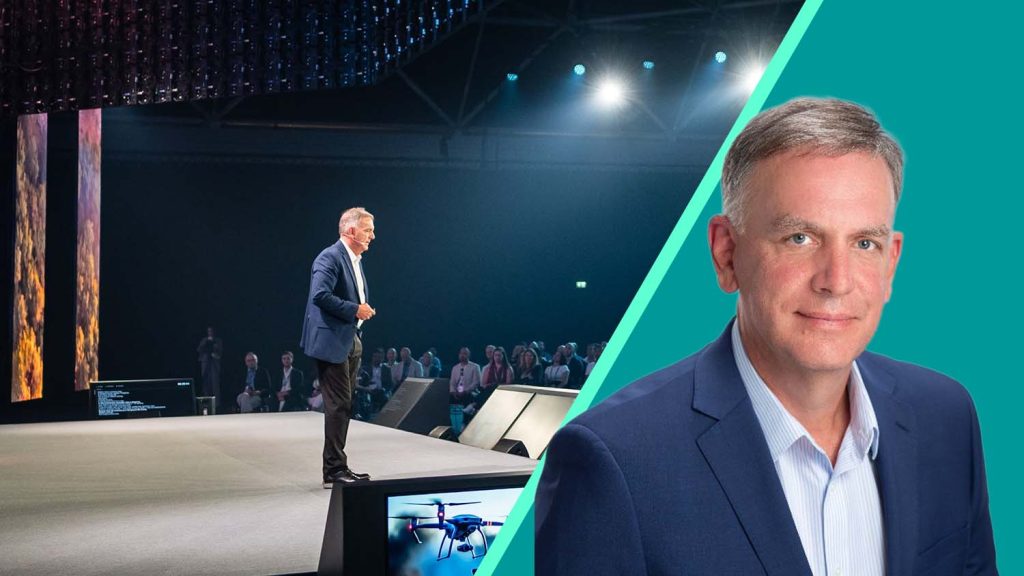

At Realize Live Europe, we sat down with Siemens Digital Industries CEO Tony Hemmelgarn to get his views on how the Siemens platform is evolving; the integration of AI in product development software and what this means for your software, and how he sees the CAD market playing out over the next few years
DEVELOP3D // How has the integration of Altair into the Siemens platform gone since the acquisition?
Tony Hemmelgarn:
There’s still integration work we’re doing and other types of things, but from a sales and go-to-market point of view, the customers are quite excited. The SimSolid and the PhysicsAI capabilities that we have, those are two big key differentiators of what’s happening in our space, so that’s gone well.
Then we have some pull-through effect between customers looking at Teamcenter, for example, today that maybe weren’t using it so much on the Altair side, or like I said, existing PLM customers that suddenly now are looking at what we’re doing with SimSolid. I think that’s all good. I think we’re well into the integration, we’re meeting all the targets and everything we said we would do so far.
// The big message at Realize Live has been about the strengths of using the full Siemens pipeline, from design through to manufacture. How well is that going to connect with software and tools outside the Xcelerator Platform?
Since I’ve been involved with this, we’ve been open – we manage all kinds of data with Teamcenter. Are there certain things we can’t do with third-party products in place? Yes, because of either one of two reasons: they don’t have the capability like we do, or they’re not open enough to be able to do that right. And so what we say is we’re open, we’ll do all these things now.
Do we have a better integration between our own products? Of course we do. So the customer has to evaluate whether that benefit is enough for them. And we’ve got a long history of that happening.
I doubt any of our competition says they’re closed, but come on, it’s a pretty simple thing to see the way some of them work and how they treat their customers, what they do with forcing them to say, ‘if you’re going to use my CAD tool you’ve got to use my data management tool’, right? We don’t do that, and so we will stay open, and it’s up to the customer to determine if there’s enough value in integration for them to use the rest of our portfolio.
But it’s very rare to find a customer to use 100 per cent everything from us. They’re going to either have homegrown things, or maybe some third-party application that we have to integrate to, and that’s been our approach for the last 25 years, if not longer.
// How do you view then the overall design and engineering software landscape, especially with the increasing use of AI – when CAD and AI have previously struggled to work together?
We’re showing that it can, but look, I would argue there’s already been a lot of free CAD tools and other things out there. There are free kernels that you can use. Is that really what the world needs? No.
The value is not in another modeler, the value is in how we can link that LLM to the CAD tools that are there, right? And then the question is, are you open enough to be able to do that? Do you have enough APIs, and so forth. And luckily, we’ve developed NX from the beginning to be able to do that. So, Designcenter has all of these APIs.
We have demos today where we show a rocket modelled in NX. We linked it up to Claude, and we asked ‘Can you tell me everything you know from this rocket?’. All it had was geometry and relationships between the geometry, and based on that it was able to calculate oxidation rate, payload capacity, all these types of things.
We didn’t have that in our model, we had the geometry, the relationships, the design, everything else. It linked it to its general knowledge about rockets, was able to figure that out. And then we said, okay, change the payload capacity, increase it by 50%. The model automatically updates based on that.
Can you trust all of that? Maybe, maybe not. But the point is, the value wasn’t in another CAD tool. The value was in how closely we were able to link a very, very good existing CAD tool to an LLM model to be able to drive it and do things with it, right. And so, that’s what we see as being AI driven.
// Is today’s move towards embracing AI the biggest shift the industry has faced?
With customers, every single meeting goes to AI pretty quickly because of the internal pressure they have as well.
There’s a lot of noise out there. Everybody says, ‘Well, let’s go look at Palantir and see what it can do’. And then I’m hearing from a lot of customers that have gotten into this, they realise, “Whoa, wait a minute, this is costing me a fortune! I have to go to Palantir every time? I’m locked in cement, I can’t go anywhere else!” And then we give them an alternative.
There’s other things you can do that bring value right away. I’m not saying Palantir doesn’t have value, it’s just I don’t know how much value it is fanning and handling in engineering and manufacturing where you need you need deterministic answers and not probabilistic answers of what’s going on.
I think we’re starting to see a little bit of an awakening in customers to say, ‘yeah, we’ve heard the hype, whatever, now let’s get back to practical use cases’, and I’ve heard that a lot at this event. What they like about what we’re presenting is we’re not giving them this song and dance story, we’re showing real applications working today.
// What is AI going to change in how users use Siemens software?
I think the thing that it is not going to change is the core engineering physics and the things that are in our products. What will change is how you access it. Back to the rocket example that we have, you’re going to have to pay for the usage for that [AI] tool to drive NX, right? There’s going to be a like a token type concept to pay for that, right?
So maybe you don’t sell a licence, but you sell tokens to be able to have that, so that the system is doing that work at night, while you’re sleeping. And it uses the tools to do that, right? I see there’s some transition that would happen there, and none of us know exactly what that looks like going forward.
// Will tokenisation remain a key factor?
There are the tokens you hear about from the large LLMs, and how they charge for their token usage. Ours is a little bit different. Ours is value-based token licensing, which means today, if you have NX and you want to use some side product that we have, like Die Design, we might say, if you buy 100 tokens, you have three users that can use Die Design at any given time. If you need five users, you got to buy more tokens to be able to use that.
Our approach with the idea of an LLM driving CAD, like Designcenter, is we’re going to charge for the flow of information through that. We’ll do that through the same token approach. You might say, I want to buy 500 tokens to be able to support AI tools driving my CAD tool, and we consume some of those tokens to be able to do that. The value of that is you don’t have unbridled consumption, right? Because that’s what you’re hearing today, some CIOs are saying, ‘Holy shit, all of a sudden my team went and used all these tokens, and I’ve got a $50 million bill that I didn’t know was coming’. You would buy the tokens in advance, so you know you’re not going to go over,
So I think the model we use for tokens fits very well to what we would apply to AI consumption.
//While today licences are your business model, do you see tokenisation taking over – because now your entry level product has had the roof taken off, and you can add in multiple functionalities, you’re no longer working through Solid Edge until you get to the point where you then need to upgrade to NX?
Remember, we can do that, they can’t, because Solid Edge and NX are the same kernel, and go up and down easily, back and forth. [Dassault Systèmes] Solidworks and Catia, two different kernels. [PTC] Onshape to Creo? Two different kernels. What do you do? I’m stuck, right? In fact, we can upgrade a person from Onshape or Solidworks easier to Designcenter than they can internally with their own products.
I guess what I’m saying is, when we talk about what we see coming with AI, is will there be more licensing being bought to drive it through AI versus a licence to you as an individual? I don’t know. I don’t think anybody really knows.
The argument is some people might say, well, you might sell a lot less licences in the future because you don’t need as many, because the [software’s] working around the clock, so you’re paying instead for tokens to be able to do that. We’d still get revenue for that, and what that balance looks like, I don’t know, but I would also argue that most customers are not talking to us about how they reduce licences, they’re talking about how do they go faster, right?
So, back to the rocket example; if it builds that rocket, you’re not just going to accept that rocket. Your engineers are going to want to interrogate that thing to make sure it’s what they think it should be, so they still have a licence to go do that, it’s just it did a lot of work for them before they got to that, so can they go a lot faster than what they’re doing.
// How long do you think it’ll be before companies are buying licences just for AI agents to use?
I can’t give you a name, but we already have customers reaching out to train LLM models for their usage
// How do you see the CAD market playing out?
I can see the continuation of EDA and PLM coming together more and more of that, because, like, I said yesterday, I mean, we started this, and people question it at first, and now it’s like, oh yeah, yeah, we see all of this, and I think that’s coming together more rapidly than we thought.
Some of the analysts tell us the next big thing is, how do you better integrate supply chain-type tools into this…What we’ve done with a Supplyframe – and the integration that we did with Xometry and Volition – we’re looking at how do we support this idea of supply chain interaction and the design process.
You’re designing the part in real time, you’re seeing cost of that part, that’s quite interesting for a designer to be able to do, and this isn’t a guess, this is real time what it’s going to be costing you to produce.
With operations software… We see a lot going on there. The Pepsi example I gave – the simulation of the plant, viewing of the plant, but also what we’re doing with an executable digital twin driving the plant. Those are all things I think will build out over time.
// How about the Viz and XR elements of design?
It’s funny, I tell people the Pepsi fly through was generated using Nvidia GPUs and graphics to be able to drive that thing and give us photorealistic stuff, and at times you have people say: why do I need photorealistic all the time, particularly for a factory, right?
You could argue that, but I’ve been in this business a long time, and I said I still remember the first time I took a wireframe, I was working on an Intergraph computer terminal, it had no compute, running off a max computer on the back end, and they put a chip in the terminal at that time that allowed you to download wireframe to the machine, and then you could rotate it. And the guy behind me says, ‘Holy cow, why would you ever need any more than that?!’
So I use that as an example of why wouldn’t I want photorealism all the time? The only challenge is cost, and so if GPU prices come down and performance increases, eventually it’ll be photorealistic all the time… just like wireframe eventually turned into solid modelling.
This article first appeared in DEVELOP3D Magazine
DEVELOP3D is a publication dedicated to product design + development, from concept to manufacture and the technologies behind it all.
To receive the physical publication or digital issue free, as well as exclusive news and offers, subscribe to DEVELOP3D Magazine here