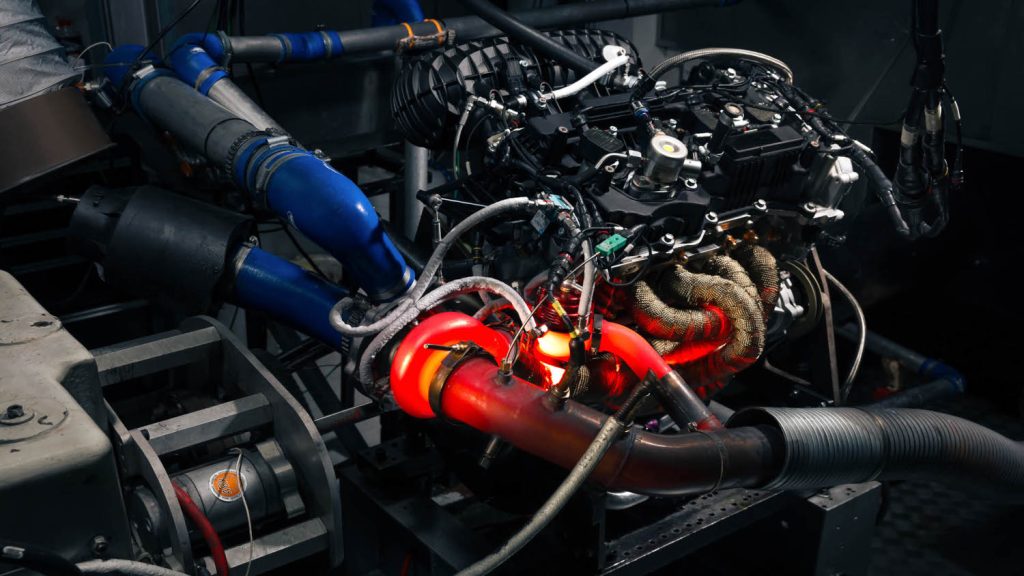

In the ultra-competitive BTCC motorsport series, engineers constantly look for ways to gain a competitive edge. At Swindon Powertrain, adopting 3D printing for a touring car engine plenum chamber enabled the team there to rethink its design, literally from the inside out
The bespoke cars seen in today’s British Touring Car Championship (BTCC) are a far cry from those seen back in 1958 when the racing series started. Then, competitors would drive their vehicles to the circuit and back home again afterwards – barring any mid-race accidents, of course.
With tightly written rules in place to ensure a level playing field for all competitors, it’s up to engineers to explore every opportunity to give their vehicle and its driver a competitive edge. That search most often involves engine developers, including multiple championship winner Swindon Powertain, the name behind the highly successful engines found in Excelr8 Motorsport’s Hyundai i30N race cars.
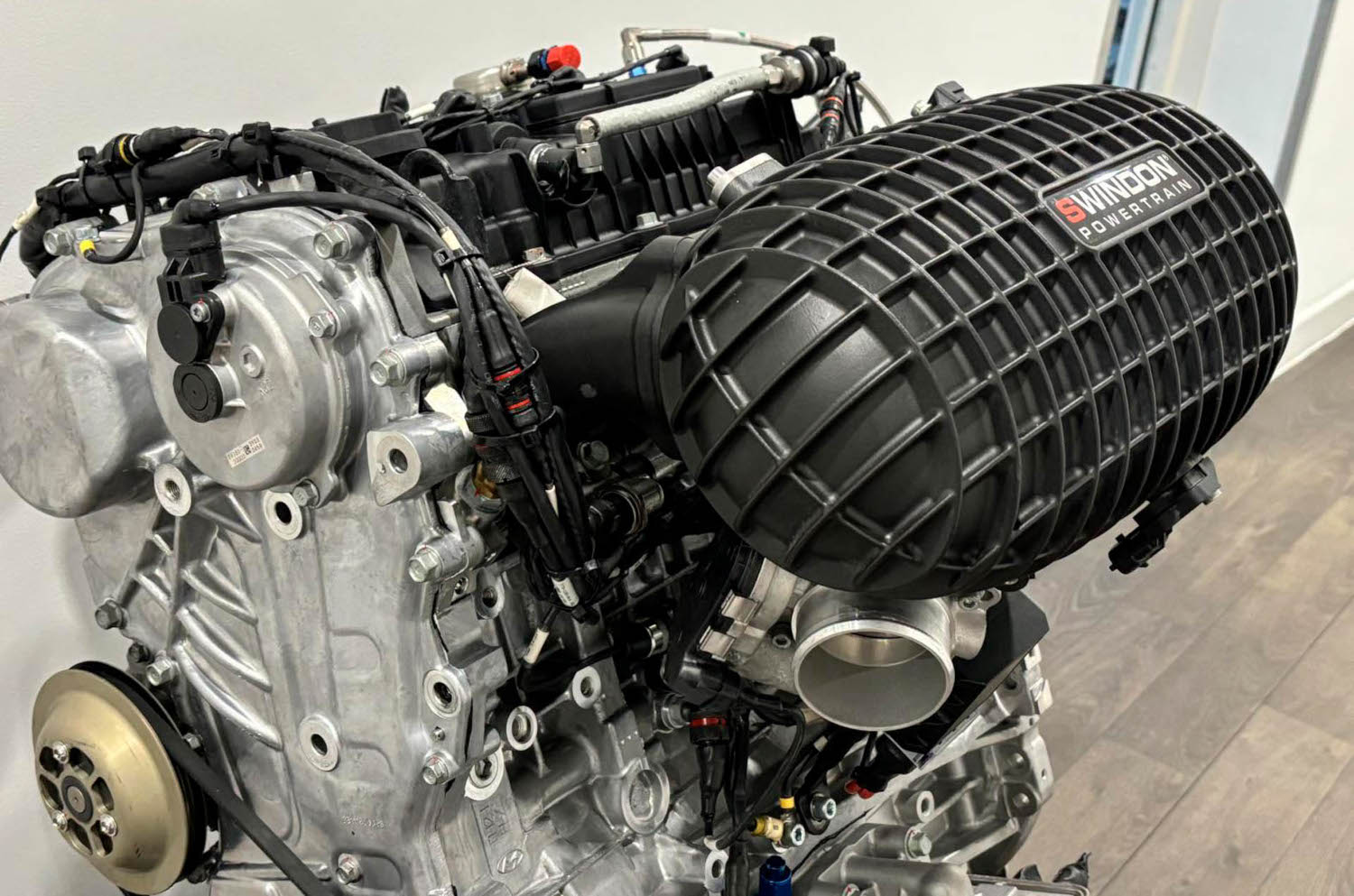
In a bid to almost double the power that can be squeezed from a stock i30N engine to between 400 and 500bhp, Swindon Powertrain’s engineers regularly upgrade or modify around 50% of its parts. That includes the plenum chamber – part of the intake manifold where air is collected and directed to the combustion chambers.
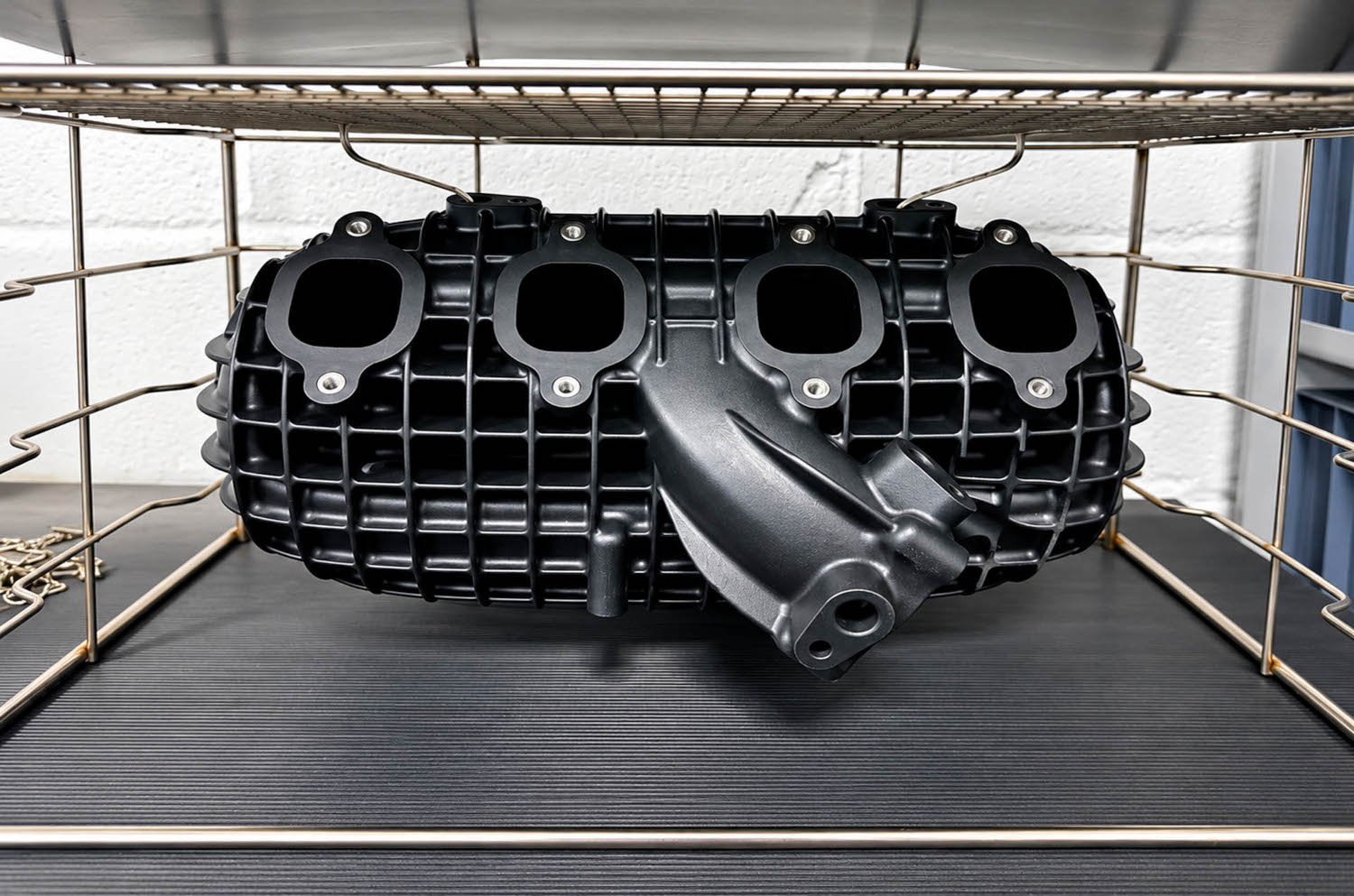
While perhaps not the most obvious point of focus, the team at Swindon Powertrain understands that a well-designed plenum can lead to improved combustion and power. But in order to deliver, it needs not only to be able to withstand 2 bar of pressure, but also be produced as a single, robust component, despite featuring complex internal trumpets for channeling air.
Most mass-produced inlet systems found on more conventional vehicles are made from injection-moulded plastic. For low-volume race projects, by contrast, an aluminium casting machined to exact tolerances is the go-to option, while the rules of some race series allow composites such as carbon fibre to be used.
Both materials have their drawbacks. Aluminium is unnecessarily heavy for an inlet system and has high thermal conductivity that can restrict engine performance by increasing the air-charge temperatures. Composite systems are light, but create design complexity limitations and can require significant tooling investment.
Injection-moulding tooling is also prohibitively costly when only a small batch of parts is needed for a race project.
What Swindon Powertrain needed to identify was an alternative that satisfies weight and heat restrictions while allowing design freedom within the BTCC guidelines. Additive manufacturing seemed to provide the best way of achieving these goals, according to the company’s technical director Sylvain Rubio.
Design considerations
One of the main advantages of 3D printing is that design complexity and topology have very little impact on component cost, provided a few minimum design considerations are observed. It also hits a particular sweet spot in motorsports, where changes are made every year to parts, set-ups and rules, which might otherwise lead to expensive tooling costs.
Prototype parts can be produced in a few days, rather than the few months typically needed for a casting. When the final product is intended to be 3D-printed, too, a prototype is effectively the same as the production part, offering a valuable shortcut in the validation process.
That said, 3D-printed parts come with their own issues, including material weaknesses, porosity, and powder residue left inside chambers.
“We had tried additive manufacturing [in the past], but struggled with reliability. Developments [in the technology] and having a partner who understood our needs made it a compelling choice this time around,” says Rubio.
To date, when designing a 3D-printed inlet system, the key technical challenge is restrictions when it comes to the size of a part that can be produced in a single piece.
“Whilst there are many large FDM machines, these aren’t ideal for components with intricate internal shapes,” explains Rubio. “SLS and similar machines tend to have limited print volumes, which would lead to us designing components and subcomponents right on the limit of the machine’s capabilities.”
New freedoms
The biggest advantage of using 3D printing to produce the part is the freedom it gives designers. In the case of Swindon Powertrain, they were free to focus on airflow and packaging tolerances, without the burden of tooling or manufacturing limitations.
The team’s plenum design was developed in Dassault Systèmes Catia V5, allowing them to create the required topology, which unlocked gains in engine performance, packaging size, overall dimensions and weight overcast aluminium. They were also able to deliver a part that offers thermal conductivity up to 1,000 times lower than that offered by a typical aluminium alloy plenum.
From Catia, the design was exported to Swindon Powertrain’s partner Graphite AM, where it underwent final checks and was produced. Graphite AM offers a large range of AM technologies, from FDM and HP’s MJF through to SLA and SLS. In this case, SLS was chosen, using a 3D Systems sPro 60 HD-HS printer with a build volume of 381 x 330 x 437mm. That allowed the full plenum to be built as a single piece, using Graphite AM’s own graphite-reinforced material, SinterWorx G4.
Lighter than comparable glass-filled nylon materials, SinterWorx G4 is temperature-resistant up to 175C, allowing the finished plenum to withstand the pressure and heat it would experience on race days. The part was post-processed using vapour smoothing, sealing any surface porosity and leaving it pressure-tight, internally smoother for better airflow and resistant to oils and automotive fluids.
We’ve come a long way since the time I first looked at 3D printing technology for this application some 20 years ago
Final results
The inlet system developed by Swindon Powertrain for the BTCC has a large plenum chamber volume to help distribute air evenly across the engine cylinders and minimise pressure oscillations. These changes to airflow are not unusual in a race engine, but are a focus of BTCC regulations, with penalties handed out should teams be suspected of ‘overboosting’.
That large volume might initially seem incompatible with a plastic, 3D-printed plenum, because of obvious structural integrity concerns. The large volume means large surface areas, and those can generate significant mechanical stresses, even from a modest pressure differential. For Excelr8 Motorsport’s engine, absolute pressure in the plenum can vary between around 200 mbar when off-throttle (0.8 bar below atmosphere) to 2.2 bar or more at maximum boost.
Those numbers might sound moderate, but across a large area, they create substantial forces and structural challenges, even before vibrations from the engine (rigidly mounted in place to contribute to overall chassis stiffness) are taken into account.
“We found that recent developments in 3D printing processes and material options have opened the door to eliminating impractical wall thicknesses. Carbonfilled nylon and other reinforced plastics offer us the mechanical properties needed for this kind of application,” says Rubio.
“We’ve come a long way since the time I first looked at this technology for this application some 20 years ago. But it’s only now that making a large plenum chamber has become technically and financially feasible.” On the Hyundai i30N, these plenums have performed faultlessly, contributing to Excelr8 Motorsport’s championship wins in the tough world of touring car racing.
This article first appeared in DEVELOP3D Magazine
DEVELOP3D is a publication dedicated to product design + development, from concept to manufacture and the technologies behind it all.
To receive the physical publication or digital issue free, as well as exclusive news and offers, subscribe to DEVELOP3D Magazine here