
Novineer is not only capable of building a 3D model from a handful of smartphone photos, but also optimising the resulting design for loads, materials and preferred manufacturing process. DEVELOP3D speaks to CEO Ali Tamijani about the company’s AI-driven, reverse engineering for additive manufacturing software
Q: Ali, what can you tell us about Novineer, its tools and technologies, and how they work for product designers and engineers?
A: The Novineer platform is an AI-powered suite that covers the full workflow from reverse engineering through performance simulation to generative design for additive manufacturing.
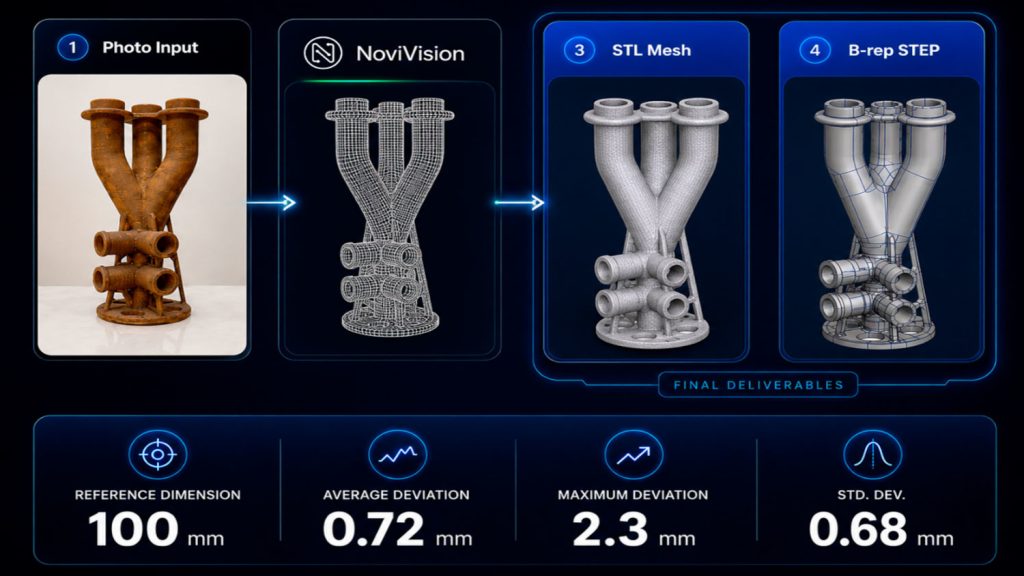
First, NoviVision generates an editable CAD model from a few smartphone photographs in approximately two minutes, replacing specialist hardware, 3D scanning and manual reconstruction.
Then comes NoviPath, a polymer performance simulation solution that predicts stiffness, strength and failure in additively manufactured parts before printing. Unlike conventional FEA tools, which treat printed parts as uniform solids, NoviPath uses actual toolpath data to account for the layer-by-layer nature of material extrusion.
NoviPath is integrated with Stratasys’ GrabCAD Print Pro as part of a strategic partnership. NoviDesign completes the suite with generative design capability, producing optimised, editable, manufacturable CAD models.
Q: And where do you see Novineer potentially making its biggest impact?
A: The sweet spot is really an additive manufacturing (AM) contract manufacturer, where customers approach the company with parts previously made using CNC or injection moulding, and now they want to use FDM to print them. Sometimes a part needs to be certified. Sometimes it doesn’t. It really depends on the end customer.
An example project is a major airline that wants to replace a specific seat arm part on its planes. The contractor has no 3D model for this part, so it has to send engineers and a 3D scanner to a hangar to disassemble the seat and scan the part. In the initial stages, this is just to check the feasibility of whether they can actually manufacture it using AM.
If the airline accepts their quote, then it’s onto the design process. But here, when they try to design the part based on the part load at failure, they don’t have all the material properties, and they typically use some general purpose FEA simulations.
Next begins the 3D printing test cycle to ensure the part is fit for purpose, before they then need to work with another organisation to certify the part for the plane.
All of this can take around three weeks and cost between $15,000 and $20,000. We know FDM technology can print that part reliably, but there is huge friction and cost.
Using Novineer, airline staff can simply share some pictures, along with some basic reference data, with the contract manufacturer. NoviVision processes the images using AI to create a 3D model, and they can quickly create the quote without going to that hangar – so, travel gone, scanner gone. Based on that quote, the airline decides whether to proceed.
Does our approach replace physical testing? No, but not every iteration in your design process needs testing. You can wait until the end
Then for some of the well-known FDM materials – like Stratasys materials – we have in-depth material property data, so the contract manufacturer doesn’t have to do the testing. NoviPath then allows users to perform simulations using the same toolpath data that will be used to print the FDM parts.
Does it replace physical testing? No, but now not every iteration in your design process needs testing. You can wait until the end. With that, you’re reducing lead times and cost; therefore, you can use additive manufacturing for more applications.
Q What part does AI play in all this – where is it deployed in Novineer’s toolset and how does it add value?
A: As you correctly said, AI adds value. AI isn’t the goal of the entire thing we do. The problem users want to solve is what to do when a CAD model is missing. The large language model (LLM) helps us to get from four or five pictures, depending on accuracy, to a model.
Another example is that accurate simulation requires a lot of small, fine elements, which takes a long time to get right. But now machine learning models can help you to go from this fine mesh to a coarse mesh, do the analysis on the coarse mesh, then map it back to a fine mesh. So, the AI is helping in specific things that we are doing, but it is not really replacing that engineering mindset or the physics.
Q Is it your own AI platform, or is it built on top of another foundational model?
A: We create our own AI. We understand that it should be our own, because for some aerospace companies or defence applications, it needs to be on a private server. Therefore, we cannot build something on another platform, because then it needs to always stay on the cloud. For applications today. we offer versions for the cloud or for your private server.
Q In terms of growing Novineer as a company, what is your strategy for reaching new users and new markets?
A: Stratasys is a strategy partner, and through them, we find hundreds of different companies, both OEMs and contract manufacturers, because OEMs sometimes have similar problems when it comes to wanting to replace some parts with additive manufactured variants, for example.
We also have another strategy partner, which is AM Craft. [With more than 35,000 flight parts produced under EASA certification to date, AM Craft supplies airlines, MROs and OEMs with installation-ready, certified components.] They help us to connect with airlines and some aerospace OEMs.
Q Are you entirely focused on additive manufacturing, or is there also scope for Novineer users to take a similar approach to subtractive manufacturing?
A: When using NoviVision right now, depending on the part, the accuracy level is around 95% to 97%, which means an error of, on average, 3%. Sometimes it’s 1%, sometimes it’s 2%, it’s really dependant on the part.
Now, that’s not good for machining, because machining requires a much more accurate model, right? And that’s what we tell our users – that this is where we are today.
Yes, we are working toward much higher accuracy, but at this stage, we are mostly focussed on AM. Additionally, the platform could be used for creating a digital map of all parts simply to visualise and understand all the parts you have instead of having to draw them.
This article first appeared in DEVELOP3D Magazine
DEVELOP3D is a publication dedicated to product design + development, from concept to manufacture and the technologies behind it all.
To receive the physical publication or digital issue free, as well as exclusive news and offers, subscribe to DEVELOP3D Magazine here