
nTop and Coreweave have partnered to show that the simulation element of NASA’s Vision 2030 study is within reach with today’s technology.
NASA’s 2015 ‘CFD Vision 2030 Study’ set the challenge target of an engineer generating, analysing and interpreting a large ensemble of related simulations in a time-critical period, without individually managing each simulation, to a pre-specified level of accuracy and confidence.
In April 2026, nTop and Coreweave exceed this milestone – running some 2,400 drone planform geometry variants across five angles of attack for a total of 12,000 simulations. One engineer set it up and walked away while 280 Nvidia GPUs on CoreWeave were fully saturated for the entire run without any geometry failures.
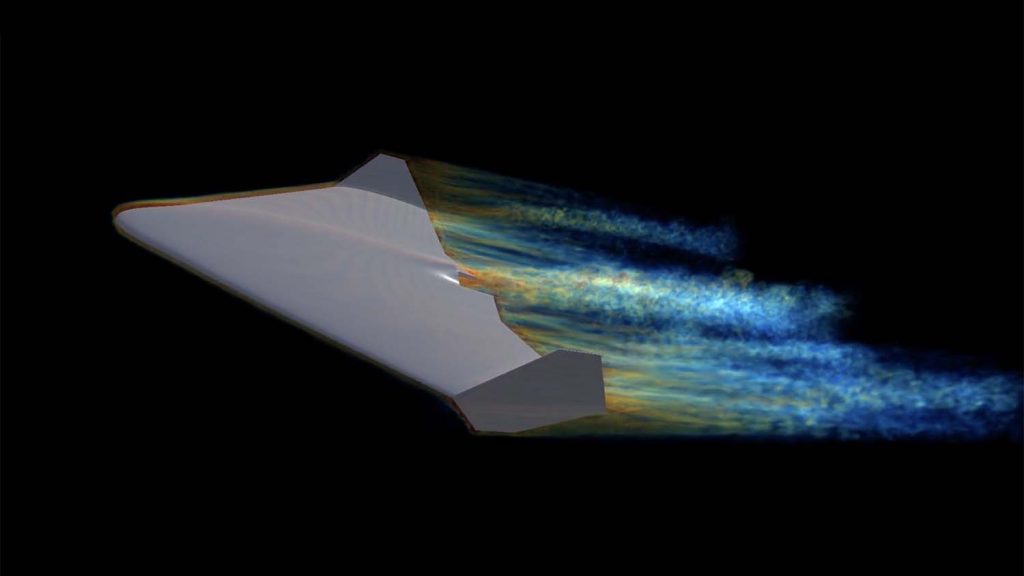
The study used a fully parametric Group 3 long-endurance fixed-wing UAS model built in nTop. Six geometry dimensions covering root chord, inboard and outboard leading edge sweep, inboard and outboard trailing edge sweep, and spanwise panel break were evaluated across five angles of attack per variant. Each sample ran a full LES CFD simulation via nTop Fluids and returned structured results: surface pressure, force coefficients, L/D across the AoA sweep.
nTop explains that the pipeline ran ‘headless’, with no geometry failures, no manual restarts, no one watching it.
CoreWeave supplied the infrastructure of 280 Nvidia RTX Pro 6000 Blackwell GPUs, each with 96 GB of VRAM, enabling one full LES simulation to run concurrently per GPU.
The cluster stayed fully utilised from submission to completion. The project was supported throughout by Justin Hodges, CoreWeave’s Head of Physical AI, contributing physics consulting expertise alongside the infrastructure — helping shape the experimental design and interpret the results.
Max Gaedtke, the nTop engineer who set up and ran the pipeline, described it as the largest nTop Fluids dataset ever generated. “The number of GPUs you have available doesn’t matter when your geometry breaks at case 47. When that happens, someone has to manually intervene to diagnose and fix the problem before the pipeline can continue, which means you can’t run 12,000 cases overnight.
“Compute capacity sits underutilised, and the pace of simulation work is ultimately limited by your fastest CAD modeller. That ceiling is what made the NASA 2030 target aspirational in the first place.”
The study produced a Pareto front across lift, drag, and L/D that would be practically impossible to build through a manual DOE.
However, the result is more than answers to the specific problem. The more durable output is the dataset itself, with the 12,000 CFD results, each having full 3D flow fields containing surface pressure, volumetric data, and force coefficients across the AoA sweep.
The geometry diversity and LES spatial resolution make the project a viable training dataset for surrogate models that can predict aerodynamic performance across the planform space without re-running simulation.