

The huge amount of data flowing through each Formula 1 team presents engineers with the challenge of winning a race within a race. Stephen Holmes visited Aston Martin F1 to find out how technology from NetApp enables a silo-free infrastructure
The Northamptonshire headquarters of the Aston Martin Aramco Formula One Team are located just a stone’s throw away from the Silverstone Circuit, home of the British Grand Prix. At this pristine, purpose-built set-up, uniformed staff are all working towards the goal of getting two racecars ready to notch up race wins at tracks around the world.
The racing conditions they will encounter in these various locations differ wildly: the tight turns of Monaco; the scorching temperatures of Qatar; the humidity of Singapore; the frequent downpours of the great British summertime.
But at every point along the way, engineers are reliant on data to guide engineering decisions. The very best of this data is not just accurate, but arrives with them almost immediately after it is captured.
Real-time data processing, based on reliable, high-performance systems, is key to success in modern motorsports. Key data streams relate to vehicle telemetry, aerodynamics, power unit performance, tyre behaviour and driver inputs. And engineering teams will typically run thousands of simulations, including CFD analysis and digital twin modelling, in order to optimise car design and race performance.
Add in increased use of AI and machine learning for predictive modelling, energy management and performance gains, and the pressure to capture, manage and analyse this data well becomes clear.

Race planning
On a typical race weekend, connecting a limited number of trackside personnel with their teammates located back at headquarters is a key.
For the F1 season’s 22 races, all teams require up-to-date weather and temperature readings to fine-tune a car’s settings, both before it leaves the pit lane and throughout the course of the race.
Today’s F1 cars are equipped with over 300 sensors and produce in excess of 1.5 terabytes of data per vehicle, per weekend, transmitting over 1 million data points per second. However, race tracks vary dramatically in terms of infrastructure, resources and connectivity, so teams need to collect and keep most of the data locally, so that they’re not having to rely on connectivity links in order to access it.
To help it tackle this challenge, Aston Martin F1 has partnered with a wealth of tech partners to create a comprehensive technology stack. Underpinning much of this stack is technology that comes from the team’s global data infrastructure partner, NetApp.
“There’s a range of technologies that we do, from synchronisation of data and caching and presentation of data. The main data set might be back at headquarters, but you need a subset of it presented at race day,” explains Grant Caley, NetApp’s UK & Ireland solutions director.
“We can do the forward caching of that, so that the data is available at race day, real-time, low-latency, but the main data set is still held back in the data centre.”
NetApp not only assists with the high-performance virtual desktop environments needed to run this set-up, but also the data wrangling required to generate multiple data sets without having to create lots of additional storage for them.
The size of data sets being moved around are huge and create numerous challenges, says Caley – plus there’s performance needed to deliver that dataset so that trackside teams aren’t sat waiting for a screen to update.
Engineers need to be able to parallel-process a half a petabyte dataset of race conditions to do versioning and run comparisons without creating five or 10 times the amount of data, and as quickly as possible. Often, this represents a race within a race.
“That’s where NetApp technology integrates underneath, because we can do things like instant cloning of data, instant movement of data and high-performance access to it,” he explains. “It just makes everything that sits above a lot faster and because it’s all API driven it’s integrated into the application stacks themselves, so there’s not a lot of complexity in terms of managing data.”
Simplifying simulation
Inevitably, data relating to action on the track feeds back to headquarters, where no time is wasted in using it to update or modify designs already in development for the next race.
Aston Martin’s base is a building where over 1,000 people work to produce the best possible products for two ‘end users’ – namely, drivers Fernando Alonso and Lance Stroll.
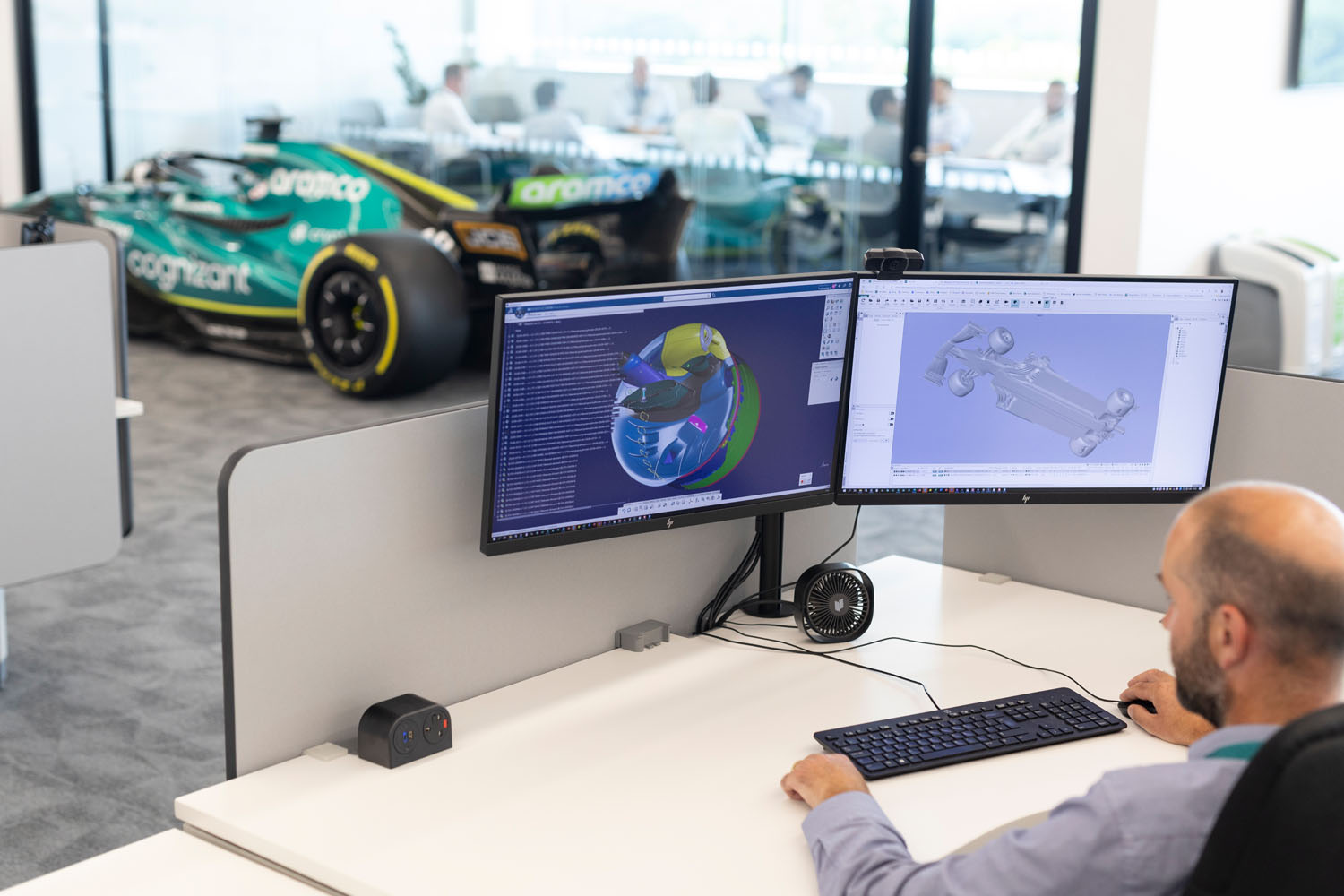
Huge CAD models designed in Dassault Systèmes Catia on Windows workstations must be shared with simulation engineers running Linux on multi-node HPC clusters. NetApp simplifies the sharing and processing of these massive 3D CAD files for CFD simulations by eliminating time-consuming file transfers between separate workstations and HPC clusters. Instead of using scripts to manually copy gigabyte- or terabyte-scale datasets back and forth over a slow network, NetApp acts as a single, highly optimised source of truth.
‘Zero-space’ technologies in NetApp enable storage efficiency and are built into the NetApp OnTap operating system. These allow users to create data copies, back-ups and testing environments without consuming any initial physical disk space or degrading system performance.
These capabilities have been around for a while in NetApp, says Caley, but when you integrate them with PLM, CAD design and more, they make a big difference in terms of reducing the amount of time users like Aston Martin F1 have to spend handling and translating data – time that can be repurposed for coming up with new concepts and race-winning ideas.
Adding AI
Factoring in the addition of AI to the design and engineering workflow at Aston Martin – and across other industries – is an interesting proposition, due to some unique characteristics it proffers, says Caley.
One is the scale of data that needs to be processed. A second relates to GPU performance, because the FIA limits GPU time for teams. “You need to make sure you’ve got as much data into that model as possible, so you get maximum benefit out of it,” he explains.
“From an AI perspective, the raw data is actually not much good for AI. It needs to be vectorised and curated. So, bringing tools, which we do, to that kind of technology means that when the data is actually ready it is presented to AI in a format that AI can use straight away, rather than having to go through a data science process, a data engineering process, all of those.”
With teams such as Aston Martin F1 racing to be at the bleeding edge of technology, managing data between countries, departments, and desktops is critical in the race for the podium.
This article first appeared in DEVELOP3D Magazine
DEVELOP3D is a publication dedicated to product design + development, from concept to manufacture and the technologies behind it all.
To receive the physical publication or digital issue free, as well as exclusive news and offers, subscribe to DEVELOP3D Magazine here