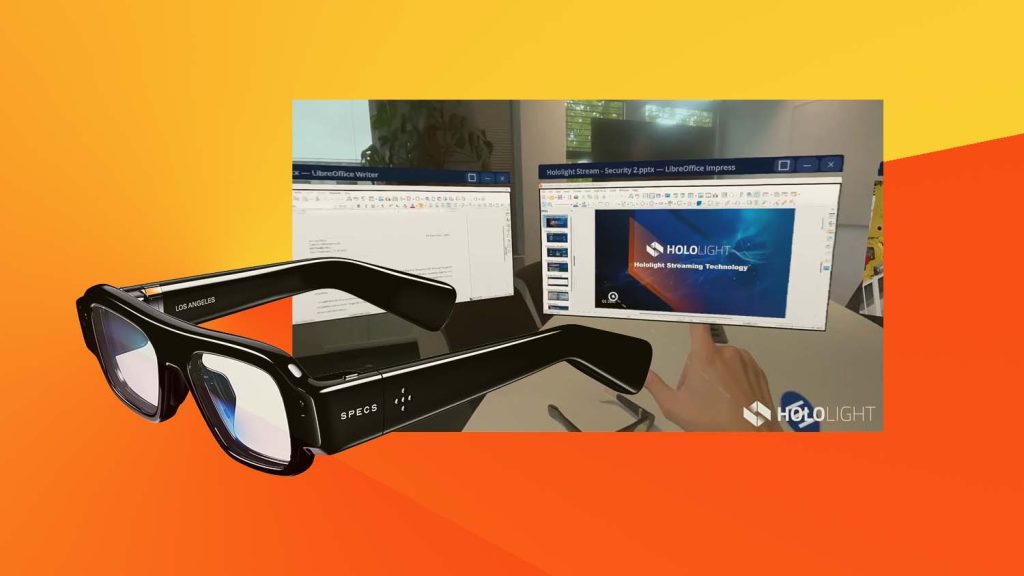

Hololight has announced its enterprise XR streaming integration for Snap’s latest product, SPECS, to display complex, high-fidelity 3D content without heavy onboard processing that lightweight glasses normally can’t support.
The application runs and renders on a workstation, on-premise server or in the cloud, including ray tracing and realistic lighting. The rendered images are encoded, encrypted and transmitted over Wi-Fi, 5G or LiFi, and the device decodes and displays them at up to 90fps with sub-50ms latency dependent on network conditions, scene complexity and server hardware.
The technology is Hololight’s own, developed in-house and optimised for Nvidia RTX GPUs.
“This ‘Netflix effect’ of streaming the data is what lets SPECS stay light and comfortable while still running demanding applications like Keyshot, Autodesk VRED, Nvidia Omniverse, Unreal and other OpenXR applications, alongside everyday tools like a browser, email, and documents all on one device.
“It also means sensitive data and models never leave a company’s own infrastructure, which matters for enterprise and regulated industries like defence.
Featured on stage as part of the SPECS keynote, Snap CEO Evan Spiegel, said: “Hololight turns SPECS into a spatial workstation, using video streaming to give employees access to the tools, documents, and 3D models they need, wherever they are.” Enterprise partnerships with Salesforce, Amazon Web Services, Nvidia and Trifork were also unveiled.
While Hololight remains tech-agnostic, working with any VR headset – including Apple Vision Pro, Meta Quest, HoloLens 2 and more – the application of its technology with lightweight ‘glasses’ like SPECS could signal a change in the usability of XR technology.
“Primarily organisations that already have serious 3D and engineering workloads and have been held back by what a headset can carry.,” said Hololight managing director, Florian Haspinger. “With SPECS, that extends further, to professionals who want one lightweight device for both a design review and the rest of their working day, rather than a dedicated headset they put on for twenty minutes at a time.
“As external rendering hardware improves, connected glasses can gain visual fidelity and capability without a hardware redesign.
“Streaming has been able to deliver full-detail models to headsets for years. What changed is the hardware on the other end.”