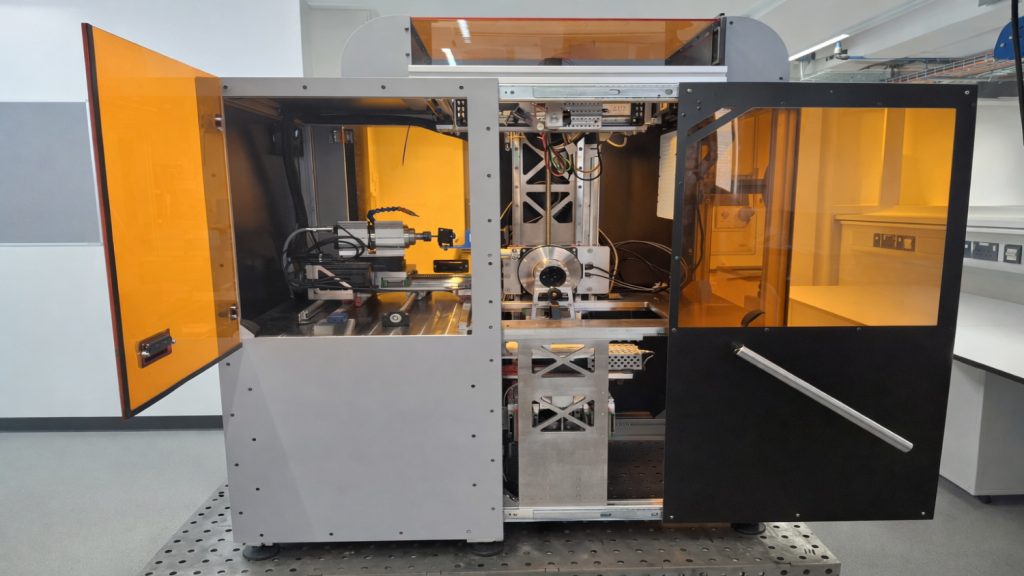

XYZO has launched its new hybrid manufacturing system that integrates polymer 3D printing, CNC machining, finishing and inspection into one automated workflow.
The multiprocess platform built onto the same chassis can integrate AM modules including Digital Light Processing (DLP), FDM pellet extrusion, inkjet deposition, as well as CNC micro-milling, alongside cleaning, curing, inspection and other post-processing operations.
Throughout the automated stages, XYZO stat that it is capable of ±5 μm part-to-part repeatability.
Developed to enable 3D printing to ‘progress from prototyping into repeatable production’, the XYZO platform is billed as a commercially viable option for manufacturing. The company initially works alongside a customer’s engineering team to develop application-specific workflows. Organisations can then test their parts, prove out unit economics and validate the process before scaling up to a full system deployment.
“Hybrid manufacturing is not itself a new idea, and additive and subtractive processes have been combined successfully for years. The more interesting development is the emergence of genuinely integrated manufacturing environments in which several complementary processes can operate as elements of one digital workflow,” said XYZO CEO Kegan McColgan-Bannon.
XYZO’s objective is to move from a digital design towards a finished, measured component through a controlled workflow while reducing manual intervention between manufacturing stages.
“For much of the last 30 years or so, the additive manufacturing (AM) industry has understandably concentrated on the additive process itself. Machines have become faster, resolution has improved, build volumes have increased. Material portfolios have expanded, and software became more sophisticated,” said McColgan-Bannon.
“All of this has mattered. But if the objective is genuinely to make polymer additive processes mainstream for production applications, improving the printer cannot be the end of the conversation. Manufacturers do not buy processes; they manufacture products, and this distinction is becoming increasingly important.”