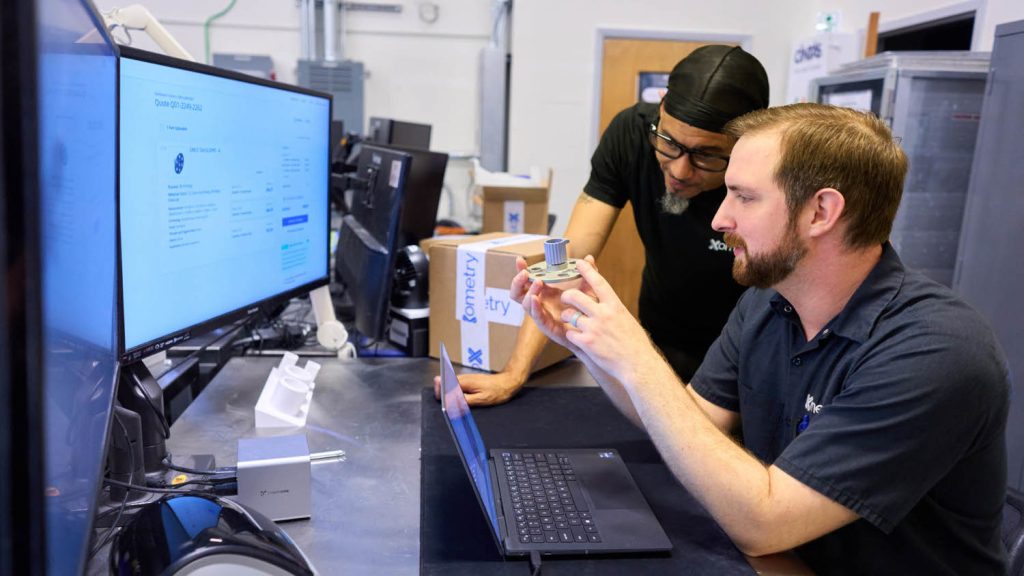

Xometry has evolved to become a global digital manufacturing platform, connecting product designers and engineers with thousands of manufacturing partners worldwide. DEVELOP3D spoke to CTO Vaidy Raghavan about the company’s roadmap and its AI plans
Q: How is Xometry continuing to evolve and stand out to customers in what is a fiercely competitive sector?
A: In the last year and a half, as I’ve been part of this journey, three main things have happened.
One is that we’re more integrated into different areas and channels of purchasing, and we’ve built a slew of tools for customers and have tapped into customer bases that are looking for large programmes and enterprise engagements.

The second thing that we have invested in is our models – they’ve grown dramatically. One of our strengths is our data, and it’s not just the data that is given to us. Yes, we get millions of parts uploaded every year, and that enables us to learn rapidly, but we’re also able to understand intent better.
Recently, we launched an LLM-based model for recommending processes. We always had one, but we’ve evolved it using the power of AI to do additional extractions. Our DFM logic has increased dramatically and is more accurate. With that comes the ability to tell the person who uploads their part where the risks are in the part and give them a trustworthy price point and lead time options.
A disproportionate number of our customers now select what we recommend because there is that degree of trust that comes with it.
Q: In May 2026, Xometry announced a partnership with Siemens. What can you tell us about the Designcenter integration?
A: Our partnership with Siemens is crucial, because what we see in the industry is a ‘shift left’ mentality. How can you bring manufacturability considerations – including lead time and cost considerations – further forward in the design process? Faster cycles mean the expectation from our customers is ‘tell me sooner’. And so we have to show up sooner [in the workflow].
The Siemens’ partnership with Xometry is precisely that: we want to add in our capability when you’re in the process of designing a part, not after you have locked in on a design iteration and then have to figure it out.
That way, customers don’t just see risk. They can also play around, because our entire menu – our 2,000 plus materials and finishes – is going to be available in Siemens Designcenter. It’s not like we’re only giving them a subset. They can trial a material, see the price and they can keep mucking around until they find the spot where they want to be.
Q: Where do you see this partnership with Designcenter leading – and are there plans for similar partnerships with the other CAD platforms?
A: Historically, for several years now, we’ve had a plugin version of Xometry for a few different [packages], Autodesk Fusion being one. Right now, our focus is Siemens Designcenter.
The partnership is not just about making it available. We’re introducing new habits with the tool. And so, for us, landing the product and landing the right capability set well – so that a user today of Designcenter is operating with a certain set of parameters – is priority number one.
Q: Is linking to a cloud-based ecosystem a priority for Xometry?
A: We’re going to be focusing on all angles. The cloud offers us one way of delivering this capability, and then [Siemens] has a substantial number of their customers that are on-prem that have been on-prem for a while. So we’re targeting both, and we’re sequencing in a way that we can start rapidly doing testing.
Q: Where have you seen the biggest growth areas across the manufacturing technologies Xometry offers?
A: Overall, all our trends are upwards, and we’re not seeing one manufacturing process get all the boom. As a consequence, this keeps us on our toes, because we must expand our partner base for manufacturing as demand grows. We’re bringing on manufacturers across all sectors, but also we are seeing a growth in demand for specialised certificates, ITAR and things like that.
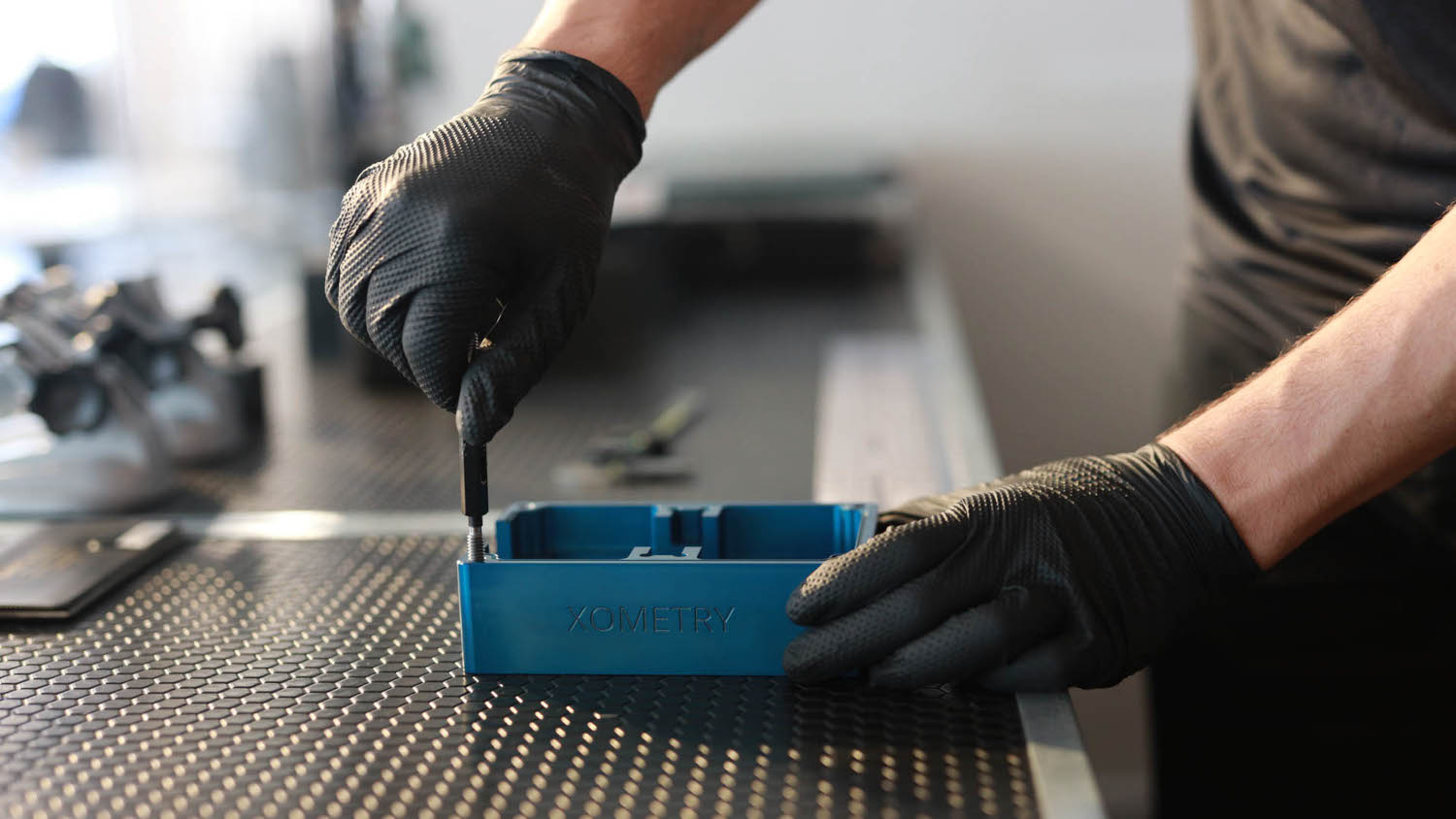
Q: What issues and challenges are presented by Xometry being a global platform and working with manufacturing partners all over the world?
A: When you’re playing the global game, you need to be able to decide where you’re going to standardise and where you are going to create customisations by geography. For example, our manufacturing partners in European countries expect drawings and CAD fi les to be given in a very specifi c way. You come to the US and the standards are completely different.
When we take a partner ecosystem that has proven itself locally, and we grow it into a global player, we’re very conscious that it can’t happen overnight. We have to graduate slowly. We have to work with them.
So I think it’s a challenge, but by and large, it’s a lot of fun and it’s very satisfying for us, because each of the geos have grown. We’re not taking a geo from zero and immediately pushing them into a boss fight to play a global game. They’ve already established themselves as a strong local ecosystem, and then we gradually pull them into a global ecosystem.
Q: How does Xometry view the current conversation around AI platforms being able to suggest part costings?
A: We frequently do what’s called a ‘cold-start assessment’ of a frontier model’s ability to gauge DFM risk and to gauge price. What we have seen over the last year and a half is that they are able to offer more relevant information. However, what we’ve also seen is the relevance drops dramatically as part complexity goes up even one notch.
We continue to pay attention to it, because we like what’s happening in the frontier models, and we also want to be able to take advantage of it when we see maturity. The hallucination factors, however, are dangerously wild, and so we have to be very conscious of that.
Q: Where else do you see AI as being beneficial to Xometry, its partners and customers?
A: We’re seeing frontier models being used for like-for-like matching: I have an image of the part, who can make it for me? [There are] search engines that can pull the product catalogue of all manufacturers and try to do a like-forlike match. We’re seeing some experimenters and early adopters in that phase.
Where Xometry has adapted is in tech that has already achieved high accuracy, related to quality and documentation that can be delivered with the power of LLMs and VLMs. We’re tapping into LLMs and object character recognition to do handwriting detection to assist our auto-generated inspection reports, for example.
Where we’re also going, and it’s fascinating, is how do we adopt image processing for quality management and use images as the part is manufactured to do defect analysis live?
Some of our partners are at the bleeding edge: they break their whole manufacturing process into chunks rather than as one sweep. And in between those chunks, they take screenshots to do an instant quality check so that they can pull [faulty parts] out of cycle.
For us, it’s interesting, because we have thousands of suppliers and we get a chance to engage with the early adopters and the mid-pack and perhaps the folks that are coming in a little late, and we are able to impedance match which capability works best and with who.
Q: How do you see AI impacting manufacturing in the next few years?
A: For decades, manufacturing was very hardware-first, with physical plants, manual labour and spreadsheets. What we’re seeing is AI pushing it into a software-first era, where competitive advantages come when you can quickly process data and leverage the power of data and ML models to make better decisions in real time.
This is us watching our own hypothesis validate [itself ] and seeing where we need to refine it. We continue to observe the power of an AI-powered marketplace being able to define the future of industrial procurement, not as tools layered onto a legacy system, but as a living system that continuously learns from the real world and gives a feedback system and a feed-forward system. That’s what’s super exciting about the journey that Xometry is on.
This article first appeared in DEVELOP3D Magazine
DEVELOP3D is a publication dedicated to product design + development, from concept to manufacture and the technologies behind it all.
To receive the physical publication or digital issue free, as well as exclusive news and offers, subscribe to DEVELOP3D Magazine here