
Formas.AI has unveiled a preview of Cartesian, its AI-assisted platform for early-stage product design, furniture and architecture design.
Designed to allow design problem-solving at the stage when spatial requirements, materials, environmental conditions and design intent can be considered together, it can begin like many other AI tools – photographs, sketches, written briefs or existing models – then use conversation to develop with precision individual components as ideas take shape.
Defined by Formas as taking the design of an object further, Cartesian can develop that idea by considering how parts fit together, which constraints matter and what should change as the design develops.
Cartesian gives designers an editable project in which to investigate those questions, carrying requirements and references into each revision.
At its core is Cartesian’s own CAD kernel layer and a geometric toolkit, both built for AI agents. Agents can discover supported tools, construct solids and freeform surfaces and inspect and revise geometry through programmatic operations.
Models can be organised into named components, layers and assemblies, with relationships that describe how parts belong together.
Cartesian coordinates multiple AI models, such as OpenAI’s GPT-6 Astra and Claude Opus 5.5, and other specialist agents across reference interpretation, brief development, geometric authoring and review. Independent improvements can be developed in parallel, then combined through geometry checks within the shared model.
Rhino and Blender integrations complement this system with additional CAD and mesh workflows. Project requirements and source references carry context between modelling activities.
The software’s initial focus on AEC subjects – the ability for agents to query sunlight, shadow and realtime wind analysis for investigating how form, orientation and spatial organisation respond to their surroundings – are being bolstered for more product design-led cases with new mechanical modules for motion and articulated assemblies are being integrated to broaden the possibilities.
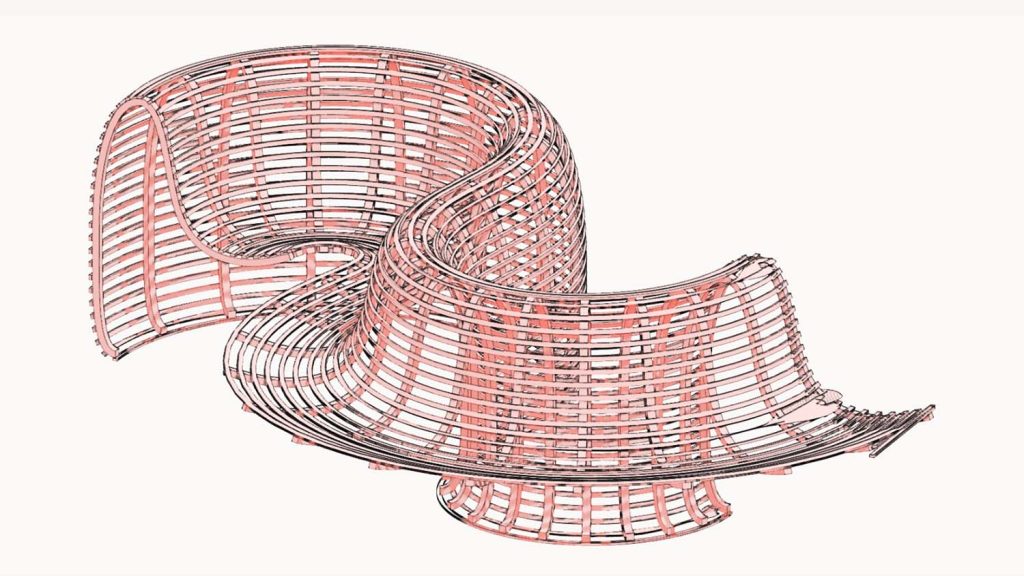
Cartesian supports concept development for furniture, products and layered structural assemblies, including studies of joints and connections, while designers can explore material thicknesses, dimensions, spacing and assembly relationships as design constraints, as they prepare concepts for real-life prototyping and further development in digital manufacturing workflows.
“The technology behind it can be incredibly complex. The experience should not be,” said Formas.AI CEO Yiping Goh. “Cartesian is designed to make 3D creation more accessible while giving experienced designers greater scope to explore ideas, exercise judgment and develop proposals with clients and collaborators.”
Rollout of the software is planned in phases for macOS and Windows, with expanded access planned from 31 October 2026. DEVELOP3D readers can apply for the preview waitlist here.
Formas raised an oversubscribed $3.98 million pre-seed round led by Vertex Ventures Southeast Asia & India, won first prize at SuperAI Genesis 2026.