
Alias and VRED 2027 have been launched by Autodesk, with the key updates built around smoother workflows coupling with increased speed.
To get from concept to surface, faster, Form Explorer has been announced in Alias for early-stage ideation. Form Explorer lets users convert 2D reference images into clean, proportionally stable 3D meshes in minutes for a consistent starting form that everyone on a team can react to.
What used to take days of volume blocking and cleanup now takes minutes, compressing the gap between a sketch and first 3D review – letting teams explore more directions before committing to one.
Mesh to SubD in Alias has added a new Regions option in the Retopology Tool to accelerate the process of approximating meshes with a Subdivision body, producing cleaner, more predictable geometry in less time.
Add to this new enhanced diagnostics for advanced shading, angle analysis and higher-precision deviation tools then better insight into how surfaces are performing helps make edits sooner and deliver better quality surfaces downstream.
Aerodynamic performance can now be considered in Alias with a plugin for Navasto’s AI-powered aerodynamic insights, enabling real-time airflow and drag evaluation. Users can make more informed decisions about vehicle efficiency earlier in the process, without waiting for engineering feedback or leaving the tools they already know.
The pipeline between Alias and VRED in 2027 is smoother with the addition of Live Referencing, a feature Autodesk says makes Alias and VRED feel like one connected workflow rather than two separate tools. Materials, annotations, variants, and sections now sync in both directions. From VRED reviews back into Alias, and from Alias updates out to VRED, design intent is maintained.
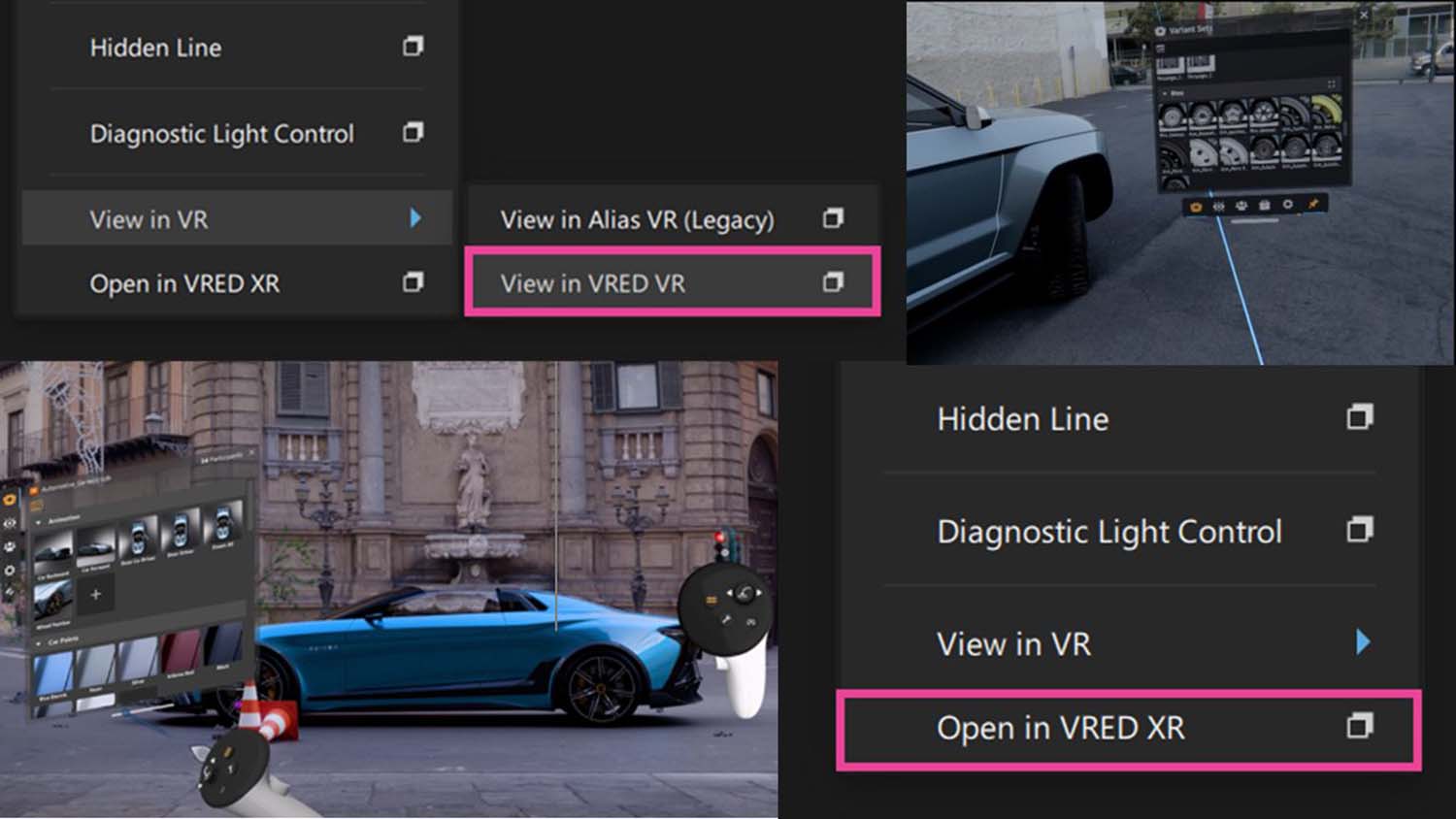
For reviews, VRED Presenter VR or a full VRED XR session can now be started directly from Alias with a single click.
VRED 2027’s dedicated Physics Editor introduces real-time rigid body simulation, giving teams the ability to interact with designs through physically accurate movement and behaviour – how components move, react, and relate to each other – on the desktop or in XR.
Overall use of XR in VRED gets some TLC in this release, with fully redesigned one-handed XR menu for live reviews, personalised avatars, and five new 3D library environments (Bridge, Desert, Minimal, Parking Deck, and Villa) fully optimised for the Vulkan render engine and built with vehicle-centric staging in mind.
Designs can be better placed in a real-world context thanks to support for Gaussian Splats (3DGS) and point clouds (PLY), allowing more lightweight real-world captures to be imported and rendered efficiently using Vulkan and GPU ray tracing.
“The 2027 releases of Alias and VRED are built around a single idea: the best design decisions happen when the tools get out of the way,” said Ananda Arasu, industry marketing manager for automotive at Autodesk. “That means less time preparing data, less friction between surfacing and review, and less distance between a design intent and the moment it can be evaluated, challenged, and refined.
“Alias 2027 accelerates the path from concept to quality surface. VRED 2027 takes what you build there and transforms how your team reviews, validates, and collaborates around it. Together, they move faster — and so will you.”