
Anthropic has partnered with Autodesk, Blender, Adobe and others to release a set of Connectors that let its Claude AI work alongside the design software.
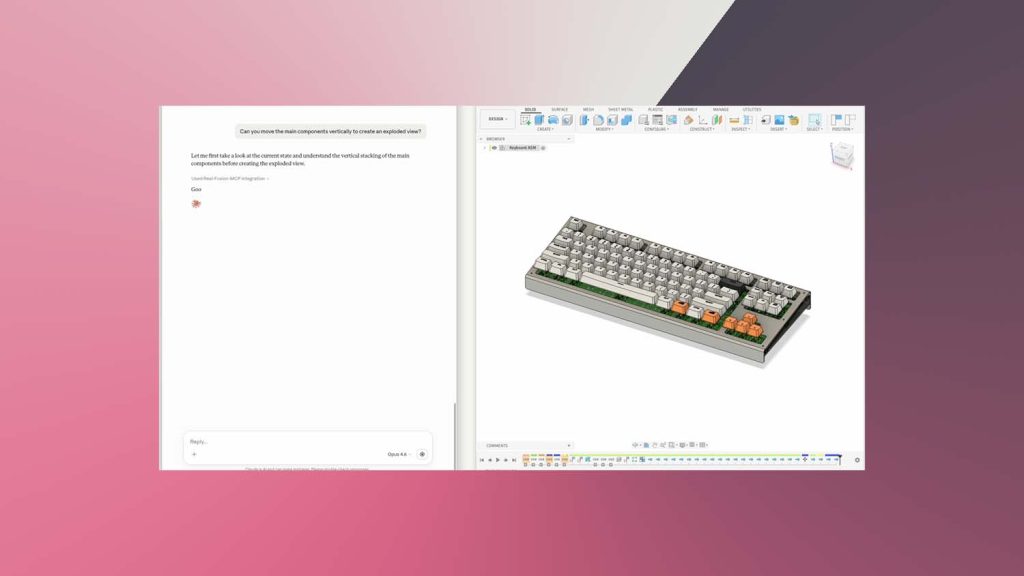
The Model Context Protocol (MCP) Connectors allow Claude to access platforms and tools directly. In the case of Autodesk Fusion, this means Text-to-CAD – natural language in and geometry out – automate repetitive modelling steps and move faster from idea to manufacturable output. Users control of what’s accessed and how it’s used, with protections in line with Autodesk’s existing privacy, security and product standards.
The announcement closely follows Autodesk’s own AI Assistant launch earlier in the month across its Product Design & Manufacturing portfolio. At the time Jeff Kinder, Autodesk executive VP of PD&M solutions, said: “Our approach combines frontier models with Autodesk’s proprietary industry-specific models, purpose-built to understand 3D design and make workflows, all with the goal of delivering practical, relevant AI that helps customers be more productive.”
Whether Autodesk’s AI will combine directly with Anthropic’s Claude is yet to be made clear.
“This is an early step in a broader shift toward a more open ecosystem where Autodesk software connects into the tools our customers already use,” said Emily Scherbenski, director of Cross Industry Audience Marketing at Autodesk.
“We’re working toward a world where:
• Design tools are accessible from anywhere you work
• AI can safely take action inside real workflows
• Ideas move from concept to production without friction
“Autodesk Fusion is there wherever it begins.”
Click here to read all our latest AI for Product Design and Engineering content
With Blender’s MCP connector, Anthropic gives the example of designers being able to use Connector to analyse and debug entire Blender scenes, or build custom scripts to batch-apply changes to objects in a scene. By using Blender’s Python API, the connector lets Claude add new tools directly to Blender’s interface.
An open source tool, Anthropic has joined the Blender Development Fund as a patron to support the Blender project as they continue to develop their Python API, and make further integrations like this possible. Anthropic’s spokesperson added that because the connector is built on MCP it is accessible to other LLMs in addition to Claude, a reflection of Blender’s commitment to open source and interoperability.
What does it mean?
Anthropic stepping into the sphere of design tools has repercussions on several levels.
Text-to-CAD ability is set to speed up workflows – the AI LLM using the CAD kernel to push out what it thinks is the geometry defined by the user – whether a clean sheet design or an edit to an existing model – in a matter of seconds.
Where it will become truly useful is when the AI starts to encompass and use intelligence gained from all the models, geometry, and edits and failures of building successful CAD models. And given the development cycles of AI, it’s possible that this is only a matter of time away.
Claude can also translate formats, restructure data and keep assets in sync across a project and multiple softwares, which should further ope
Autodesk connecting Fusion to Claude is an interesting stage and, like Solidworks before it, acknowledges that even the biggest CAD vendors cannot compete with the big developers of AI, and instead are left performing the role as the geometry kernel. This equally applies to Adobe, a company that set out early to develop its own core AI tools, yet has since backed down.
For the dozens of Text-to-CAD software start-ups, this is likely to signal end or the time to pivot, given it’ll be hard to compete against a company with the development resources and free license packages of Anthropic.
Perhaps the most interesting element among all of this is Anthropic’s move to back open source Blender, which should act as a flag to all the major CAD vendors. While Blender is a B-mesh polygon modelling software, rather than NURBS-based BREP used in the main CAD tools, few would doubt that Claude’s ability to program and integrate new tools will accelerate the development of the free-to-use software, which already has a strong user community.
For Fusion users, it’s an exciting time and should help turbocharge AI abilities within the software. Where it will end is anyone’s guess.