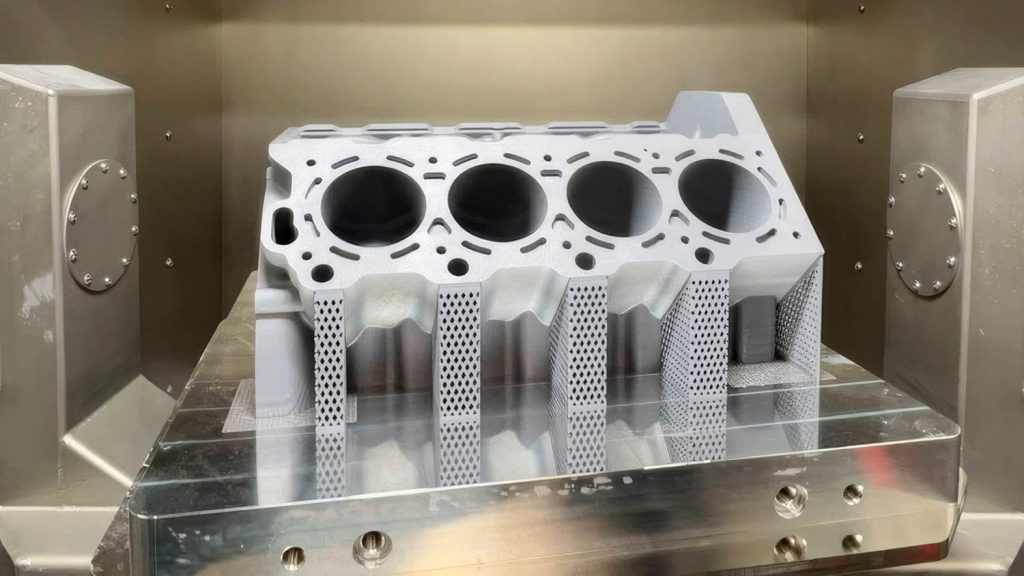

This V8 engine isn’t built like other V8 engines. Gabrielle Brown learns how two German companies partnered to put additive manufacturing to work on producing a complete, one-piece V8 engine block in aluminium alloy
For additive manufacturing (AM) to expand beyond its mainstays of prototyping and R&D in the automotive sector, it cannot remain confined within the development centres of the world’s OEMs.
That’s the thinking behind a recent collaboration between the Bosch Additive Solution Center, based in Nuremberg, Germany, and 3D printing specialist Nikon SLM Solutions of Lubeck in Germany. Together, they have printed a complete, one-piece V8 engine block in AlSi10Mg aluminium alloy, using Nikon SLM Solutions’ NXG XII 600, a large-format, multi-laser powder bed fusion system.
Complex geometries
Conventionally, a cylinder block is produced through casting, involving weeks, if not months, of tooling to develop and validate before a part can be made. The geometry of the part, meanwhile, is highly constrained by what the casting process can reliably produce.
With AM, by contrast, complex geometries are produced directly from a digital file, without the lengthy lead times associated with tooling and casting. This means that novel and previously out-of-reach design features – such as integrated cooling channels, topology-optimised structures and consolidated multi-component assemblies – suddenly become achievable.
In the process, entirely new approaches to engine design, development and manufacture are opened up.
Lifting weights
An immediate benefit of using AM to build an automotive engine is weight reduction. Material can be placed precisely where it is needed and removed where it is not, making for lighter components with no compromise on performance. In motorsports, where seconds count, that kind of weight saving isn’t just a marginal gain – it’s a real source of competitive edge.
This V8 engine block is a powerful example of what current additive manufacturing technology can achieve, but its real significance lies in the kind of future it points toward, rather than what it represents in isolation. And the collaboration between Nikon and Bosch is a good showcase of how both brands see AM scaling into real production environments, although it is clearly not as simple as just putting a machine on the factory floor.
An entirely new approach to building engines requires close collaboration on materials, process parameters, design for AM, software integration, and ongoing application development. It is through Bosch’s automotive experience and Nikon SLM’s expertise in additive technologies that the two partners were able to pull off this feat.
As a result, the question is no longer whether AM can take on such challenges, but rather, how it can be shifted into automotive production environments to tackle projects that come with geometric complexity, strict performance requirements and sizable production volumes. The technology is ready
This article first appeared in DEVELOP3D Magazine
DEVELOP3D is a publication dedicated to product design + development, from concept to manufacture and the technologies behind it all.
To receive the physical publication or digital issue free, as well as exclusive news and offers, subscribe to DEVELOP3D Magazine here