
From bowls to cutlery and inspired by ceramics, Guzzini has developed a new range of designer homewares. Gabrielle Brown learns how post-consumer plastic can coexist with high-quality design
In 1912, Enrico Guzzini founded a company that would go on to become a household name, an eponymous homeware brand defining midcentury modern and Space Age Italian design.
Experimenting with materials is a staple of Guzzini. Back in 1938, it pioneered the use of Plexiglas and acrylics for home goods and, in the post-war period, it successfully repositioned plastic as a vibrant, durable and stylish medium for everyday household goods.
Almost a century on, materials innovation continues at Guzzini, which uses injection-moulded, post-consumer plastic in its Tierra collection.
Tierra, meaning ‘earth’, is the creation of brothers Pio and Tito Toso, who designed the collection as part of the Guzzini Circle programme, a sustainable manufacturing initiative introduced by the company in 2019. At the heart of this programme is the idea that sustainability should not be considered an additional feature of a product, but rather, one of the parameters that should guide its design from the start.
“Tierra was designed not simply as an environmentally responsible product, but as a collection in which material, form, texture and colour communicate the same idea of sustainability,” explains Riccardo Ricci, head of sales for Guzzini in Italy and the UK.
Spinning plates
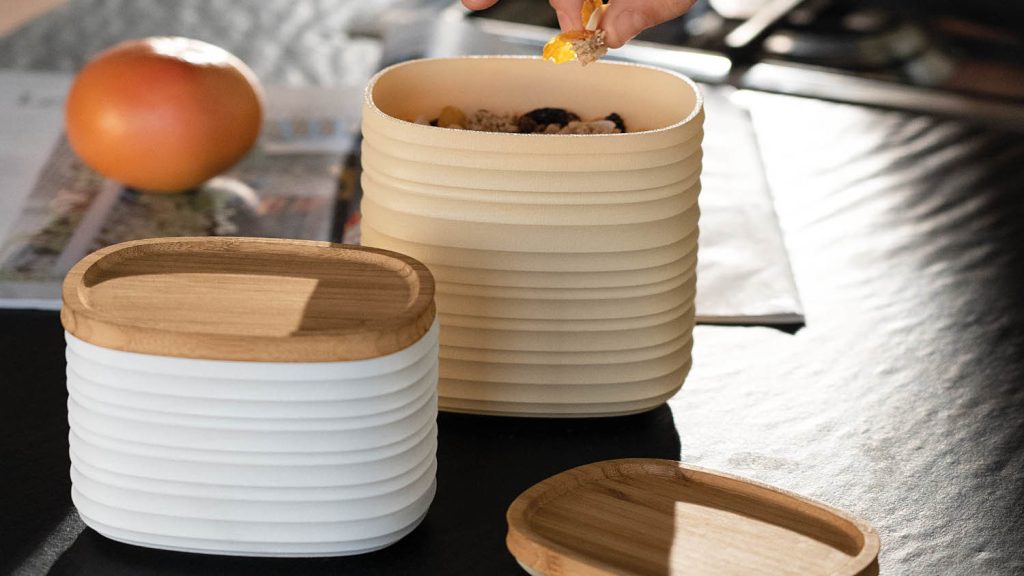
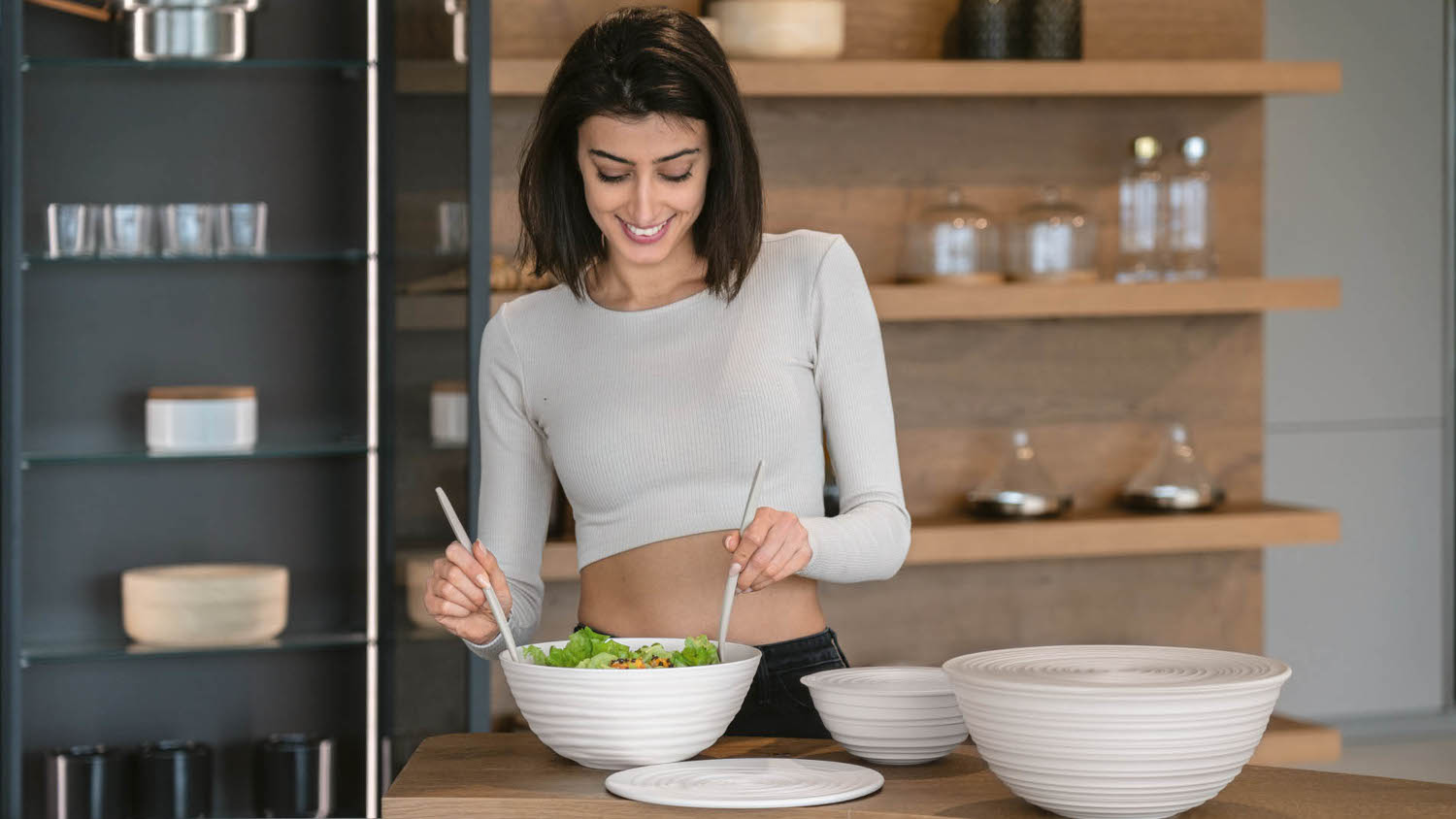
Inspired by handmade ceramics shaped on a potter’s wheel, the intentionally irregular circular patterns that run across the surface of products in the Tierra range give each piece a handcrafted feel, in a juxtaposition of the traditional image of hard plastics.
The project began with two connected objectives: to create a strong and recognisable design language; and to demonstrate that post-consumer recycled plastic could be used to manufacture high-quality products.
The first concepts of Tierra produced by the Toso brothers are sketches that explore soft, organic volumes and the irregular concentric surface texture inspired by handmade pottery.
This made defining the surfacing of the product a challenge; it had to convey the spontaneity of an object shaped by hand, while also being precisely engineered, so that it could be reproduced consistently using injection moulding.
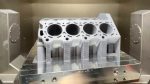
The process involved surface modelling to perfect the organic surfaces. With proportions and wall thicknesses honed, and surface details refined, 3D modelling shifted into Dassault Systèmes Catia, in order to ready the design for tooling. The team at Guzzini also used design-for- manufacturing techniques specifically related to injection-moulding recycled plastic.
“The challenge was not merely to substitute one material for another. It was to create a product in which recycled material, industrial technology and design language became completely integrated, transforming sustainability from a technical characteristic into a visible part of the product’s identity,” explains Ricci.
Post-consumer plastics
With the design approved, mould trials and pre-production samples became an essential part of the development process.
“These samples allowed the team to test the actual recycled material, evaluate surface finish and colour, check dimensional stability and refine injection parameters,” Ricci explains.
One of the main challenges was working with post-consumer recycled plastic while maintaining the aesthetic and functional standards associated with the Guzzini brand, he says. “Recycled materials present greater variability than virgin raw materials, particularly in terms of processing behaviour, colour consistency and surface appearance.”
Simulation software was used to assess material flow, mould filling, pressure, cooling behaviour, shrinkage and potential deformation.
Disposable PET water bottles were transformed into the new raw material for the Tierra, and given a second life as durable products.
Prototyping using the recycled plastic was needed to test mould filling, cooling, dimensional stability and surface quality before mass production.
According to Ricci, Tierra demonstrates that recycled plastic does not have to look like a compromise or a second-choice material. “Through design, technology and manufacturing know-how, it can acquire a completely new value, both functional and aesthetic,” says Ricci.
After much trial, the process was perfected, enabling Guzzini to introduce a full range of kitchenware – including sculpted bowls (which take 15.6 water bottles to create) and a neat ladle rest (just 5.6 water bottles).
The resulting collection achieved its goals, proving that aesthetics that harmonise with a brand’s identity can also be environmentally friendly.
This article first appeared in DEVELOP3D Magazine
DEVELOP3D is a publication dedicated to product design + development, from concept to manufacture and the technologies behind it all.
To receive the physical publication or digital issue free, as well as exclusive news and offers, subscribe to DEVELOP3D Magazine here