
At Milan Design Week, Lexus showcased a new concept car designed to demonstrate what ‘the future of mobility’ truly means to the Japanese automotive brand, as Gabrielle Brown reports
Milan Design Week (MDW) is the world’s premier design event, encompassing furniture, fashion, architecture, art and technology. Every April, the city overflows with installations that premiere some of the most innovative and imaginative design concepts. In short, it’s the place to be for any designer wishing to flex their creative muscles.
For over 20 years, Lexus’ exhibition has been a key attraction for MDW visitors.
“Creativity is at the heart of everything we do, and we decided that Milan would be a good place to experiment and to try and define a new road, not only for automotive design but also the way that we interact with our customers,” says Lexus global design chief branding officer, Simon Humphries.
In the past, Lexus has used Milan as a showcase for cutting-edge design concepts such as the 2025 black butterfly dual-interface control device featured in the cockpit of the Lexus LF-ZC concept car. The creativity didn’t stop in 2026.
With over 30 years of design experience, Lexus Design general manager Koichi Suga has a particular affinity with MDW, precisely because it’s not a car show, but an opportunity to express himself as a designer.
Sanctuary space
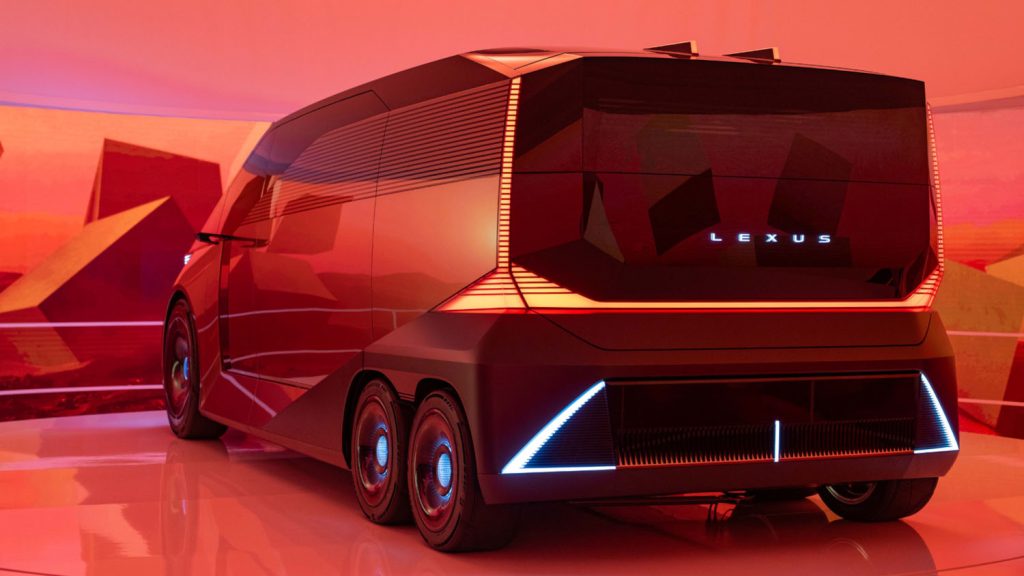
Centred on its LS concept, initially unveiled at the Japan Mobility Show in October, the immersive Lexus installation ‘Discover Space’ at MDW was designed to express the brand’s vision of space within a luxury-lifestyle context.
The installation combines 360-degree visuals with sound and lighting, placing visitors at the centre of that vision. This is not just a car on display, but an experience.
LS stands for Luxury Space. This 6-wheel concept was developed to offer interior space isolated from the hustle and bustle of modern life, offering passengers a serene and luxurious form of escape.
“We’re going in a new direction. For instance, our flagship concept car is now a chauffeur-driven vehicle and takes on a new shape,” explains Suga.
Because the design team wanted to maximise space with extra-wide door openings and smaller tyres, the number of tyres needed to be increased to meet loadcapacity requirements.
“We didn’t aim for six wheels, nor did we start with it as a given. We didn’t seek to be eccentric. We simply examined the interior space and usage that a true chauffeur car should have, and that led us to this concept car,” says Suga.
Bamboo panelling covers the interior of the car, and the seats are made from cedar wood, which has been bent using traditional Japanese techniques to give the feel not of regular car seats but of furniture you would have in your home.
The blending of heritage crafts with new ideas and materials is central to the design, “so we’ve actually reborn the way we think about how to use space itself, and how to make it a very reassuring space. Because everything is brand new, we need to rely on the heritage of the craftsmanship to bring that to life as well. It’s a design language for us that’s been unprecedented,” adds Suga.
The LS concept is fully electric, and Suga explains how this completely changed the design and proportions of the car. “Given that [the car is electric], we were able to really create a very appealing, new, refreshing take on what a chauffeur vehicle should be, could be,” he says.
“So even though we’re using, you know, traditional materials, the way that we use it, for instance, the way we bend certain items – those are all very new techniques.”
This is Lexus’ vision for the future of mobility. It explores what the products can offer in terms of new value, constrained not by the brand’s past thinking, but being open to a new identity.
One step further
The LS Micro takes the LS concept one step further, as a mobile sanctuary for uninterrupted personal time. Described as ‘micro-mobility’, it allows a single passenger to move freely in busy cities with small streets and alleys.
“As designers and engineers, we talked extensively with people who are being chauffeured around. The consensus was that they want time completely alone,” says Suga.
The LS micro is Suga’s vision of what chauffeur-driven vehicles could be in the future, a private travel experience enabled by autonomous driving in a relaxing space surrounded by a high-quality luxurious finish. “
As we transition from the era of cars to the era of mobility, where people enjoy more freedom in movement and enrich their lifestyles, we reflected on the brand: ‘What is Lexus?’,” says Suga, “Because our foundation was the idea of not imitating anyone, we weren’t bound by anything and could purely explore what a true chauffeur car should be.”
Lexus has kept the cornerstones of the brand the same with the concept car – quietness, ride comfort and allroad capability – while proposing something new.
These concept cars are not just an idea of what cars could be like in the future, but a way to communicate the Lexus brand’s vision and to show customers what the company is all about.
This article first appeared in DEVELOP3D Magazine
DEVELOP3D is a publication dedicated to product design + development, from concept to manufacture and the technologies behind it all.
To receive the physical publication or digital issue free, as well as exclusive news and offers, subscribe to DEVELOP3D Magazine here