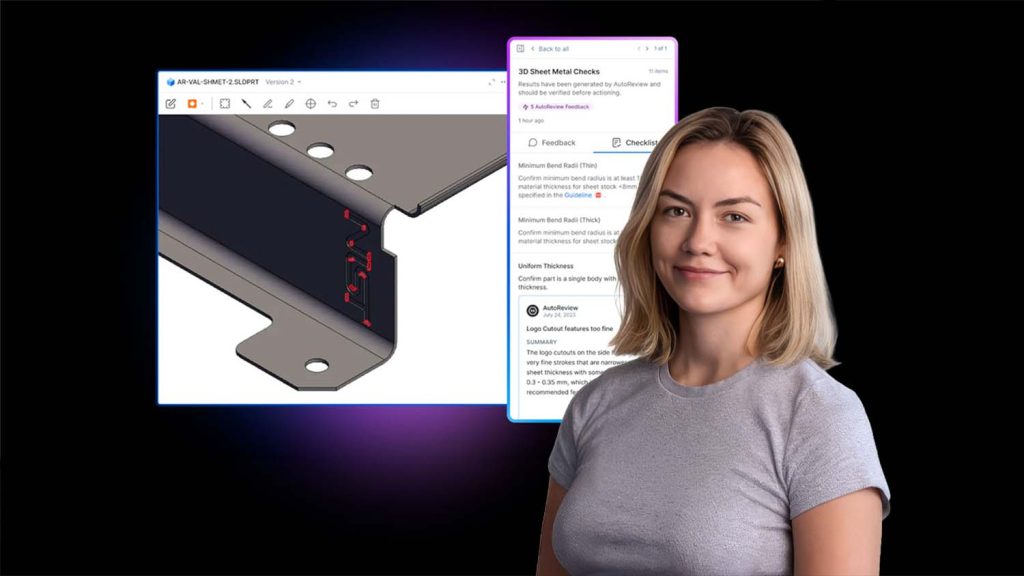

In 2025, CoLab Software won a coveted spot on our D3D 30 list of exciting new technologies with its AI-powered AutoReview tool, which automates the checking of design files for common issues. More recently, we caught up with chief strategy officer Taylor Young to get an update on the company’s progress and future plans
Q: Taylor, let’s start with the basics. How do you describe CoLab and what it can do for product designers and engineers?
A: CoLab is what we call a design engagement system. We help engineers and cross-functional partners work together, review engineering data of all forms, work with agentic tools to make better decisions faster, often in the form of informal and formal design review.
Q: Initially, this took the form of an automated ‘design checker’. How has the thinking around this evolved at CoLab Software?
A: I would say the origins of CoLab are very much MCAD design review, and over time, we’ve really expanded to much broader engineering review and engineering decision-making. That means the types of data getting reviewed are often broader – so it’s not just a CAD model. It may be a bill of materials, a specification document. It’s all of the things that engineers actually look at day to day to make a decision. The actual review itself, I would say, has transitioned from a more formal kind of ‘pencils down’ design review into a more rapid, informal, freeform kind of design review.
Q: How is AI involved in this, what value does that bring, and how do you keep all that data safe?
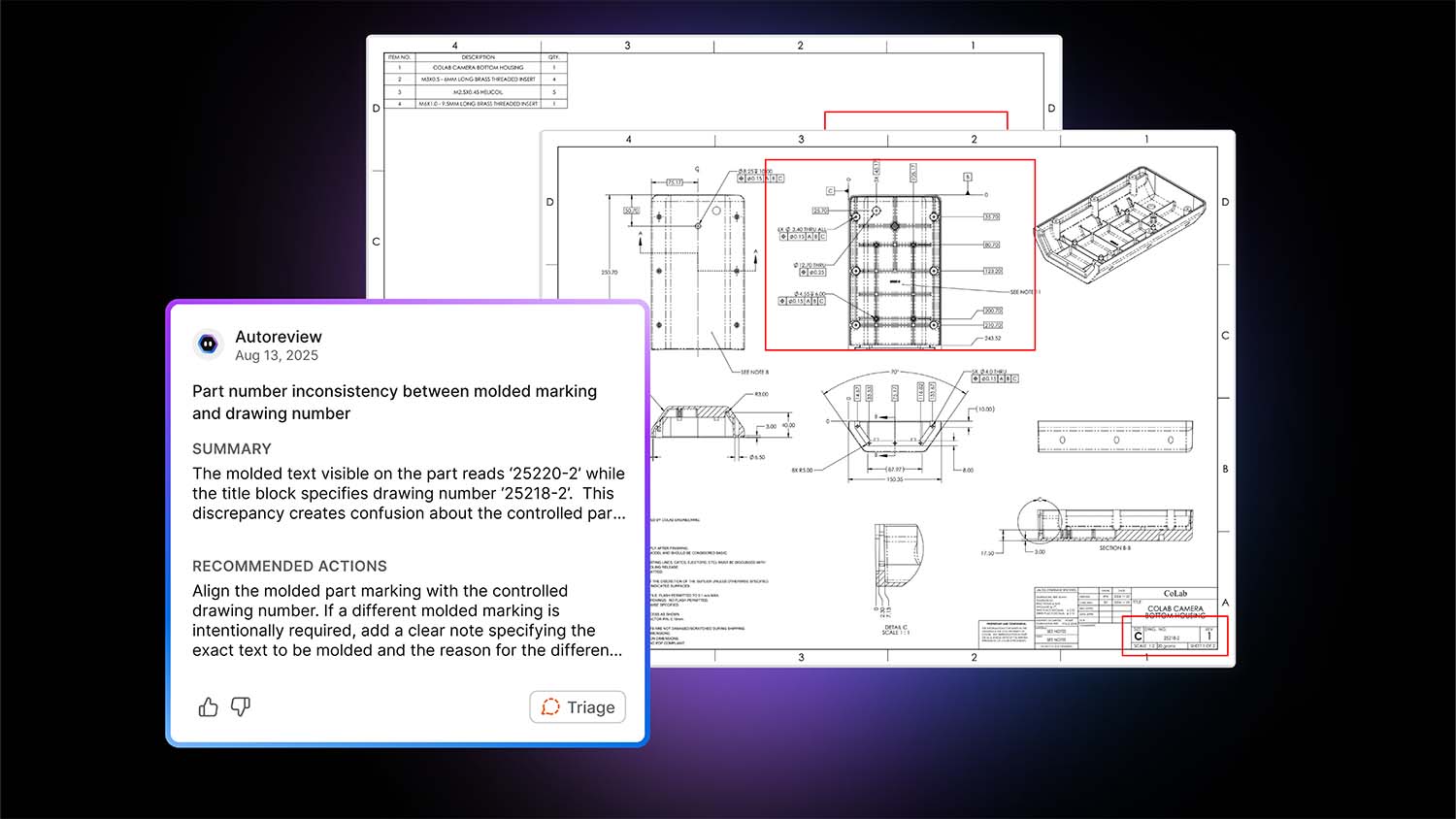
A: There’s really a couple parts of the product where we’re seeing major AI impact and practical use cases that teams are actually using in production. One is what we call AutoReview, which is basically a first-pass check on drawings and models. It leverages a number of different leading LLMs [large language models] under the hood to do that, but also and maybe most importantly, it leverages standards, guidelines and lessons learned.
So it’s going to take industry standards like ISO, but it’s also going to use a company’s internal guidelines. For most organisations, it varies. Some could have thousands of well-documented guidelines, some might have less than ideal ones, but generally, engineers aren’t using them to their fullest.
Either they’re not very good, so engineers don’t use them, or they’re quite good, but there’s way too many of them to leverage in daily decision making. So it’s a great use case for AI, where our system will automatically review a drawing or model, go read through every single standard and guideline in the organisation, and let you know if there’s anything in the drawing or model that’s not in compliance with that particular standard or guideline.
Q: How does CoLab benefit from working with several LLM foundational models over maybe a single one?
A: We’ve found that in order to get an actual kind of enterprise, production-grade review on one of these very complex parts, you actually need to rely on several different models for different jobs in that process.
So while one of the models might be very, very strong at understanding images, another is much better at dealing with geometry, and so we are constantly not only using different models for different parts of the process, but we’re constantly changing them as they advance.
Q: So what kind of companies are buying this technology and in which industry verticals do they typically operate?
A: We work primarily in complex discrete manufacturing, I would say. So those core industries would be all the ones you’d expect: automotive, aerospace, defence, industrial equipment, heavy machinery, medical devices. I would say we have very strong use cases within all of those.
We’re also seeing a ton of growth in aerospace and defence; we got our FedRAMP high authorisation – the clearance for us to be allowed to host ITAR data – a few months ago, so we’re starting to see an influx on that side of things. Also, anything related to the broader data centre industry; we’re seeing a ton of pull here, particularly because those companies are dealing with an outrageous level of scale that they’ve never seen before.
Q: How do users connect to CoLab?
A: It’s a browser-based tool, although we also have a desktop application. It integrates directly with CAD and PLM, so we’re now integrated directly with PTC Creo and Siemens NX, as well as PTC Windchill and Siemens Teamcenter, and other major packages such as Solidworks. As it’s primarily web-based, it makes it very easy to use. Like we always say, it’s an enterprise grade system – in terms of its ability to pull in engineering data and preserve the information you need – with a consumer grade user interface and user experience wrapped around it, so it’s very, very easy to use and doesn’t require training.
The introduction of ECAD and simulation, I think, is going to make CoLab Software truly multidisciplinary in a way that’s going to help a lot of companies
Q: What’s coming next for CoLab?
A: We’re now in that transition to broader engineering review and we’re introducing everything we’ve done on the mechanical engineering side for ECAD and for simulation, which I think will be a big deal for multidisciplinary collaboration. Part of the reason we exist is that products are getting increasingly complex, harder to talk about and make decisions on, and so the introduction of ECAD and simulation, I think, is going to make us truly multidisciplinary in a way that’s going to help a lot of companies.
Q: How will it work for simulation?

A: There are two levers to it. One is the more obvious one, which is when you think about CoLab, the ability to, for example, conduct a review, markup, annotate a 3D model. We’re going to do all the same things for simulation results. You take a result out of your FEA software and want to look at the analysis, visualise the model as well as any tabular data, how the simulation was set up and more, and bring simulation engineers and design engineers together in that process. Right now, traditionally that process would be done by probably a simulation engineer taking a bunch of screenshots and putting it in a model or putting it in a PowerPoint deck and sitting down with someone about it.
The other part of it is more experimental – the ability to orchestrate simple simulations or simulation reruns directly from CoLab – for which we’ve done a proof of concept with SimScale.
We know design engineers would run more simulations earlier in the process if they had the ability, but many have to proceed without, especially if they can’t access an engineer to do it for them. The idea here is to give them the ability to simply click a button. We won’t do the actual simulation ourselves, but connect into the user’s existing simulation tools.
Obviously, for PhD level simulations, we need the simulation engineers to run those things – but the simple simulations, or the reruns that aren’t being run at all because of that disconnect between the simulation and design engineers? We’re trying to bring that closer together as well.
Find out more at: colabsoftware.com
This article first appeared in DEVELOP3D Magazine
DEVELOP3D is a publication dedicated to product design + development, from concept to manufacture and the technologies behind it all.
To receive the physical publication or digital issue free, as well as exclusive news and offers, subscribe to DEVELOP3D Magazine here