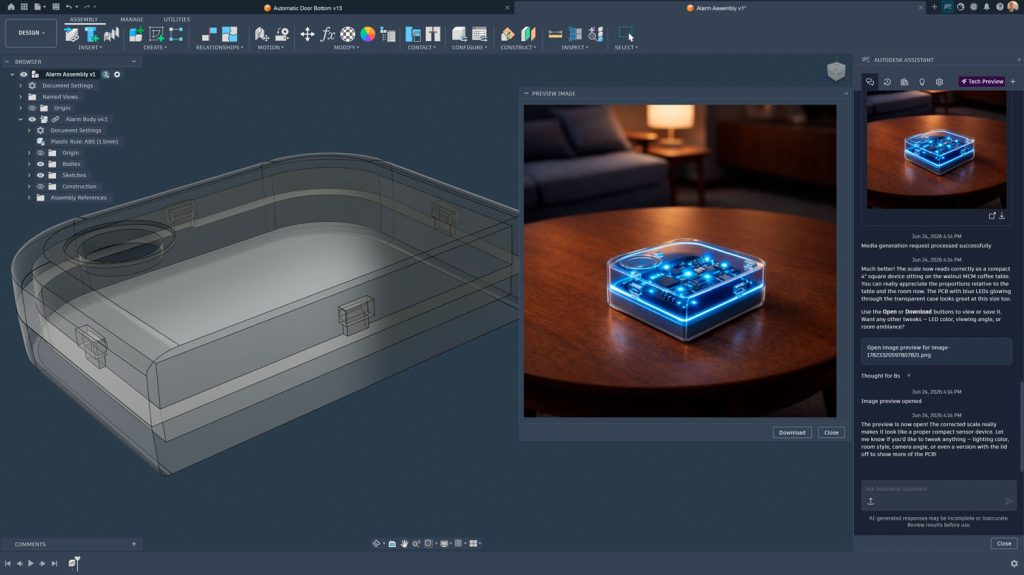

Executives at Autodesk have begun to reveal how the company believes AI will reshape design software, combining geometry-aware foundation models with a persistent layer of engineering knowledge it calls ‘project intelligence’. Martyn Day examines the emerging strategy
Autodesk’s emerging AI strategy goes further than adding co-pilots to its existing CAD applications. The company is working towards geometry-aware foundation models combined with what it calls ‘project intelligence’: a persistent layer of data, decisions and engineering knowledge that follows a product throughout its lifecycle.
Although Autodesk CEO Andrew Anagnost has framed his recent comments primarily around AEC, the underlying argument applies equally to product development. AI, he argues, should not replace designers, but bridge the gap between an idea and a fully developed model, carrying design intent further into simulation, engineering and manufacturing.
A central tenet of his argument is that too much engineering knowledge is lost as work passes between people, applications and stages of development. Much of that intelligence rarely lives in the CAD model. The geometry records what was designed, but not necessarily why a tolerance was changed, or which manufacturing constraint dictated the final geometry.
Anagnost argues that these decisions, assumptions and lessons should remain connected to the product and, more importantly, become data that informs future work. AI potentially makes this surrounding engineering knowledge far more valuable, because machines can retrieve and reason over it rather than leaving it buried in documents, meetings and engineers’ memories.
Neural CAD
When Autodesk unveiled Neural CAD at Autodesk University 2025, it marked a significant shift in the view of AI’s role in design software. Until then, much of the industry’s focus had been on using LLMs to automate repetitive tasks, generate scripts or call existing CAD APIs.
Neural CAD takes a different approach. Rather than treating geometry as something to be manipulated indirectly, Autodesk has developed a foundation model trained specifically on professional CAD data, enabling AI to reason directly about geometry, topology and engineering relationships.
The distinction matters. Most current AI implementations in CAD use an LLM to interpret an instruction and then call tools in an existing modelling system. Neural CAD attempts to put an understanding of geometry inside the model itself.
The technology builds on research by Autodesk’s AI Lab and Project Bernini, culminating in a geometryaware AI model capable of generating editable boundary representation (B-rep) CAD geometry from combinations of text prompts, sketches, images and voice commands.
Autodesk positions Neural CAD as complementary to traditional parametric modelling, rather than its replacement, describing it at its unveiling as the first fundamental change in CAD interaction for more than four decades. Instead of reasoning primarily about text, the AI reasons about 3D geometry and produces editable CAD models that can be refined further within Autodesk Fusion.
In June 2026, Mike Haley, Autodesk SVP of research, explained more about the thinking behind this emerging Neural CAD layer. The technology can generate multiple design alternatives simultaneously, create fully editable B-rep geometry and, for some tasks, generate a parametric construction sequence for the resulting model.
Parametric CAD continues to provide precision, deterministic control and engineering accuracy, while Neural CAD supports conceptual exploration and more natural interaction with software. Haley also describes how LLMs can work alongside Neural CAD, using geometry-aware models to analyse assemblies, identify components and support engineering workflows.
Future Neural CAD interfaces are expected to combine prompts, sketches, reference documents, images and voice commands, rather than relying on text prompts alone.
Haley has also outlined Autodesk’s work on AI trust, including internal benchmarking, anti-parroting research designed to prevent AI from reproducing customer designs, transparency documentation describing how models are trained, and customer controls over data usage and AI features.
Early examples of Neural CAD include AutoConstrain in Fusion, with more capabilities in the pipeline. Haley also outlines a future in which organisations will be able to fine-tune Autodesk’s foundation models using their own historical data and processes, creating companyspecific AI models that reflect their engineering expertise and workflows.
What this means

Read together, Anagnost’s strategic vision and Haley’s technical pointers present a coherent picture of where Autodesk believes AI is heading.
Given the complexity of modern products, it is easy to see why Autodesk believes a persistent layer of project intelligence is the right foundation.
That said, the approach also raises important questions. If project intelligence becomes the repository not only for CAD models, but also for an organisation’s engineering knowledge, design rules, workflows and ontologies, it represents a much deeper form of platform dependency than proprietary file formats ever did.
The industry has spent 20 years trying to escape proprietary file formats. AI raises the prospect of something far stickier: proprietary knowledge lock-in. Intellectual property increasingly shifts from manually created design files to the knowledge accumulated around them, and the more useful these models become, the more they depend on access to proprietary project knowledge, workflows and design intent.
In an interview with Haley, he confirmed that some models use customer-authored design data, although in aggregated and de-identified form, with opt-outs for advanced AI features. Autodesk is also using transparency cards and anti-parroting checks to manage trust and IP risk, which is welcome.
Practical considerations remain, however. To realise the full vision, customers may need AI systems that understand far more than geometry. Potentially, that understanding will include client briefs, project objectives, performance requirements and design intent.
Many companies will be uncomfortable placing that level of commercially sensitive information inside a vendor-managed platform, regardless of the safeguards in place.
Finally, there is the question of economics. Firms already pay for authoring software, cloud collaboration and data storage. Adding AI compute and project intelligence services creates another layer of recurring cost.
On Neural CAD
Haley’s answers make Neural CAD sound more serious than a simple AI add-on; it is aiming for editable CAD outputs and typically B-rep geometry. That matters, because CAD is geometry with meaning, relationships and downstream consequences.
His answers on accuracy are also revealing. Neural CAD cannot yet guarantee perfect precision. Autodesk’s approach is to combine probabilistic AI generation with deterministic parametric CAD engines that can heal, constrain and bring geometry into tolerance. That is sensible, but it confirms this is not yet a magic button and more likely a tool for concepting and bounded design tasks, where AI can generate options and humans remain in control.
On the context window problem, Haley is right that the goal is not to dump an entire project into an LLM. Large projects are not just large. They are also semantically dense.
The solution has to be compact, multi-scale representations, retrieval strategies and AI agents that access the right information at the right level of abstraction, which aligns closely with Autodesk’s wider ‘project intelligence’ message.
Overall, Neural CAD looks less like ChatGPT for Fusion and more like a new AI layer for design intent, geometry and project knowledge.
Logical vision?
Rather than bolting generative AI onto existing applications, Autodesk is describing a future built around persistent project knowledge, geometry-aware foundation models and AI that understands engineering context rather than isolated prompts. Technically, much of the vision makes sense. Many projects are simply too large and too interconnected for today’s LLMs to reason over in isolation. The direction of travel, towards structured project intelligence, retrieval-based AI and domain specific models, appears increasingly inevitable.
Whether Autodesk will be the company that ultimately delivers that future is the more interesting question. The strategy depends on customers entrusting even more of their engineering knowledge, workflows and IP to a single platform, at a time when industry appears increasingly split between cloud-based managed AI services and firms seeking to retain ownership of their data and run AI on their own infrastructure.
The next few years will determine not only how AI changes workflows, but how software business models evolve and, ultimately, who owns the engineering intelligence that sits behind it.
This article first appeared in DEVELOP3D Magazine
DEVELOP3D is a publication dedicated to product design + development, from concept to manufacture and the technologies behind it all.
To receive the physical publication or digital issue free, as well as exclusive news and offers, subscribe to DEVELOP3D Magazine here