
Cognitive Design Systems (CDS) releases Cognitive Design 2.3, the latest version of its AI-powered engineering platform, featuring Design Explorer capability to avoid late-stage design changes
CDS’s new release introduces automated Design of Experiments (DoE) as its flagship capability, for engineering teams to explore design alternatives systematically during the concept phase, up to the Preliminary Design Review (PDR).
“For decades, DoE has come into play late in the engineering workflow, once the main design choices have already been made and every change has become costly,” said DCS CEO Rhushik Matroja.
“At CDS, we are convinced that DoE delivers its greatest value at the concept phase, when the decisive choices on a part are still open. Our approach is to give engineers the means to base those choices on evidence, and to explore far more options than engineering hours have ever allowed,” added Matroja.
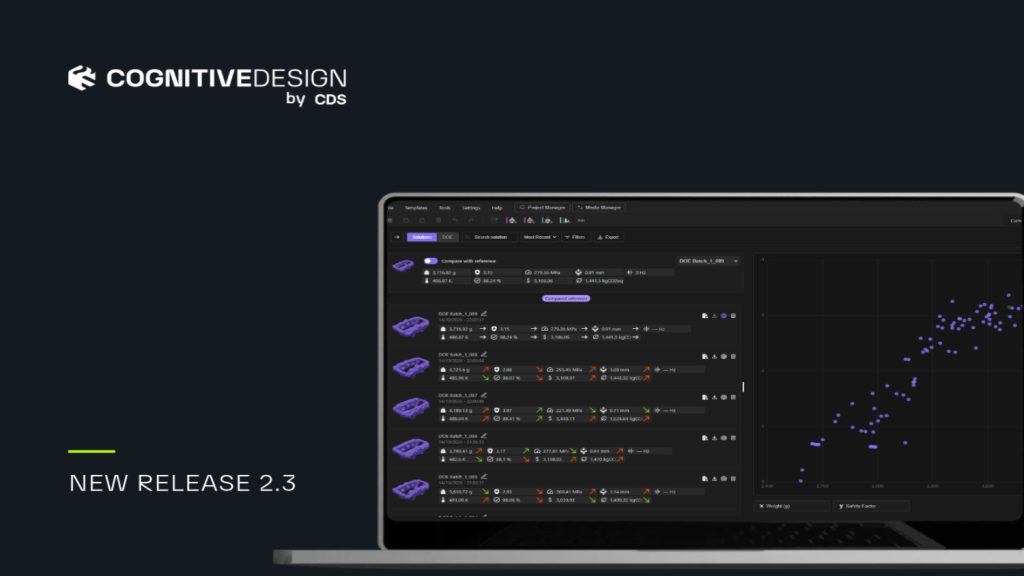
Cognitive Design 2.3 lets engineers define the design parameters and ranges; the software then automatically conducts the parametric sweep within these engineer-defined limits, generating each design variant and evaluating it against structural, manufacturing, cost, and CO2 criteria.
All variants are consolidated in Design Explorer, the platform’s decision-support environment, where designers can compare trade-offs, filter candidates against requirements, and justify the selected concept with full traceability.
Cognitive Design 2.3 hopes to offer engineering organisations the ability to make earlier and better-informed design decisions, reducing the need for late-stage redesigns and repetitive modelling tasks.
2.3 marks a step in CDS’s focus on integrating its software at the earliest stage of the engineering cycle.
CDS has published a white paper entitled “Design of Experiments at the Concept Stage”, which examines why concept decisions are locked early while exploration remains narrow, explains how concept-stage DoE differs from traditional CAD DoE, and sets out a seven-step method leading to a traceable concept selection, supported by field evidence.