
Luminary launches Shift-Crash, the first physics AI model for capturing crash dynamics across an entire vehicle.
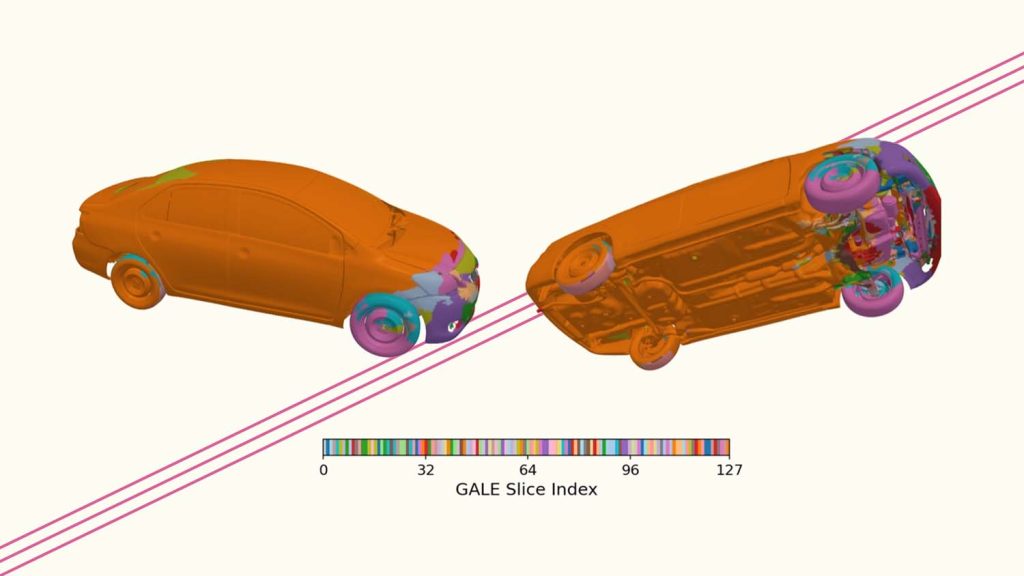
Built on a dataset of 5,000 crash simulations based on the 2010 Toyota Yaris, Shift-Crash can predict full-vehicle crash response, including deformation and stress fields, reportedly in seconds instead of hours.
Unlike traditional FEA crash test simulation, which must be run from scratch for every new design variant, Luminary explain that Shift-Crash is a reusable AI model that retains and improves on crash physics knowledge across vehicle programs.
Where a single NHTSA NCAP 56 km/hr full-vehicle frontal crash simulation typically takes 10 to 12 hours on HPC clusters – and no inherent memory, with every program starting from zero with a new mesh and solver run – detailed crashworthiness analysis typically occurs late in development, when design changes are minimal and far more expensive to implement.
Shift-Crash uses transfer learning to carry crash physics knowledge forward from one vehicle program to the next, and across vehicle classes. As the model is applied to additional programs, it continuously builds on what it has already learned about structural crash behaviour.
With the automotive industry is increasingly adopting virtual validation as part of the crashworthiness development process, the goal is straightforward: OEMs that can screen designs against NHTSA NCAP, Euro NCAP 2026, and IIHS protocols in seconds rather than days can lock designs earlier and move vehicles into production sooner.
Luminary state that the predictions demonstrate less than three per cent Root Mean Square Error (RMSE), giving engineers the confidence to perform downstream safety analysis and derive key crash metrics.
“Crash analysis today is a very expensive and time consuming computational mechanics problem. With Shift-Crash, we offer crash engineers the ability to explore richer design spaces than ever before, compress time to solution and drastically reduce costs,” said Luminary CPO Suds Menon. “With a Physics AI Crash model, each new vehicle design program reduces the number of simulations required, makes the model smarter, and delivers higher accuracy results in a fraction of time, compressing design cycles.”