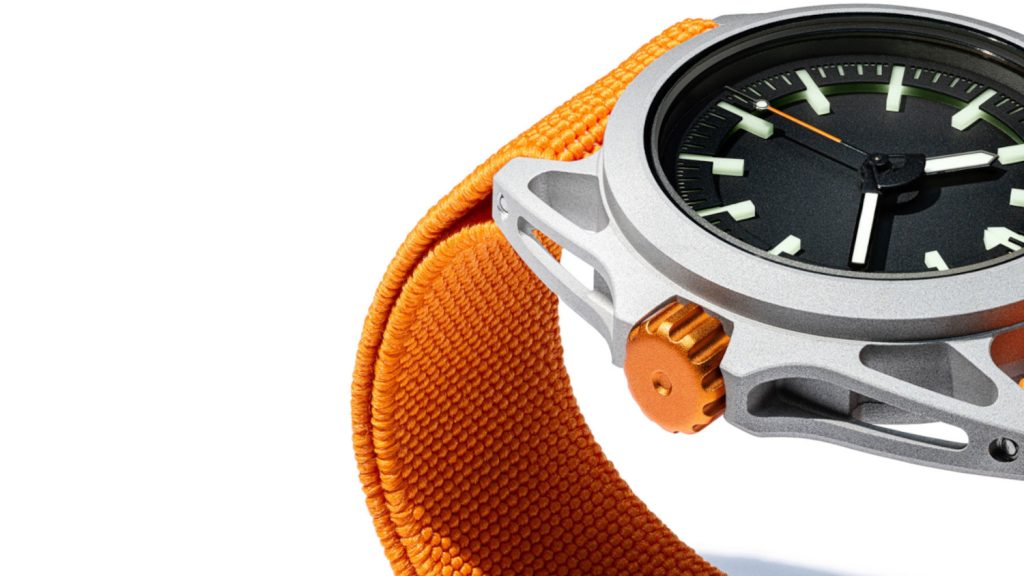

Equipment sent into space is typically purpose-built using cutting-edge methods. The same rule applies to Barrelhand’s Monolith watch, designed to keep operating thousands of miles from Earth and created using technologies not typically associated with legacy watchmaking, as Stephen Holmes reports
Even in space, accurate timekeeping is essential. That creates challenges as humans are increasingly sent to explore new areas of the galaxy, where liquid crystal displays and quartz batteries are no match for the harsh environments to be found there.
For that reason, the traditional manual-winding, mechanical watch is the timekeeping device of choice for astronauts, and the Omega Speedmaster remains the leader of the pack.
First qualified in 1965, the Speedmaster is still the only timepiece flight-qualified by NASA for extravehicular activity (EVA), enabling it to be worn for work outside of a spacecraft. But in fact, the Speedmaster was originally designed for racing cars that should – in theory – stay firmly earth-bound, not for traversing the galaxy.
The creators of Barrelhand Monolith hope to unseat this rival and disrupt the wider world of horology by incorporating technologies far more advanced than most watchmakers have even contemplated.
One small step
The team at Barrelhand started work with a study of current timekeeping systems in use in space, and their relative strengths and weaknesses, “as highlighted in decades of NASA white papers,” explains Karel Bachand, the company’s co-founder and lead mechanical engineer.
Considerations such as temperature, radiation and the effects of full vacuum and microgravity conditions were all taken into account, along with existing protocols followed inside various space vehicles. For example, care must be taken to eliminate off-gassing from a watch, or glass fragmentation should its face receive a knock or blow.
In the end, it took around six years and 24 iterations for Barrelhand to develop its Monolith watch, with designers and engineers pouring over details and prototyping every feature in order to arrive at the final production version. Along the way, they were able to push back the boundaries of watchmaking technology, a feat that their peers at more traditional companies might struggle to pull off.
In his previous role at 3D printing company Formlabs, Barrelhand co-founder and strategy lead Michael Sorkin saw that most watch companies were using 3D printing simply to prototype watch cases. No one company was yet tapping into the full potential of additive manufacturing.
But his attention was caught by a request from a student looking to get more from 3D printing and use it to build watches and end-use watch components. This request came from Karel Bachand, who while still at college managed to reverse-engineer a highly complex Urwerk UR-202 watch and then 3D print a working model of it.
As Bachand recalls, the project opened his eyes to the incredible engineering packed into the small form factor represented by a wristwatch. “Additionally, it also highlighted the profound impact 3D printing would have, allowing someone to essentially recreate one of the most complex mechanical watches on the market of the time on a college student budget,” he says. “This would become transformative for prototyping micromechanics, which traditionally has been exorbitantly expensive.”
Bachand’s work continued, and increasingly focused on both horology and space exploration, with a research project at NASA Ames to develop a 3D clinostat capable of simulating microgravity on plant cells, as well as Project One, an initiative to build the world’s first production model watch with an entirely 3D printed movement bridge.
Michael Sorkin was so impressed with Bachand’s work, which demonstrated what even a non-professional watchmaker could achieve using digital design and fabrication technologies, that he would eventually leave Formlabs and join Bachand in founding Barrelhand in 2018.
Deep dive
While most watch start-ups begin by targeting aesthetics or reshaping what already exists, Barrelhand’s first mission was to identify a watch application that presented the biggest challenges. A dive watch wasn’t the answer, says Sorkin, because it wasn’t sufficiently complex. But a space watch comes with an almost unlimited catalogue of performance metrics that need to be hit just for the device to survive, let alone function well. “We found space, because it gave us the harshest performance metrics that no one had really tackled before,” he says.
The idea was not simply to design a wristwatch for someone going up into space and coming back down again – already a test – but also to create a complex mechanical product that could be serviced and upgraded remotely without a watchmaker present, says Sorkin. After all, no one is likely to send a watch back from Mars to be fixed, so any design needs to think ahead.
In the early stages of development, the team at Barrelhand was speaking to traditional watch part manufacturers in their efforts to identify components and technologies that would fulfil their requirements, but this proved a political nightmare. Dependence on the watchmaking industry’s giants, formed over decades, means that any innovation by suppliers must be filtered through key customers first.
In short, these firms were not to risk their valuable commercial connections with prestigious Swiss and Asian watchmakers just to provide a handful of parts to an unknown start-up.
Back to Earth
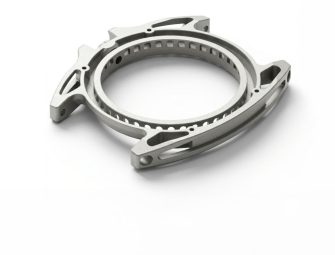
The Barrelhand team realised that the only path forward might be to look outside of watchmaking and turn instead to suppliers already dealing with spacecraft. With no casemakers to rely on, they made the decision to manufacture their own cases with no compromise on materials. Both aluminium and titanium have issues when exposed to the conditions found on board a spacecraft, so Scalmalloy was chosen instead.
This high performance, scandium-modified, aluminium/ magnesium alloy was designed for additive manufacturing by Airbus spin-off APWorks and it proved the perfect choice for Barrelhand.
All the core components and sub systems of the Barrelhand Monolith were designed or modified in CAD using Dassault Systèmes Solidworks and Autodesk Fusion360. FDM and SLA prototypes were created to quickly iterate on the performance and functionality of its case, with the goal being to complete as much of the raw design process using basic polymer prints, in order to check component fit and to physically test concepts, says Karel.
Only once the design had been sufficiently refined were parts printed in the final materials. Out of those 24 prototype iterations, only six were created in full metal.
“This watch was always about functionality not cosmetics, so visually, there wasn’t a guiding principle for how we wanted it to look,” says Bachand. “The core model became a platform to sculpt from, adding new features and optimising.”
With the case designed for 3D printing, the team could then create an ‘air core’ – hollow pockets in non-critical areas that reduce the overall weight of the watch to a mere 31g. The air core also adds insulation that protects the watch movement from extreme temperature and pressure variations.
The Scalmalloy parts were outsourced for metal 3D printing by Materialise before being machined to exacting tolerances.
“Although our value isn’t derived from the usual luxury or hand-finished proposition, the product should still meet high expectations for a finished item,” Bachand explains. “Once the mechanical logistics of the chassis were ironed out, Materialise put significant effort into the final finishes and the results far exceeded even my own expectations.”
An item like a watch tends to come under some intense scrutiny from the wearer, as well as other would-be buyers, so every detail counts. “This was also one of the early implementations of anodising Scalmalloy, so achieving an even coverage for this novel material required extensive prototyping to perfect,” says Bachand.
Untethered production
In this way, suppliers keen to push their technologies to their limits quickly found themselves in unfamiliar but intriguing territory, becoming luxury goods manufacturers, says Sorkin. “Materialise became a watch case manufacturer, you could say, which is unheard of!” he laughs.
Other suppliers, often recommended by space infrastructure specialists and without existing contracts with other watch manufacturers, also got involved in helping Barrelhand to create a timepiece that is technologically ahead of anything else on the market.
The glass of the Monolith had to be shatter-resistant and possess antiglare properties so that wearers didn’t get blinded during extravehicular work. Instead of crystals that wouldn’t work at the temperatures involved in space exploration, the Barrelhand team instead used C-plane sapphire, a material known for its extreme hardness and used in scientific microscopes, with a magnesium fluoride coating to reduce glare.
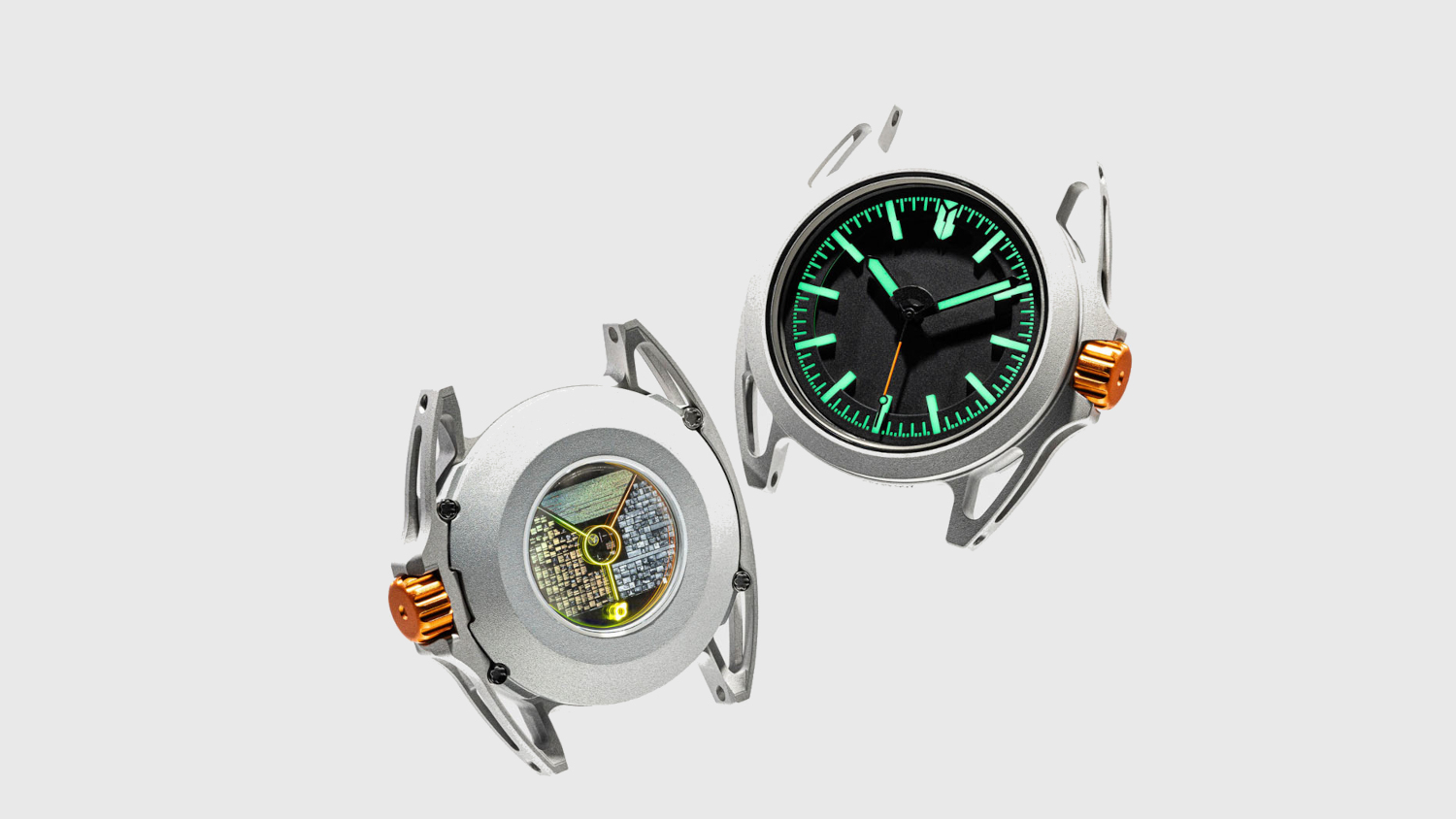
The dial needed to be particularly bright – more so than any other product on the market – in order to enable astronauts to tell the time even when wearing a helmet visor. Here, Barrelhand turned to Swiss materials specialist RC Tritec to help develop a monolithically created fluorescent ceramic block (hence the watch name) over which a filter sits. This allows light to shine through, but UV rays hitting the face are absorbed across a wider body, extending the life of the phosphoric glow dramatically.
The screws used in the Monolith’s construction are all standardised Torx screws, of the same kind as those already used onboard the International Space Station, so that astronauts are already equipped with tools and replacement screws if needed.
A Sellita SW300-1b base movement, described by Sorkin as a “workhorse” that has already been produced millions of times, provides the watch’s beating heart. It has received proprietary modifications to ensure it still works in temperatures ranging from -120°C to 120°C while in a vacuum.
A final touch is provided by the Memory Disc, a nickel disc 19mm in diameter, which sits on the back of the case. Nanolaserengraved, this can store some 3GB of data. Barrelhand worked with UNESCO to decide what type of data should be included, providing the wearer with an anchor to home and, potentially, enabling other life forms to get an overall picture of our civilisation, should they happen across a Barrelhand Monolith on their own travels.
This disc adds to the functionality of the Monolith, making a modern-day Rosetta Stone of a design that is not simply another timepiece, but instead, a tool for the next chapter of space exploration.
This article first appeared in DEVELOP3D Magazine
DEVELOP3D is a publication dedicated to product design + development, from concept to manufacture and the technologies behind it all.
To receive the physical publication or digital issue free, as well as exclusive news and offers, subscribe to DEVELOP3D Magazine here