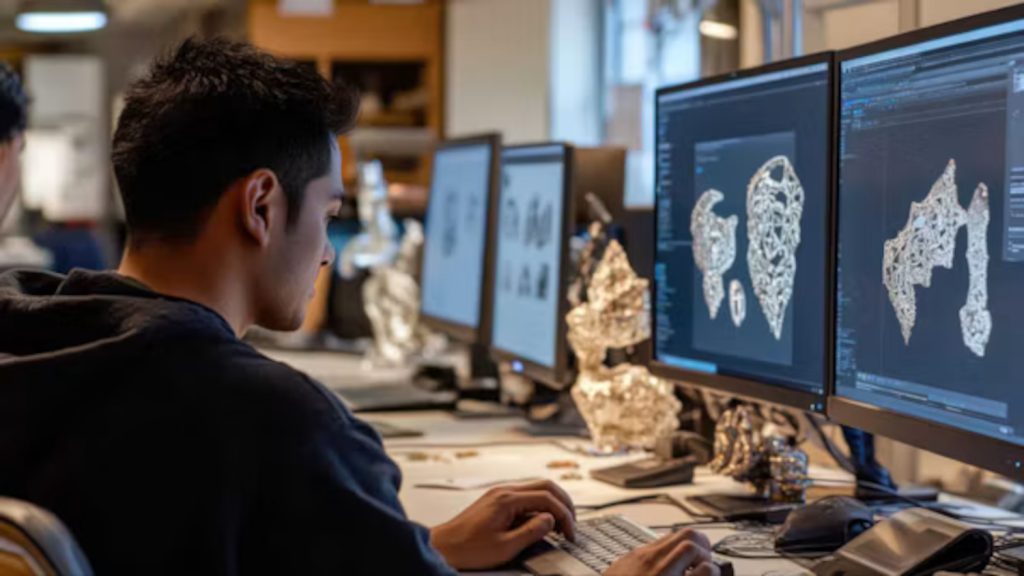

AI is generating a lot of buzz in product design, but not all of it is helpful, writes Nathan Partington of design agency npd. AI never calls out a client’s bad idea, but it’s certainly responsible for a bunch of unrealistic expectations
I sat at my desk a few weeks ago, trying to figure out how an industry that I had known for 20 years had started to evolve into something completely unrecognisable. Almost every new business enquiry received from a product start-up has already been ‘designed’ by the customer, using AI. Our role, in their view, is simply to make it real.
I remember speaking with one prospective client, and suggesting that we would have charged them around £20k for the amount of conceptual work that they were displaying in front of us. But our work would likely have resulted in a better end product and simplified the development process. Importantly, their work represented money that would no longer be in our pipeline.
Yes, the money that a start-up saves makes their life easier, allowing that start-up to bootstrap a new idea. And an increased volume of potential new clients, on paper at least, looks like a steady stream of new work for design agencies.
But the reality is that this arrangement drops us into a project at a later stage, unable to guide and shape an idea. That goes against the basic principle of design for manufacture, which relies on getting the fundamentals right from the start.
Then there’s AI-calculated pricing, which often creates unrealistic expectations of what development actually costs. The irony is that money spent with a specialist early on usually saves far more money later on, in tooling, redesigns and in getting to market.
Inbound enquiries
Npd is a data-driven business, so we started to collect more information around our inbound enquiries: how they found us, why we rejected them, and what we thought the average project value might be, given the AI briefs we were receiving.
Now, with several months’ worth of data, the analysis is really interesting. The average estimated project value would be in the region of £15k, well below our target project value of £50k. We rejected almost all of them, or tried to discourage the customer from taking their idea further, because we deemed the ideas to be too weak or not in line with our company ethos.
The issue here is that AI never says no. But the truth is that AI cannot make a bad idea into a good product that people will want to buy
Rejections jumped to 89%, but the ideas weren’t validated, qualified or suitable for us. They were just white noise, a distraction. With the AI tools available now, anyone can visualise their idea, no matter how complex or crazy it might appear to be.
The issue here is that AI never says no. A frontier AI model doesn’t work a 9-5 job, get tired or get hung up on design details, CMF or user experience. It simply does what it is asked, when it is asked, without complaint.
This can prove misleading to the person with the idea, though rarely, if ever, does it challenge that person’s thinking or do anything to highlight their product’s lack of suitability in today’s market.
AI cannot make a bad idea into a good product that people will want to buy.
Encouraging signs
There are some encouraging signs though and all is not lost. We find that our regular clients are not turning to AI and requests for proposals from established companies are not formulated by agents.
In fact, there seems to be a resistance to adopt AI among those people with actual experience of what it takes to build a physical product and successfully bring it to market.
I’ve spoken with several senior design managers whilst I’ve been on my fact finding mission, and so far, they tell me they have not been allowed to bring AI into their companies. In most cases, this is due to worries around IP ownership and adherence to cybersecurity legislation. For most of them, adoption will be slow and limited, it seems.
As for us, we haven’t stopped using Onshape, our preferred CAD software. We still use Keyshot to visualise our ideas and, in that regard, our process hasn’t really changed.
Problems are still solved around the whiteboard and through discussion and observation with real people, with genuine experience of the real world of product development.
We do, however, try to automate some of our admin tasks around project planning, note-taking, data analysis and reporting. Yet the concept work that we show to clients is created by us, not by AI.
Frontier models are yet to understand user experience, ergonomics, that ‘new product’ smell and the emotional response we have as humans when we use a product for the first time. These are uniquely human aspects associated with products and I can’t see how a computer would ever be able to replicate them.
As designers and engineers, our roles need to evolve to focus on what makes us human. In my view, it’s OK to use AI to make that role more efficient, but not to lead it.
Given the pace of progress with AI, I’m well aware that this article may not age well – but at least I wrote it myself.
About the author:
Nathan Partington is Founder and CEO of npd Studio, a product design and engineering consultancy based in Lancashire that works across a wide range of industry sectors.
He has spent two decades in product design and started npd in 2014 with one rule: only work on products that deserve to exist.
This article first appeared in DEVELOP3D Magazine
DEVELOP3D is a publication dedicated to product design + development, from concept to manufacture and the technologies behind it all.
To receive the physical publication or digital issue free, as well as exclusive news and offers, subscribe to DEVELOP3D Magazine here