
Software specialists have dominated the AM realm since its inception, but now Siemens is bringing its considerable manufacturing know-how to increase its own platform’s impact on end-to-end processes, reports Stephen Holmes
Away from the noise and chatter of Siemens Digital Industries Software’s grand Realize Live user event, I’m invited to a small, quiet room to talk about the most understated weapon in the company’s manufacturing arsenal.
Siemens has always looked to narrow the gap between what is built on screen and how it is manufactured in reality. From Solid Edge’s sheet metal nous to NX’s CAM abilities, the goal is to plug directly into the veins of fabrication with underlying knowledge garnered from Siemens’ Sinumerik software running on many factory-floor machines.
Although a relative newcomer, 3D printing is a sector where Siemens is fast extending its reach. The latest updates come through Designcenter, which increasingly looks to make early decisions around using additive processes and Design for Additive Manufacturing (DfAM) as effortless as choosing any traditional process to build a part.
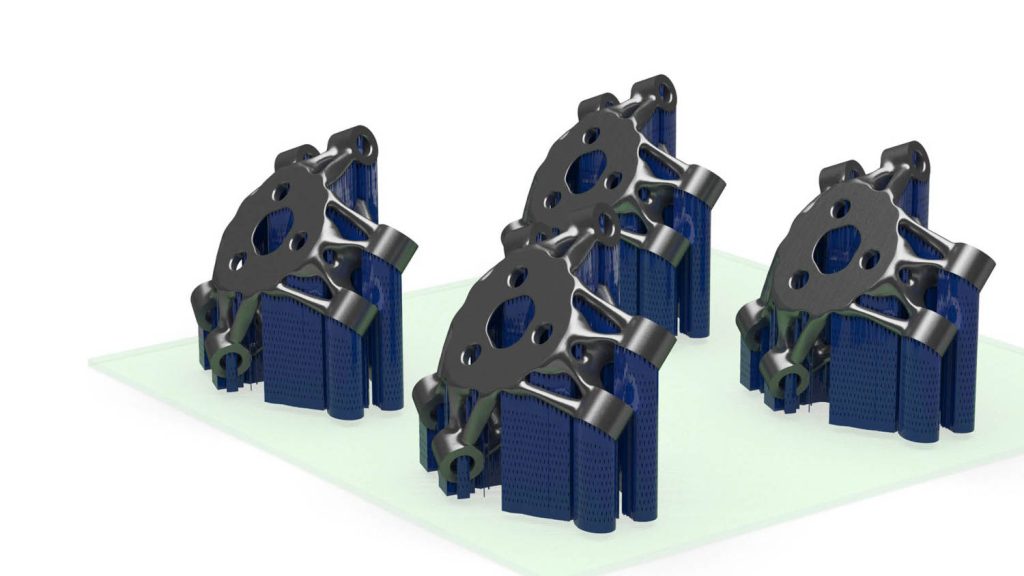
From an initial CAD design to the simulation and design validation stages, build simulation, build preparation and OEM integration, building an end-toend process flow within a single application has seen considerable development on Siemens’ part.
Existing relationships and integrations with key players have also expanded, explains Mike Vasi, the product manager for NX AM. Not only does NX AM cover all the machines and parameters for metals 3D printing from hardware vendors EOS, Trumpf, Renishaw and Nikon SLM Solutions, but it can also orchestrate the necessary post-processing work – CNC machining through NX X Manufacturing – and thus keep all work and decisions on a single platform.
Enhancing additive
Much of this effort is being enhanced by AI engineering tools specifically developed for AM. For example, the build-time prediction capability within NX eschews running a job runtime estimation in the traditional manner; namely, by sending a build job to the machine, and the machine coming back with its stock OEM -generated calculations. Instead, NX AM uses AI tools to generate a prediction for the specific job, material and machine the user chooses.
This matters in AM, where even machines costing close to six figures can produce results that differ minutely from the next machine to follow it on the production line. When dealing with micron accuracy and complex laser systems, knowing your own machine and dialling down its settings – as well as learning from every successful and failed build – is a key skill. Here, AI excels.
“Based on that information, we can apply that knowledge through the language models to get a time estimation for new setups,” explains Vasi.
“Once we have a realistic time estimation, then we can quite easily compute, for example, the energy consumption, depending on when the manufacturing process would take place, and also the cost estimation for coating purposes, so customers working as service providers can [move] very fast, starting from initial design, automatically doing the build operation and simulation, get into the time prediction and get back to quoting in terms of cost estimation within one or two minutes.”
All process steps are linked together within a digital process flow that is associative, meaning that once a design change is implemented within the NX CAD model, that change automatically propagates downstream, without the user needing to leave the environment.
A good example, Vasi explains, can be found in NX manufacturing, where AI is applied to automatically recognise the features and function of parts, meaning supports can be identified and removal can happen automatically during post-processing work. This intuitive flow into post-processing – often a quietly costly and time-consuming aspect of AM process – also extends to being able to automate drilling, milling and surface finishing. With Designcenter’s new software-as-a-service offering, all these abilities can be switched on and off at will with Siemens’ token-based approach.
Widespread appeal
It’s an interesting user proposition: a CAD platform, plus specialist additive software, plus CAM functionality, all working via the same familiar user interface. It will likely appeal to businesses where not everyone requires ‘always on’ access to DfAM, but can contribute when necessary, knowing that up-to-date production capabilities are already dialled into the system at any given time.
With a token pool available across Designcenter licences – Siemens sells these as token packages in 50-pack or 100-pack bundles as an annual floating subscription – NX AM Fixed-Plane (Basic & Advanced) would require 18 to 22 tokens, allowing users to run build prep on SLS/PBF systems among other abilities. NX AM Multi-Axis for LFAM robotic-arm systems requires 25 tokens.
Advanced Simcenter 3D AM Build Simulation can also be brought into the workflow. This requires a different Simcenter license, but provides multiphysics simulation for thermal distortion, shrinkage analysis and print-failure mitigation.
For those running metals 3D printing in their workshops, the ability to scale more easily and tap into the power of cloud processing will generate further interest.
With more design and simulation features promised for 3D printing on the horizon, thanks to the ongoing integration of Siemens’ Altair acquisition, Vasi concludes that there’s a lot to come across all stages of the AM workflow.
In that small room at Realize Live, Siemens has quietly announced big changes for the additive workflow. And it looks like the established model of longrunning annual licences for solely AM software may be set for a loud wake-up call.
This article first appeared in DEVELOP3D Magazine
DEVELOP3D is a publication dedicated to product design + development, from concept to manufacture and the technologies behind it all.
To receive the physical publication or digital issue free, as well as exclusive news and offers, subscribe to DEVELOP3D Magazine here