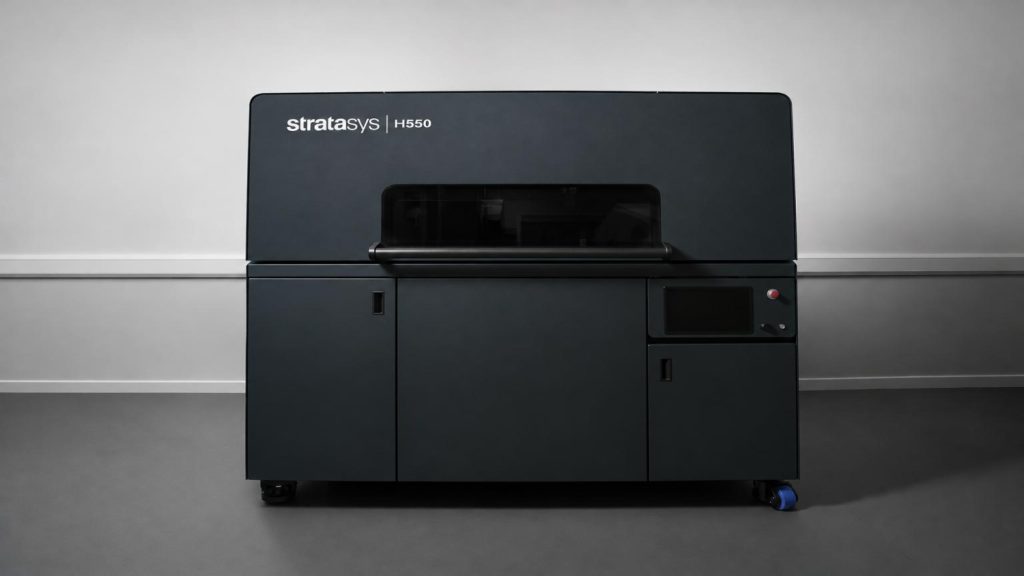

Stratasys unveils H550 and PowderEase T2 post-processing system to produce larger parts, increase batch productivity and improve the economics of final parts production
Developed to address manufacturers requiring more complex capabilities to scale operations for industrial powder bed fusion applications, the Stratasys H550 features a 34.2-litre build volume and a 450 mm long axis, 20% longer than the leading comparable print-and-fuse system.
For manufacturers scaling 3D printing, the H550 is designed to deliver up to 30% lower total cost of ownership when compared to other print-and-fuse systems, while providing faster time to part than comparable SLS systems.
“Manufacturers choosing a production system are making decisions that will shape their operations for years. Before committing to their next powder bed fusion investment, they should see what the H550 can do,” said Stratasys chief business unit officer Rich Garrity.
“It brings greater capacity, larger parts and more attractive production economics designed to scale, so more applications can move onto the factory floor,” added Garrity.
Also new is the PowderEase T2 post-processing system, offering an automated powder handling workflow for the H550.
The PowderEase T2 system automates breakout, powder retrieval, sieving and dosing and is designed to support up to six H550 systems from a single station when using the same material.
“Longer parts than other print-and-fuse systems, faster than SLS, and at a lower total cost of ownership. With the H550, SAF is designed to give manufacturers a production system that provides the best available combination of part size, throughput and economics,” said Stratasys VP of SAF Neil Hopkinson.
The production workflow requires under 30 minutes of total operator time per build.
The H550 aims to complement the Stratasys H350 printer by extending the SAF technology into applications with double the build capacity and the ability to produce bigger individual parts, giving manufacturers a choice of systems based on their application, production volume and manufacturing requirements.
It addresses customer needs where throughput, repeatability and cost per part are critical, and the system’s reduced infrastructure requirements and smaller production footprint simplify installation on the factory floor.