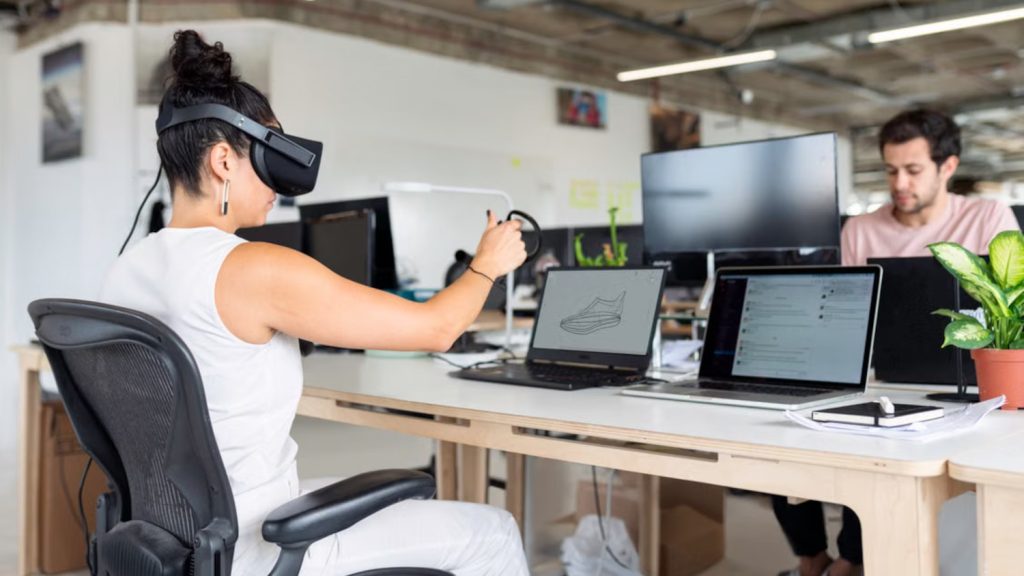

Spatial computing is about much more than VR headsets. As the technology matures, designers and engineers must remain open to new ways of working in order to see its benefits, writes Oluwaseyi Sosanya of Gravity Sketch
The biggest challenge facing virtual reality (VR) and spatial computing isn’t the technology itself. It’s human behaviour.
Every major computing platform out there was built on habits that already existed. Landlines became mobile phones, and mobile phones became smartphones. Desktop computers became laptops. Each step asked us to change our habits and behaviour only a little.
Spatial computing is different. There is no existing behaviour for it to inherit. Putting on a head-mounted display (HMD) does not build on an action we already perform every day. Instead, it asks us to replace our vision with digital information and to interact with computing in an entirely new way. This is a much higher bar and it is why adoption will take longer than the market might like.
The challenge is also one of perception. When a new technology enters the market via consumer entertainment, its arrival in the workplace is met with friction. Big Tech hasn’t built enterprise trust and it’s left to independent developers to build the confidence of business decision-makers. Like every major computing shift that came before it, the transition to spatial computing will happen gradually, one workflow at a time.
Not just a headset
VR has a branding problem. For many, it has become synonymous with a headset. That makes it difficult to separate the technology from the device delivering it – but we must achieve that separation to understand where this technology is heading.
The future is not the headset. It is spatial computing – the ability to experience and interact with digital information in three dimensions in a more human way, much like we experience the physical world. This technology will continue to evolve, and the form that today’s HMDs take is unlikely to represent the final form.
We have been pursuing this idea of presenting an independent image to each eye since the invention of the stereoscope in the nineteenth century, because humans naturally perceive the world with both eyes in three dimensions.
This is more than displaying digital content; it is about giving people a more natural way to communicate ideas with shape, volume and scale. For those of us who are designing, engineering and building the physical world, this is a transformative shift, not simply another display technology.
When judging VR’s progress, it’s important to recognise that the consumer first approach accelerated hardware development and reduced device costs, making the technology accessible earlier than would otherwise have been possible.
It is fair to say that the technology has not been given the same time that previous technologies have had to establish clear use cases and to mature into enterprise adoption. That transition is now happening, but more slowly than the market anticipated. The technology is still discovering where it creates the most meaningful value – and it’s not on the consumer side.
Success stories
The past decade has seen enterprises quietly unlocking value from spatial computing through everyday use.
Ford has reportedly reduced interior design times from months to around 20 hours, potentially saving $33.5 million per vehicle in development costs.
Lockheed Martin has achieved a tenfold return on its investment, avoiding $10 million in potential costs in a single year through virtual product development.
Rocket manufacturers are using VR regularly to evaluate designs and identify problems far ahead of production.
Similar stories can be found across aerospace, robotics, and medical, where teams are using immersive environments to evaluate products, review patient data and identify issues long before they become expensive to fix.
Their investments created hardware that enables entirely new ways of working, even if early successes do not generate the desired headlines.
By evaluating the success of VR through the lens of breakthrough workflow innovation, the conclusion is completely different.
The technology already provides measurable return on investment, solving real problems, improving decision-making and enabling workflows that simply aren’t possible using a flat screen.
However, we need to recognise that introducing a new way of working is never instantaneous; it takes time for people, workflows and organisations to adapt.
Building tomorrow with yesterday’s tools limits the pace at which we can innovate and those willing to challenge the status quo and explore these new workflows today will be best-positioned as the technology matures.
In short, success will not come from headset sales. It will come from making spatial computing genuinely useful and creating experiences that change the entire trajectory of the market.
About the author:
Oluwaseyi Sosanya is the CEO of Gravity Sketch, a London-based start-up building a 3D design and collaboration platform.
His goal is to make emerging technologies more accessible to the wider creative audience by building tools that lower barriers to entry and focus on the human experience.
is article first appeared in DEVELOP3D Magazine
DEVELOP3D is a publication dedicated to product design + development, from concept to manufacture and the technologies behind it all.
To receive the physical publication or digital issue free, as well as exclusive news and offers, subscribe to DEVELOP3D Magazine here