
From a DIY duck house project to a provider of luxury outdoor accommodation, Gabrielle Brown learns how Armadilla aims to give glamping a sustainable upgrade
When Ross Hunter and his father Archie left over building materials fifteen years ago, no one could have predicted where that one-off project would lead thefather-and-son team.
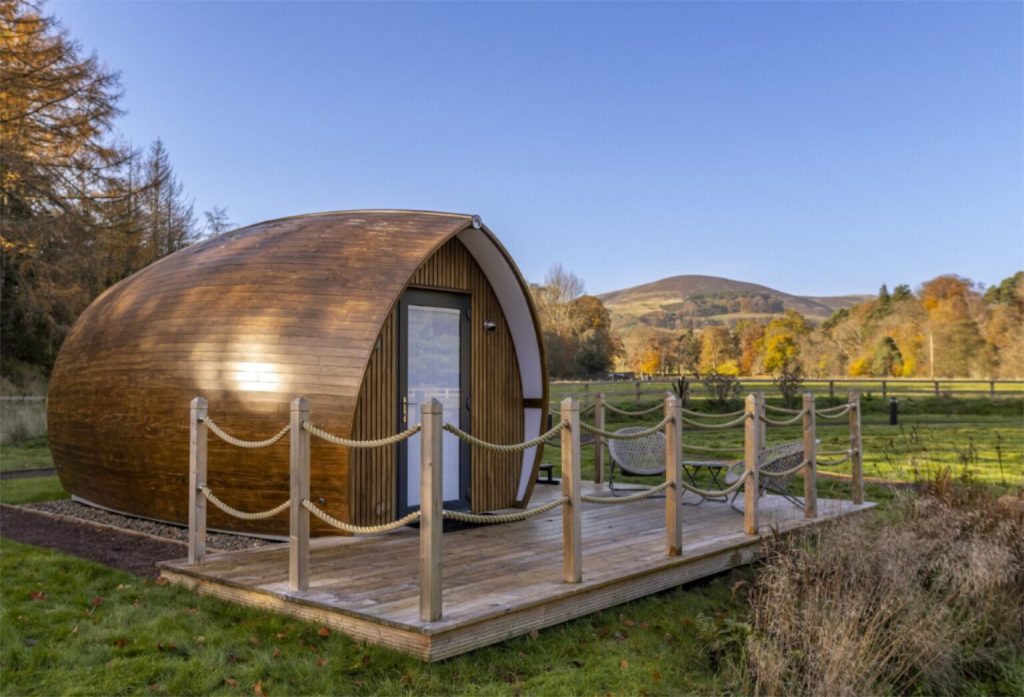
Friends and neighbours, who fell in love with the duck house’s unique arch shape and stylised design, began asking Ross and Archie to create larger versions for sheds and outdoor shelters. This enthusiasm swiftly led to the establishment of Armadilla, a designer of luxury modular units for the hospitality industry, focused in particular on providers of outdoor experiences.
Based in Midlothian, Scotland, Armadillo now offers three flagship models: the Pod, the Wave, and the Kurv. Each unit is outfitted with full en-suite facilities, smart technology, furniture and controllable ventilation. These modular living spaces can be customised, too, making them suitable for a wide range of purposes, from accommodating wedding guests in Northumberland to hosting yogis at wellness retreats in Portugal.
Ready to go
Each unit leaves the Armadilla factory almost complete and flat-packed. Installation requires only a few days. “Throw in a coffee maker and some bedsheets, and you’re ready to go,” says Ross Hunter.
But it is also built to last, with sustainability at the heart of every Armadilla design, he adds: “I don’t believe in greenwashing, and our goal is to make the units last at least 50 years.”
With that in mind, material choices are driven by longevity and performance, and include acetylated timber that lasts for decades, high- performance insulation and nearly airtight construction.
Each pod’s mechanical heat and recovery ventilation system recovers about 80% of the heat or cooling produced by its air-source heat pumps. These allow guests to set a comfortable internal temperature in their pod, even when external temperatures soar or plummet. Each unit is fitted with energy-efficient LED lights and A-rated appliances.
To design the pods, the Armadilla team initially used SketchUp, but as the business grew, the team found it needed software to cope with more complex designs offering more detail. SketchUp proved too “cumbersome”, says Hunter, adding: “We were waiting ten minutes just for it to save a design.”
That meant that an action as simple as moving a hole could trigger hours of rework across multiple design files and CAM workflows. On one occasion, Hunter recalls, he was installing a glass door in a unit’s bathroom, went to close it and realised its path was obstructed by the sink. That was when he knew, he says, that the company needed to upgrade its design technology.
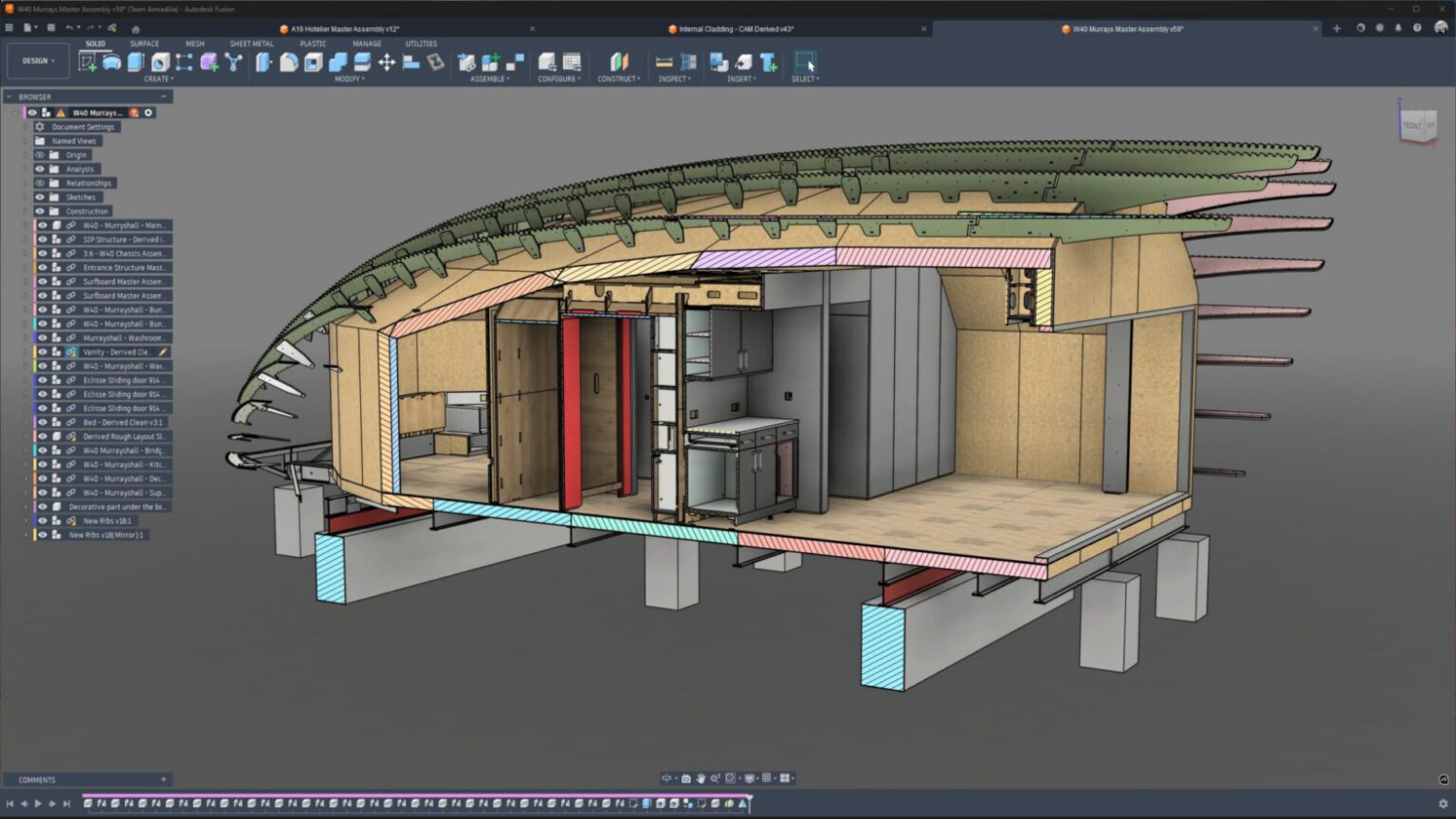
He soon began watching YouTube videos that taught him how to design in Autodesk Fusion. “I just love the way everything is integrated from CAD to CAM with Fusion,” he says. “You make a change in the design and it follows right through to the CAM.”
Switching Software
The switch at Armadilla from SketchUp to Autodesk Fusion cut project timelines from six to eight months down to six to eight weeks and reduced design cycles by about 80%.
When it comes to nesting and material usage, Fusion’s Manufacturing Extension plays a critical role. Previously, parts were nested unit by unit. Now, Armadilla nests entire projects together.
“With the Manufacturing Extension, we can save ourselves – in some cases – 28 sheets of material. Each one of those sheets costs about £50, so it adds up,” says Hunter.
The company also saves up to £1,400 per project in materials, keeping sustainability at the forefront by minimising waste. “It’s part of our lean principles. We want to minimise waste. The offcuts are nested, and everything is numbered, so we can sort it efficiently once it comes out,” Hunter explains.
Integrated with the company’s multiple 3-axis and 5-axis CNC machines, Fusion enables Armadilla to move seamlessly from design to production while keeping all data in a single platform.
What was once a father-and-son DIY duck house has become something that takes the glamping experience to the next level. The pods are luxurious, the interiors are inviting and the beds are lavish – a far cry from rollmats, communal toilet blocks and hopes and prayers for clement weather.
This article first appeared in DEVELOP3D Magazine
DEVELOP3D is a publication dedicated to product design + development, from concept to manufacture and the technologies behind it all.
To receive the physical publication or digital issue free, as well as exclusive news and offers, subscribe to DEVELOP3D Magazine here