

Comsol now boasts greater simulation solver performance thanks to Nvidia GPU connectivity in its Multiphysics version 6.4 release, which introduces Nvidia CUDA direct sparse solver and Nvidia cuDSS, for Nvidia AI infrastructure.
Multiphysics v6.4 also extends multi-GPU capabilities for acoustics simulations, with the release marking a major step forward in Comsols work to improve solver performance and scalability.
cuDSS, a GPU-accelerated sparse direct solver optimized for hybrid CPU–GPU computation, supports all recent Nvidia GPU architectures. Depending on the hardware and model characteristics, cuDSS can provide substantial speedups compared to CPU-based direct solvers.
GPU acceleration is beneficial for both single-physics and multiphysics simulations, particularly in cases where solver robustness is important. In benchmarks, Comsol says that some multiphysics simulations have achieved speed increases of of five-times or greater.
“The integration of cuDSS into Comsol Multiphysics marks a critical step in bringing accelerated computing to the heart of engineering simulation,” said Tim Costa, general manager of industrial engineering at Nvidia. “Engineers can now explore larger design space with greater fidelity, reshaping how industries design, validate, and optimise the products that power our world.”
Additionally, Nvidia CUDA-X cuBLAS library is accelerating the GPU formulation for transient pressure acoustics simulations which can now be run on multiple GPUs on the same machine, or even on a GPU cluster. Comsol explains that these improvements reduce computation time significantly for larger models.
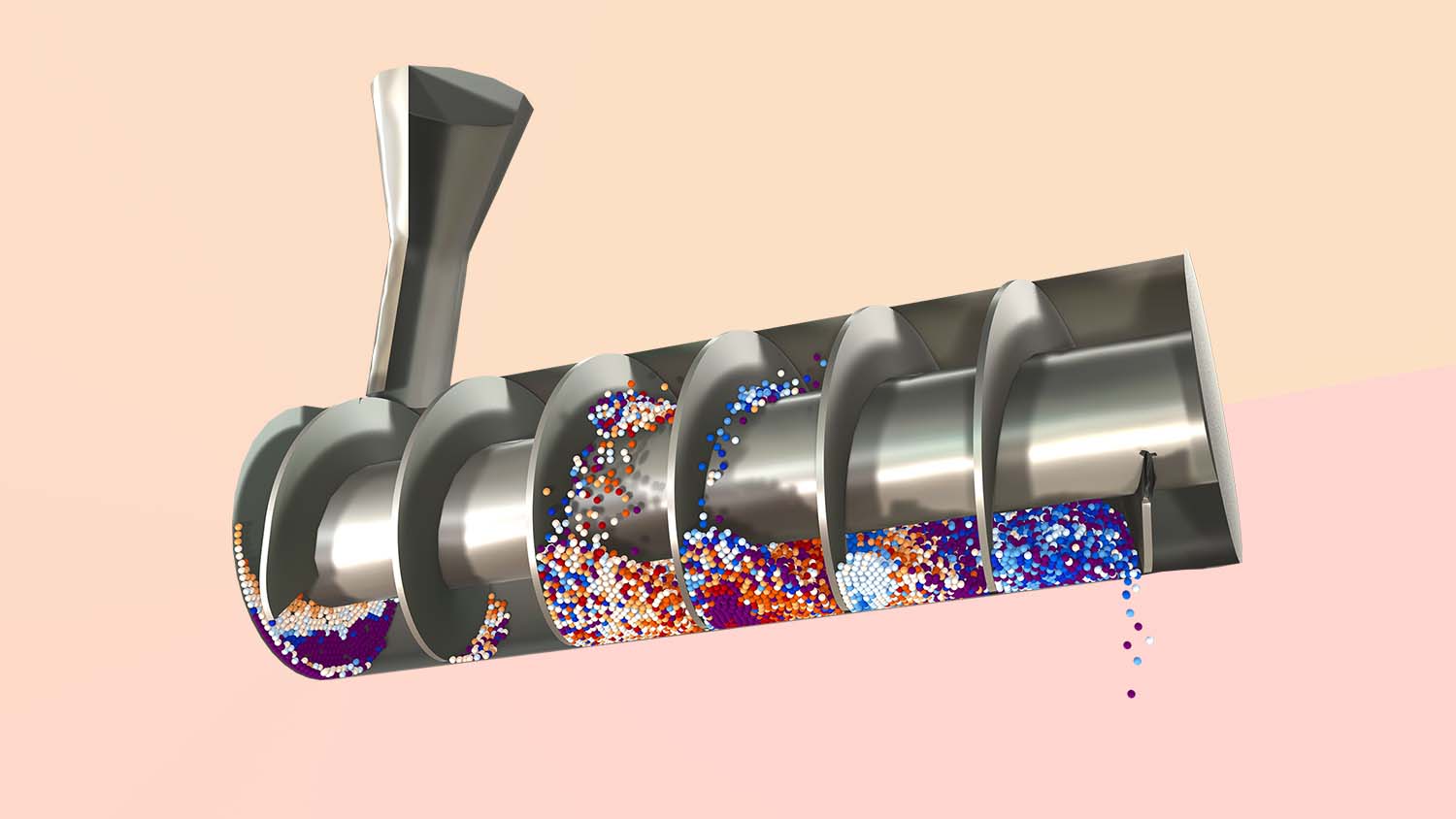
A new Granular Flow Module add-on product based on Discrete Element Modelling (DEM) has also been added to v6.4, allowing users to model granular processes such as hopper discharge, silo storage, chute transport, powder spreading and mixing.
By capturing particle-scale effects such as collisions, adhesion and rotational resistance, and providing detailed control over grain properties, release conditions and wall interactions, the module helps users evaluate flow uniformity, packing density, mixing efficiency, and wall stresses — revealing issues like blockages or uneven flow to support better process design and optimisation.
In addition, geometry, meshing and visualisation workflows in Comsol Multiphysics have been enhanced via optional large language model (LLM)-assisted simulation. The Chatbot window now supports connections to GPT-5, DeepSeek, Google Gemini, Anthropic Claude, and other OpenAI API-compatible models, enabling interactive, model-aware assistance that combines Comsol documentation with information from the active simulation.
Version 6.4 also introduces a new framework for time-explicit dynamic analysis, enabling efficient simulation of fast, transient and highly nonlinear events such as impact, crushing, and elastic wave propagation. The explicit formulation supports a wide range of nonlinear structural materials, including hyperelastic, plastic, viscoplastic, and creep models, and can also be combined with dynamic fracture simulations.
To streamline model setup for complex mechanical assemblies, new functionality automatically detects and defines contact conditions between interacting parts.
“Our goal with every release of Comsol Multiphysics is to enhance the user experience and make it easier to achieve faster, more accurate modeling and simulation results,” said Bjorn Sjodin, SVP of product management at Comsol. “With added support for GPU-based solvers, the new Granular Flow Module, and explicit structural dynamics capabilities, we’re looking forward to seeing how users apply the platform to improve product designs and innovate. I’m particularly excited to see how GPU acceleration will speed up compiled simulation apps.”