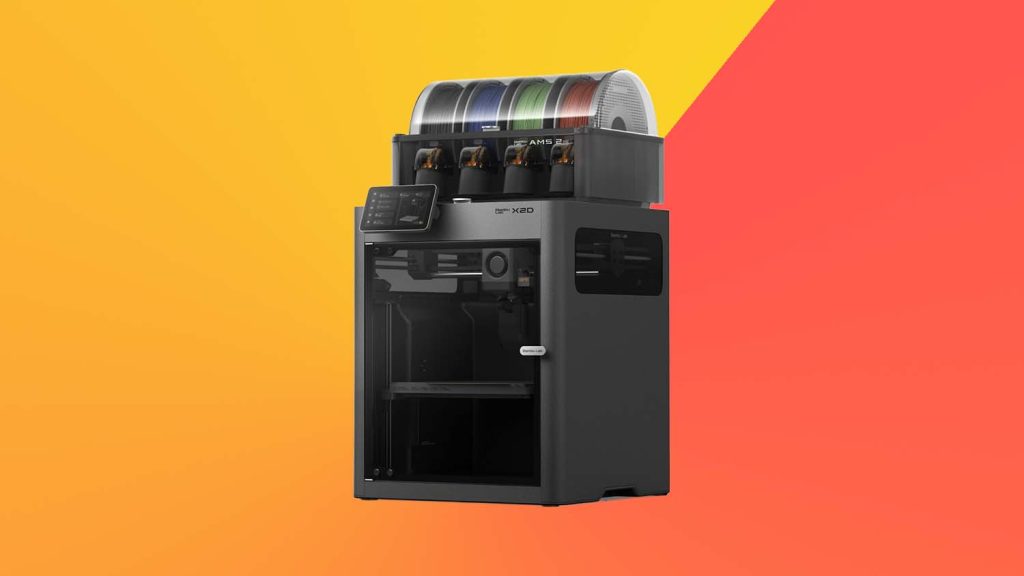

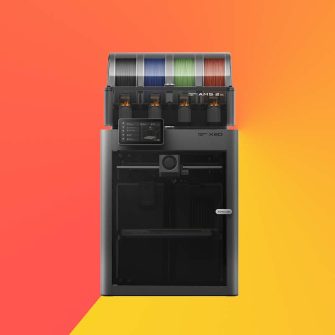
The Bambu Lab X2D 3D printer has been launched, succeeding the Bambu Lab X1 series launched in 2022 with a range of updates that include a mechanical nozzle-switching system, AI algorithms from the H series and intelligent chamber thermal management.
 The FDM filament-printing X2D has a dual extrusion system that allows for mechanical nozzle switching without an additional motor in the printhead.
The left nozzle uses a direct drive setup (motor mounted directly on the toolhead, short filament path, broad material compatibility), while the right operates in a Bowden configuration, with the motor mounted at the rear of the printer, capable of feeding filament over a longer path without compromising stability. Both systems are integrated into a single printhead.
The setup allows the primary nozzle to print the part while the secondary prints support material. In durability testing, Bambu Lab says the switching mechanism completed over one million cycles without performance degradation.
The Dynamic Flow Calibration system continuously monitors the extrusion motor, hotend, nozzles and filament, compensating for deviations in real time. Calibration runs automatically before each print without user intervention.
Bambu Lab says that its proprietary PMSM servo motor samples torque and position ‘20,000 times per second’, allowing the X2D to detect filament jams before they become critical. This feature is available for the model printhead (direct extruder).
The intelligent thermal system has two modes – the first ensures fresh air circulation notably for PLA prints. Heat Mode actively heats the chamber up to 65°C, with nozzle temperatures reaching 300°C, enabling reliable printing of engineering materials such as ABS, ASA, and Nylon, reducing warping and contributing to strong layer adhesion.
With a 256 × 256 × 260 mm build chamber available to the single main nozzle (reduced to 235.5 × 256 × 256 mm for the dual-nozzle intersection) some 31 sensors monitoring filament path, thermal environment and safety. Bambu Lab says that the X2D Optional Vision Encoder allows accuracy down to 50 microns.
The X2D base model starts at $649 – and tops out at $899 for the materials station-enabled version.