CyberPowerPC

Review: CyberPowerPC Intel Core U7WS Workstation

3 0

With a thoughtful combination of hardware, this tower handles CAD, BIM, and viz tasks efficiently while staying price-conscious, writes Greg Corke


The UK arm of CyberPowerPC, a brand long associated with high performance gaming rigs, is now spreading its wings into the workstation sector. Operating under the name NXPower, the business is now 20 years old, having grown from a startup into a sizeable operation producing around 65,000 systems each year.

Unlike its US counterpart, which is heavily focused on high-volume prebuilt machines and retail channels, CyberPowerPC UK has carved out a business around custom configurations and direct customer relationships. That background makes a deeper focus on pro workstations a logical next step. Years of building high-end gaming PCs has given the team deep experience in component selection, thermals and system balance — skills that translate well to CAD, BIM and visualisation workloads.


This article is part of DEVELOP3D’s 2026 Workstation Special report

➡️ Subscribe here


Sleek, professional aesthetic

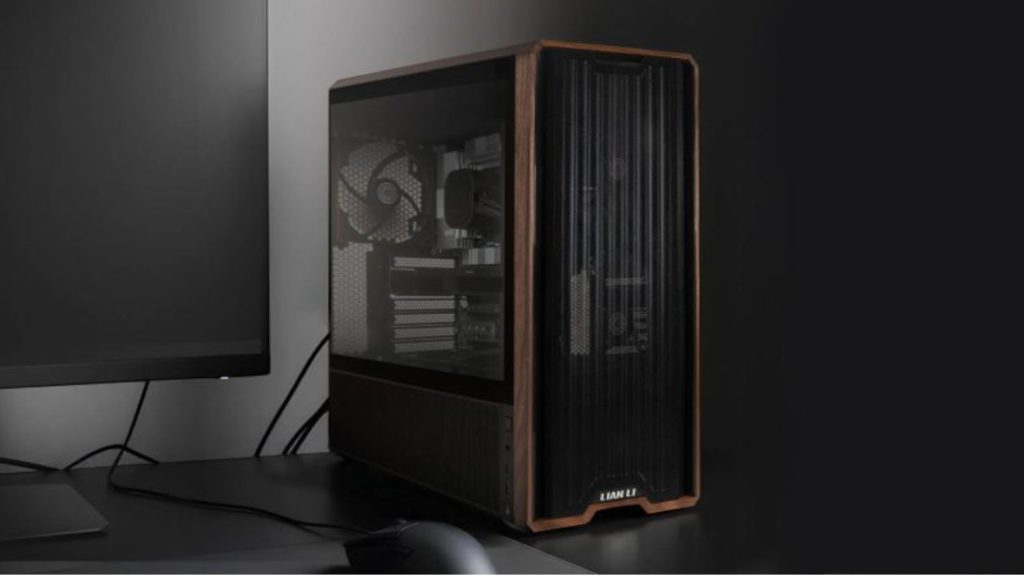
For its AEC debut, CyberPowerPC has deliberately taken one step away from its gaming roots. The familiar glow of neon fans gives way to “dark walnut” accents on the Lian Li Lancool 217 chassis, creating an understated, professional look. The detailing strips are flush-fitted, giving the system a subtle, crafted feel rather than a token eco statement. However, CyberPowerPC can’t quite let go of its gaming DNA, with RGB-lit memory modules visible through the glass side panel — though, according to the company, this is down to availability (see here). Under normal circumstances, the modules would be black. Overall, it’s a well-judged enclosure that suits an office or studio without drifting into blandness.

Well-balanced components

Our review system is clearly aimed at the volume end of the workstation market, targeting CAD, BIM and entry-level visualisation workflows. At its heart is Intel’s Core Ultra 7 265KF processor, paired with PNY’s Nvidia RTX Pro 2000 Blackwell GPU. It’s a refreshingly realistic configuration. The temptation for system builders is often to spec the very top-end processors in review machines, but that doesn’t necessarily reflect what design and engineering professionals actually buy — or need.

In practice, the Core Ultra 7 265KF delivers very similar performance to Intel’s flagship Core Ultra 9 285KF in most modelling workflows, despite costing around 60% less. It runs at slightly lower boost clocks (up to 5.5GHz) and has fewer cores (8 P-cores and 12 E-cores), which means it falls behind in heavily multi-threaded workloads. In our testing, it was around 16–22% slower when rendering across V-Ray, Corona and Cinebench. However, in everyday CAD, BIM and reality modelling workflows, the difference was negligible.

Advertisement
Advertisement

Thermally, the workstation performs well. Even during extended rendering sessions lasting several hours, the CPU maintained a consistent all-core frequency of around 4.82 GHz. Thermals are handled by a Corsair Nautilus 360 RS AIO liquid cooler and a Thermal Grizzly Kryosheet (instead of standard thermal paste), which means it comfortably handles the CPU that rarely exceeds 200W, contributing to stable performance and low noise levels.

Memory is sensibly specified at 64 GB of DDR5, using two 32 GB Corsair Vengeance RGB modules running at 6,400 MHz. 64 GB is a sweet spot for most CAD, BIM and entry-level visualisation workloads without pushing costs unnecessarily high.

Storage comes in the form of a 2 TB Kingston Fury Renegade G5 Gen5 NVMe SSD, which delivers excellent sequential and random performance. For most designers and engineers, a single fast primary drive like this provides a responsive experience across OS, applications and active project data, with plenty of capacity before secondary storage becomes necessary — although should that be required there plenty of room for 2.5- inch or 3.5-inch drives.

On the graphics side, many designers now rely heavily on GPU-accelerated rendering and real-time viz tools – such as Enscape and Twinmotion for AEC and KeyShot and Solidworks Visualize for product development. In this context, the RTX Pro 2000 Blackwell (16 GB) has plenty of punch for its class, as detailed in our review here. For users who need more grunt, the system is fully configurable and can scale all the way up to an RTX 5000 Pro Blackwell (or higher with a larger PSU).


Cooling and acoustics

The Lian Li Lancool 217 chassis comes with five pre-installed fans: two large 170 mm front intake fans, a single 140 mm rear exhaust, and two 120 mm bottom fans drawing cool air in through side perforations — combined with the three fans on the Corsair AIO, that brings the total to eight. Acoustics are generally good, with a gentle, consistent hum that only rises slightly under sustained rendering loads, allowing the system to blend fairly unobtrusively into a working environment.

Practical design touches

At 503mm in height, the case is arguably larger than necessary for a system housing a low profile 70 W GPU, but the extra space provides airflow headroom and upgrade flexibility. There are also some thoughtful design touches. For optimal airflow, there are no USB ports on the front or top — just a power button. Instead, connectivity is tucked away on the lower front-left side, offering two USB-A ports, one USB-C, a microphone jack and a second power button. That second button is unusual, but potentially useful if the chassis is placed on a desk.

At the rear, the MSI Pro Z890-P WiFi motherboard provides four USB 2.0, two USB 5 Gbps Type-A, one USB 10 Gbps Type-A, and one USB 10 Gbps Type-C, with 5 Gbps LAN and Intel Wi-Fi 7 completing the connectivity.

The verdict

Overall, this is a well-balanced and thoughtfully built workstation tailored for CAD, BIM and visualisation — and at £2,200, it represents excellent value. It prioritises real-world workflows over headline specs and that bodes well for what comes next from CyberPowerPC UK.


Specifications

  • Intel Core Ultra 7 265KF processor (3.9 GHz, 5.5 GHz turbo) (8 P-cores, 12 E-cores, 20 Threads
  • PNY Nvidia RTX Pro 2000 Blackwell (16 GB) GPU
  • 64 GB (2 x 32 GB) DDR5 6400 MHz Corsair Vengeance memory
  • 2 TB Kingston Fury Renegade G5 Gen5 NVMe SSD
  • MSI Pro Z890-P WiFi mainboard
  • Corsair Nautilus 360 RS AIO CPU cooler
  • Corsair RM850X 850W 80Plus PSU
  • Lian Li Lancool 217 Black case 482mm (L) x 238mm (W) x 503mm (H)
  • Microsoft Windows 11 Home Advanced
  • 2 year return to base warranty (upgrades available for longer periods and on-site)
  • £2,200 (Ex VAT)
  •  cyberpowersystem.co.uk

This article is part of DEVELOP3D’s 2026 Workstation Special report


Leave a comment