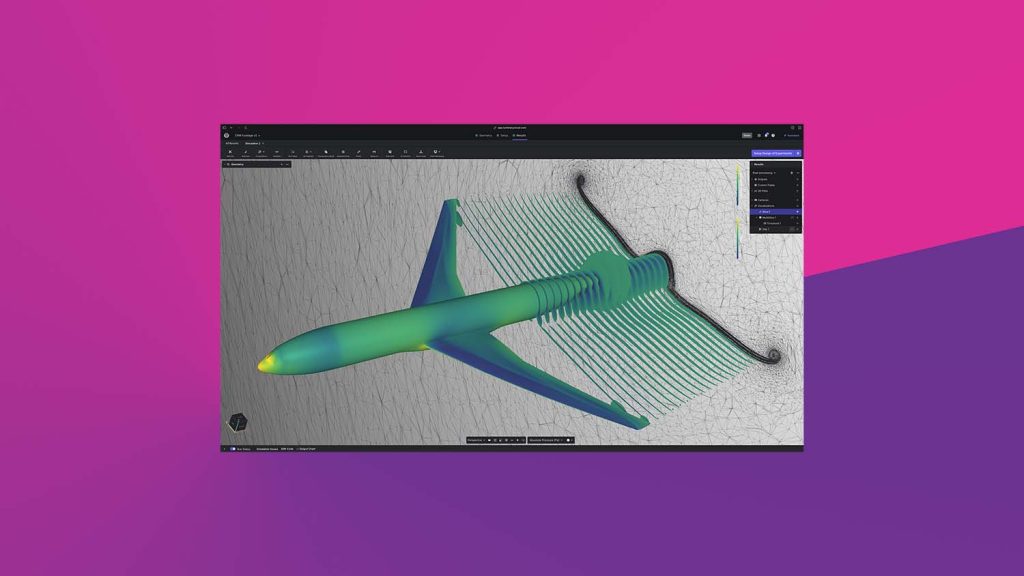

Shift-Wing, the newest Physics AI model from Luminary Cloud, has been launched to enable aircraft designers to explore more forms and analysis for transonic wings.
Designed to be used earlier in the conceptual design phase and avoid costly late-stage rework by performing real-time, it offers high-speed aerodynamic analysis of transonic wings with Physics AI inference. The Shift-Wing model and dataset were developed with the Nvidia PhysicsNeMo framework in collaboration with advanced aircraft manufacturer Otto Aviation.
“At Otto, we believe the future of aircraft design lies at the intersection of first principles and artificial intelligence,” said Obi Ndu, chief information and digital officer at Otto Aviation. “This partnership with Luminary Cloud will complement Otto’s ability to unlock scale in generation of Otto’s proprietary physics-based simulation data, making it possible for our engineers to explore, optimise, and validate aerodynamic concepts faster than ever before.
“By running our proprietary flight sciences methodologies on their simulation platform, we’re not only accelerating innovation but also developing next-generation surrogate AI models that bring physics-informed intelligence into every stage of our designs.”
Luminary Cloud say that Shift-Wing opens up the design space for aircraft manufacturers by enabling aerospace engineers to experiment with new designs with high fidelity and low risk. Development and redesign costs for commercial aviation can be substantial, with large cost overruns being common. Combined with regulatory compliance and certification costing millions and taking years, these expenses have stifled breakthrough innovation.
“It is a dream come true to release a Physics AI model that can help aerospace companies transform how they push the boundaries of conceptual wing design,” said Luminary Cloud CTO Juan J. Alonso. “Shift-Wing unlocks AI-driven innovation for the next generation of aircraft by allowing aerospace companies to feasibly explore more designs than previously possible and to use the almost-instantaneous aerodynamic predictions to introduce interactions with other elements of the design, including structural analysis and actuator and control system design.”
Alonso is also the chair of the department of aeronautics and astronautics at Stanford University and former director of NASA’s fundamental aeronautics program.
One of the biggest bottlenecks in building accurate Physics AI models has been access to large-scale, high-fidelity simulation data — until now. The Shift-Wing aerodynamic dataset was generated by parametrically modifying and simulating several thousand geometry variants of the NASA Common Research Model wing-body geometry (similar to the Boeing 777) using Luminary’s high-fidelity CFD platform.
Solutions were created using Luminary Mesh Adaptation to guarantee the highest accuracy and superior resolution of all flow features including shock waves. The model is trained on this dataset using Nvidia PhysicsNeMo, leveraging its DoMINO architecture for external-aerodynamics
“AI-Physics and Accelerated Computing promise to revolutionise the aerospace industry by accelerating design cycles and reducing cost while pushing the boundaries of engineering design,” said Tim Costa, senior director of CAE & CUDA-X at Nvidia.
“With Nvidia PhysicsNeMo, Luminary Cloud is building the tools that will transform the industry with near real-time aerodynamic simulation and design optimisation.”