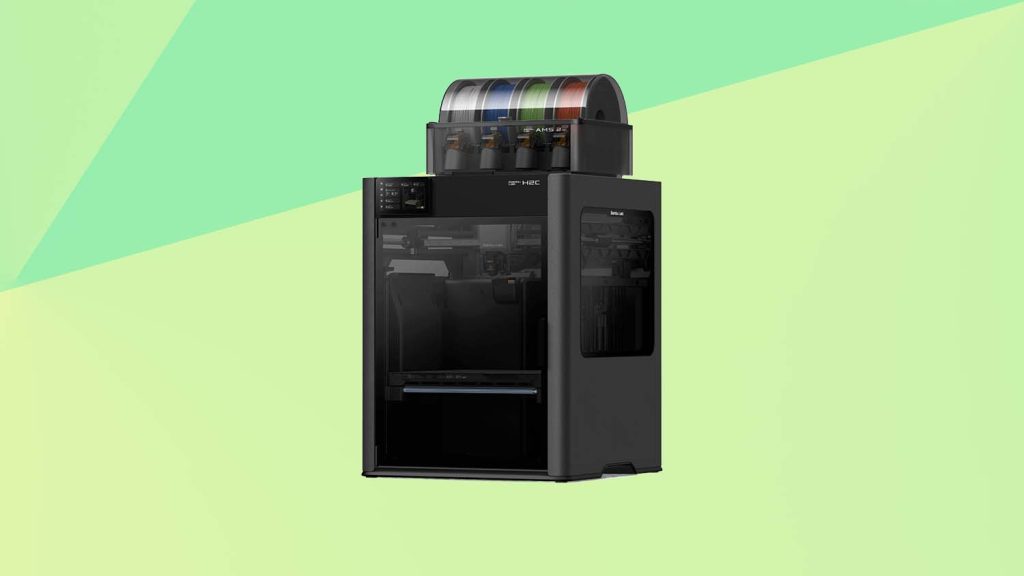

Bambu Lab’s latest 3D printer, the H2C, has been stocked with new technology to support its multimaterial capabilities, including its Vortek intelligent hotend technology.
Every H2C hotend is equipped with onboard memory that records which filament it was last used with. As a result, the system automatically suggests the correct settings for the next use. This feature helps eliminate setup errors and accelerates project preparation by minimising time spent managing the printer.
Touchless calibration, intelligent nozzle cleaning and automatic filament assignment add to the reduced need for manual intervention.
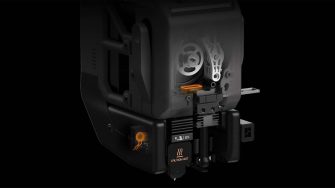
The H2c 3D printer has a 305 x 320 x 325mm build chamber, while the system is built around its Vortek Hotend Change System that supports six interchangeable hotends. The H2C enables printing with up to 24 filaments simultaneously while minimising purge waste for better material efficiency. Each of the hotends can be assigned to a specific filament.
When printing with fewer than 7 filaments, Bambu Lab says the purge cleaning cycle can be completely eliminated during filament changes, further enhancing efficiency.
The H2C handles most operations autonomously; before each print, it scans the build plate, verifies nozzle compatibility with slicer settings, and analyses potential issues. A built-in macro lens camera monitors extrusion in real time, detecting anomalies before they affect print quality.
The Vision Encoder system onboard the H2C allows the printer to achieve movement accuracy below 50 micrometers, with the automatic nozzle calibration system operating contactlessly, compensating for mechanical deviations in real time.
Temperature and material flow control are powered by a PMSM servo extruder that generates extrusion forces up to 10 kg – around 70 per cent higher than traditional stepper motors, enhancing flow control, reducing clogs and maintaining stable performance even at high printing speeds.
While much of the marketing is about printing multi-colour prints, with a nozzle temperature capable of 350°C, a print bed temperature of 120°C and active build chamber heating of 65°C, the H2C is capable of handling TPU, carbon and glass fiber filled composites, and engineered polymers like PA6-GF and PC-FR. The machine can reach working temperature in just 8 seconds from switching on.
“The H2C is designed for makers, engineers, designers and professionals who demand industrial-grade reliability from a desktop machine,” said a Bambu Lab spokesperson. “This is the most advanced multi-material 3D printer on the market – combining the intelligence of industrial systems with the ease of use of desktop devices.
“Once again, Bambu Lab proves that reliability is what matters most, and that true innovation lies not only in creating new features but in ensuring that users no longer need to think about them.”