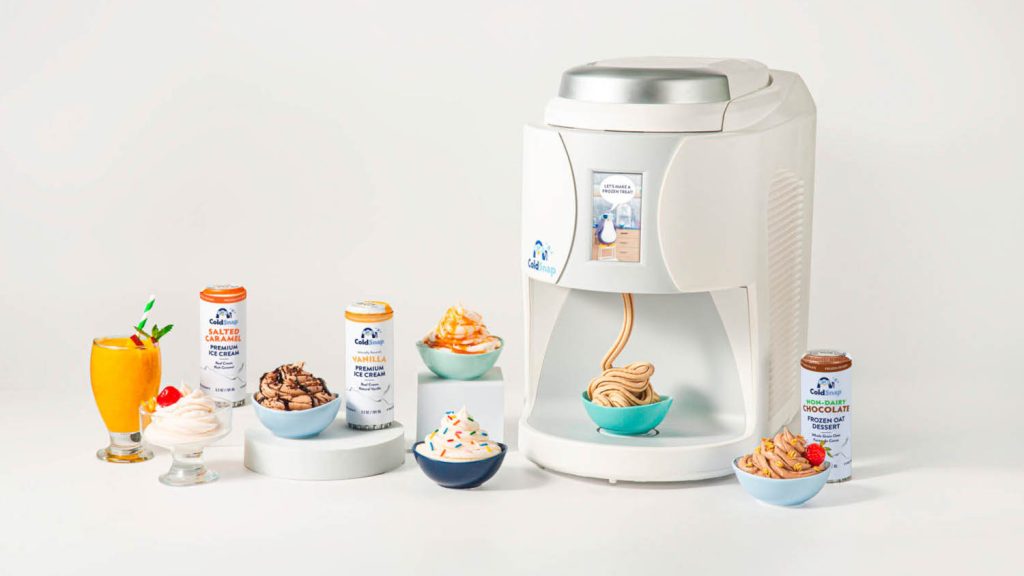

What began as playful brainstorming between Matthew Fonte and his children has become a fully fledged business that offers customers a way to make and serve individual frozen desserts on demand. Stephen Holmes speaks to the ColdSnap founder about the company’s mouthwatering mission
Instead of reading them bedtime stories, Matthew Fonte would often encourage his daughters to dream up wonderful inventions instead. One night some years ago, they declared it ‘unfair’ that adults can just pop a pod into a machine, press a button, and get a piping hot cup of delicious coffee. Why couldn’t they have a similar machine that served up their favourite flavour of ice cream with the same speed and ease?
“So we sketched a little machine, dated it and signed our names,” says Fonte. “The kids fell asleep and I kept thinking about it.”
In particular, he says, he wondered if it was even possible to freeze six ounces of ice cream in one minute; what approach to long shelf life pasteurisation might work best in this scenario; and crucially, whether anyone else had tried to build such a machine before.
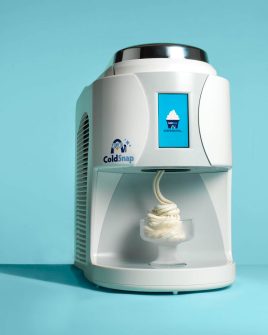
Some years later, and after considerable development work, the result is ColdSnap, a counter-top appliance that rapidly freezes and dispenses single servings of frozen treats – ice creams, certainly, but also frozen smoothies, protein shakes and margheritas.
The ColdSnap Frozen Treat Machine uses aluminium pods that mix, freeze and dispense the product, meaning no foodstuffs ever touch the machine, no cleaning is required and there’s no risk of cross-contamination.
“The big advantage is that shipping ice cream is very expensive and puts a lot of carbon emissions up into the atmosphere just to keep that ice cream frozen. Here, it’s a better environmental play, because we can ship [the pods] at room temperature,” says Fonte, loading a vanilla ice cream pod into the machine.
Just as they would with a typical pod coffee machine, the user simply drops the container into the machine and closes the lid. The machine does the rest – and in under two minutes.
This involves an internal camera reading the QR code that identifies the product inside the pod and then applying the right levels of cooling and mixing.
A mini impeller is key to the ColdSnap design. Located inside the pod, this rotates at up to 3,000 RPM, churning the liquid during the freezing process while also acting as a fan that draws air into the container to create the perfect texture for the finished product. For that to happen, he says, “you need at least 30% air in the premium ice cream.”
This impeller also enables ColdSnap to control the buildup of ice. It creates ice crystals that are 60 times smaller than those normally produced by a domestic ice-cream maker. “And when you take premium formulation 14% milk fat, and smother it with these small ice crystals, it’s the smoothest ice cream you’ve ever had,” he says, helping himself to another spoonful.
The company has not just developed a new appliance, but also a new market for a premium class of ice cream – one that uses high-fat dairy but delivers the product at soft-serve temperature, a combination that doesn’t exist anywhere else.
ColdSnap // Levelling up
While their original idea was for a domestic kitchen counter appliance, Fonte and the ColdSnap team soon realised that there was scope for a larger model. After all, even the most ardent ice cream fan might only use one or two pods per day – but a machine serving guests at hotels and resorts, or employees in a workplace canteen, might easily tear through 50 pods per day.
“There were a lot of challenges when we first started. We really didn’t have an example in industry,” says ColdSnap vice president of appliance engineering, Ben Fischera.
“We couldn’t look at another product and say, ‘That’s how big it’s supposed to be’, because it doesn’t exist. So we had to come up with some pretty innovative designs for the cooling system, for the evaporator and how we get the whole process to happen in two minutes or less.”
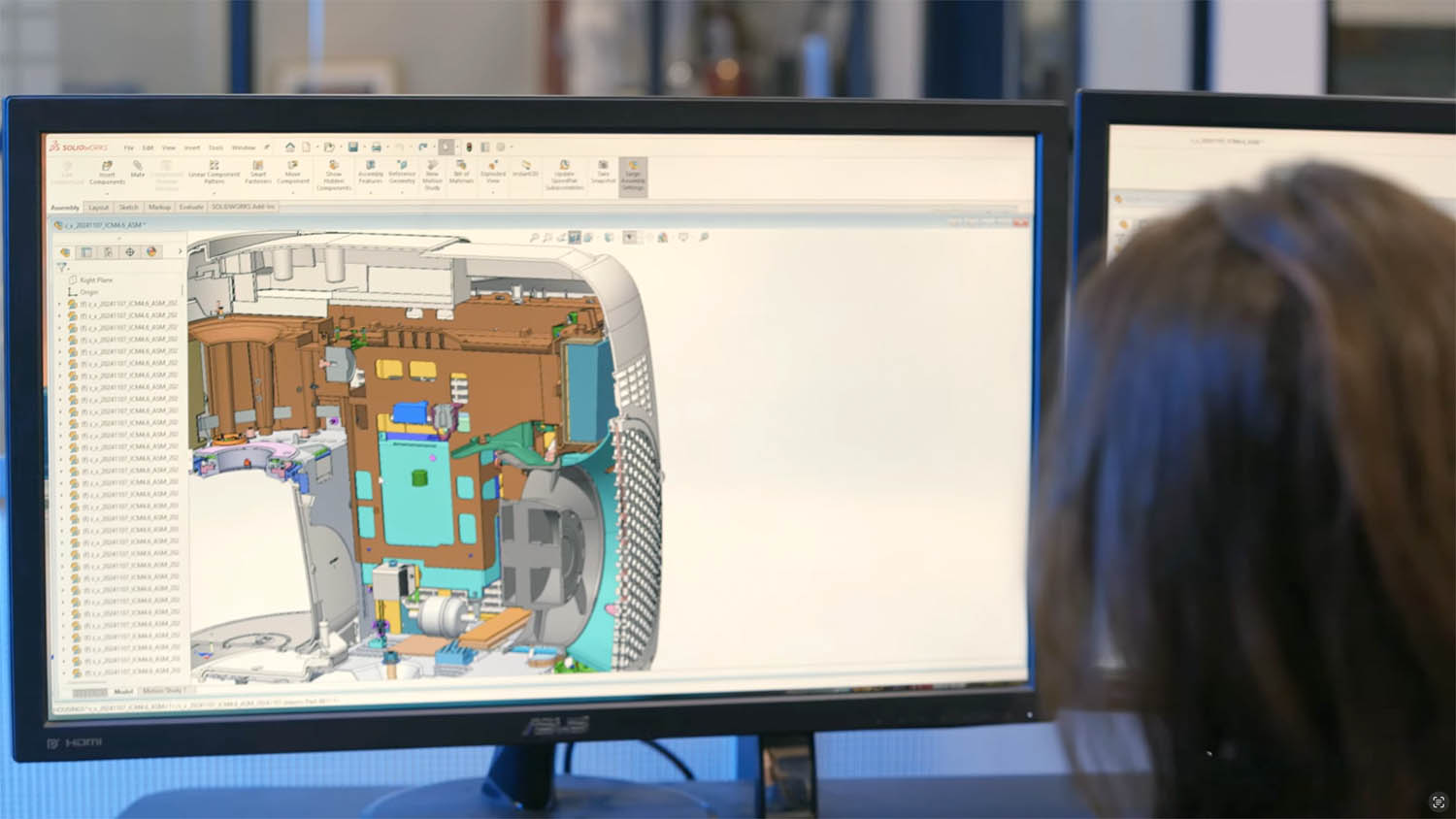
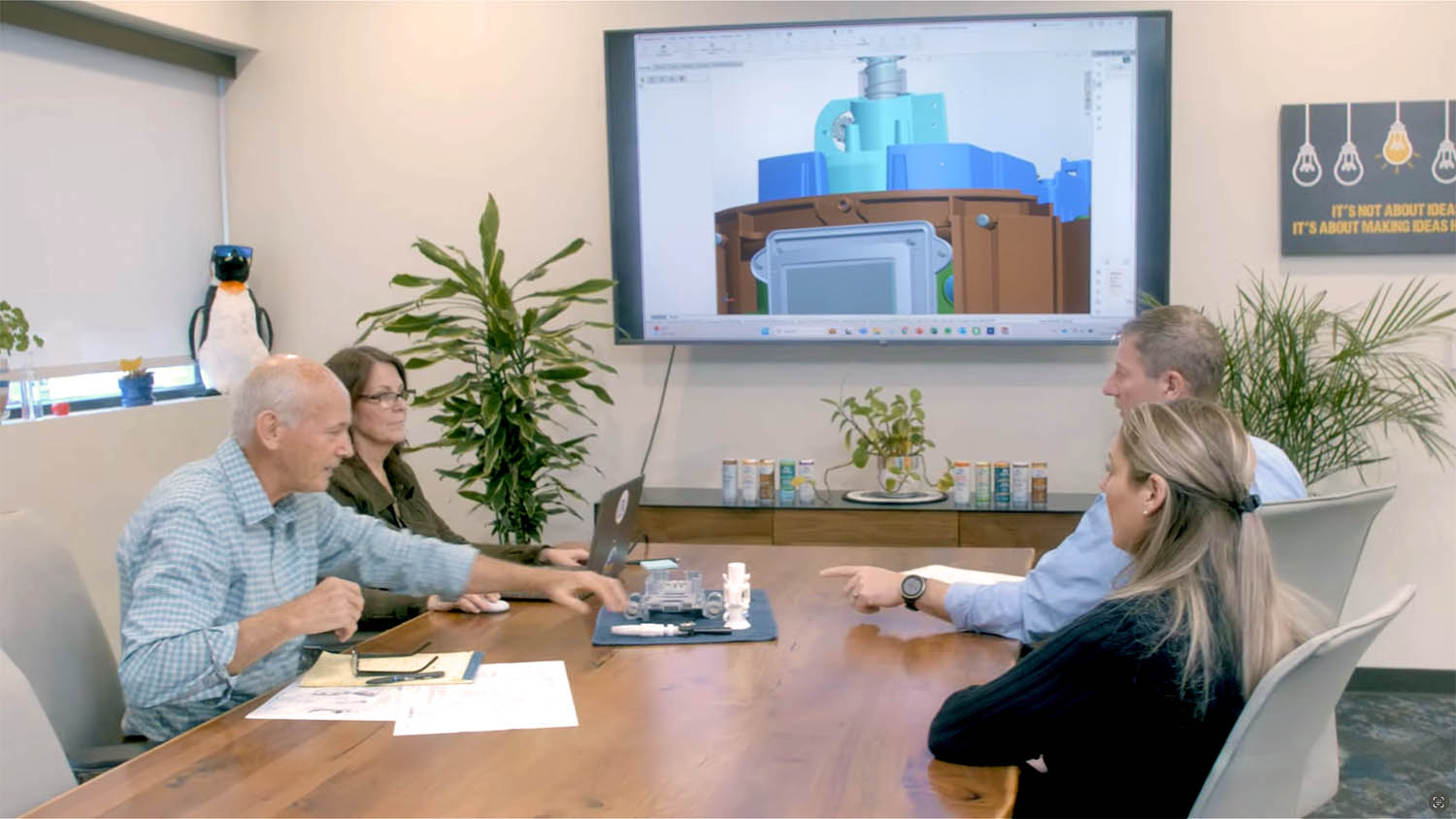
The entire machine, from its inner workings to its styling, was developed in Dassault Systèmes Solidworks, to ensure that all components would fit together and that the machine would remain within tolerance even with its 3,000 RPM motor working at full strength.
FEA simulation capabilities in Solidworks Simulation proved critically important, according to Fonte. These allowed his design team to conduct stress analyses on all the components and to ensure a reliable mechanism, based on pods that open every time and nothing breaking prematurely.
The CFD package within Solidworks Simulation, meanwhile, enabled them to finetune the refrigerant and model the phase transformation as it switches between gas and liquid.
To develop the best churning action for the impeller within the pod, they were able to use Solidworks Simulation to optimise the form for better stirring during the freezing process.
“Historically, we’ve been doing this through trial and error, trying to optimise the geometry of that impeller. Now, we’re using the CFD package to model it and try to put more engineering and science behind that process,” says Fonte.
According to Fischera, Solidworks helped to refine the design so that all the required components could be packed into the tight space in the most efficient way possible. “There are copper tubes in there, there are wires, there are circuit boards, there are compressors that move around,” he explains.
“So we’re looking at clearance and tolerances between parts with the max and min material conditions so that, no matter what happens during shipping or during an out-of-tolerance condition, nothing’s going to touch anytime. Solidworks really helped us get through those iterations quickly.”
The next design challenge was shrinking the machine and reducing the price point to make it accessible to more homes around the world – but that’s not all, says Fonte.
Each ColdSnap machine is connected to company HQ and feeds back data about performance and usage. This data helps the food team monitor flavour. It helps sales teams keep customers stocked. And it also helps ColdSnap’s engineers learn what works well – and what doesn’t – and refine their design accordingly.
In short, all this data is put to good use, so that the company can build longer lasting machines, avoid unnecessary waste and get new insights into how they might develop the product line-up in future.
“We can make it bigger and faster, and I also want to take the refrigeration system and put it under the counter, with four or five heads up top so it can go on a concession stand at a stadium or at a university where you’re trying to feed hundreds of people within, like, 45 minutes,” explains Fonte.
His team is certainly not short of ideas. Vending machines are a possible future direction, along with systems that blend ice cream with espresso to deliver an on-demand affogato.
Stay frosty
Keeping ice cream frozen – as it’s made in the factory, as it’s conveyed through logistics networks, and as it sits in retail stores and, ultimately, homes – is a demanding task that devours energy and money and emits a lot of CO2 along the way. Fonte’s point is that if you can freeze ice cream on demand in single portions, you can potentially save around 90% of that energy.
That’s not the only sustainability consideration on the ColdSnap team’s radar, either. Just as pod coffee manufacturers are working hard to boost recyclability (and recycling) of pods, so are they. In fact, the aluminium pods used with the ColdSnap machine are already fully recyclable, while the plastic impeller contained within them is soon to be replaced with a new aluminium design. First, the team needs to identify a BPA-free coating they can use.
“You can’t put bare aluminium in the can, because it reacts with the food. In California, you can’t have BPA, or if you do, you have to disclose it,” explains Fonte. “So, it’s always something. I tell people, ‘If you want to work at ColdSnap, you better enjoy figuring out problems.’ That’s all we do!”
A mechanical engineer, Fonte spent years working on devices in the medical sector, garnering nearly 40 patents for his work. His Italian grandfather ran the family machine shop and brought to the US a German process for developing precision metal tubing used in applications such as motor casings, jet shafts and directional drilling.
Says Fonte: “What I learned from my grandad is that you have to do something that nobody else is doing if you really want to stand out. Now, when I go anywhere in the world and show people this machine, they’ve never seen anything like it before.”
This article first appeared in DEVELOP3D Magazine
DEVELOP3D is a publication dedicated to product design + development, from concept to manufacture and the technologies behind it all.
To receive the physical publication or digital issue free, as well as exclusive news and offers, subscribe to DEVELOP3D Magazine here