

Suppliers of visualisation tools have been some of the fastest to adopt and evolve AI technology, and Depix is one of the companies leading the field and wowing designers. Stephen Holmes spoke to Depix CEO Philip Lunn for his view on what AI capabilities bring to design workflows
Artificial intelligence (AI) has completely solved rendering, according to Philip Lunn, CEO of visualisation tools company Depix. It’s a bold statement, but coming from Lunn, it’s one that deserves closer attention.
After all, Lunn was CEO of Bunkspeed when it launched real-time ray tracing with Hypershot back in 2008. That introduction fundamentally changed rendering for good, transforming long cycles into instant updates – and enabling designers to make tweaks to lighting, materials, camera angles and so on in a matter of seconds.
So it’s a surprise to hear him downplay that achievement. “When I look at that now, or I look at any rendering, per se, it seems obsolete,” he says. Today, far bigger changes are coming down the line, “and they’re much larger than I ever imagined.”
AI-enabled rendering has made some serious inroads into workflows in the past year. But this category continues to be plagued by concerns around image quality, user control, output scale and legal issues. So when someone with Lunn’s industry experience announces that their ‘ultimate tool’ is powered wholly by AI, you’re bound to sit up and take notice.
“What we’ve built is an end-to-end workflow for the whole design process, from planning all the way to presentation,” explains Lunn. “It comes from years of experience.”
It’s certainly true that the Depix team boasts significant know-how. Lunn exited Bunkspeed in 2013 when it was sold to Dassault Systèmes, but has continued to work in visualisation, XR and 3D data capture.
Depix chief product officer Christian Braun, meanwhile, was an artist at Porsche for 20 years. As a result, the linear design workflow followed at Porsche has been influential in shaping Depix, says Lunn, but can now be applied to many different categories of products, from consumer electronics to skyscrapers.
“It’s so fantastic and amazing to use,” he says. “This is a game changer, and it uses AI deeply from start to finish. I’m a firm believer that the intelligence is actually there, and I’ve been using it deeply for two years now.”
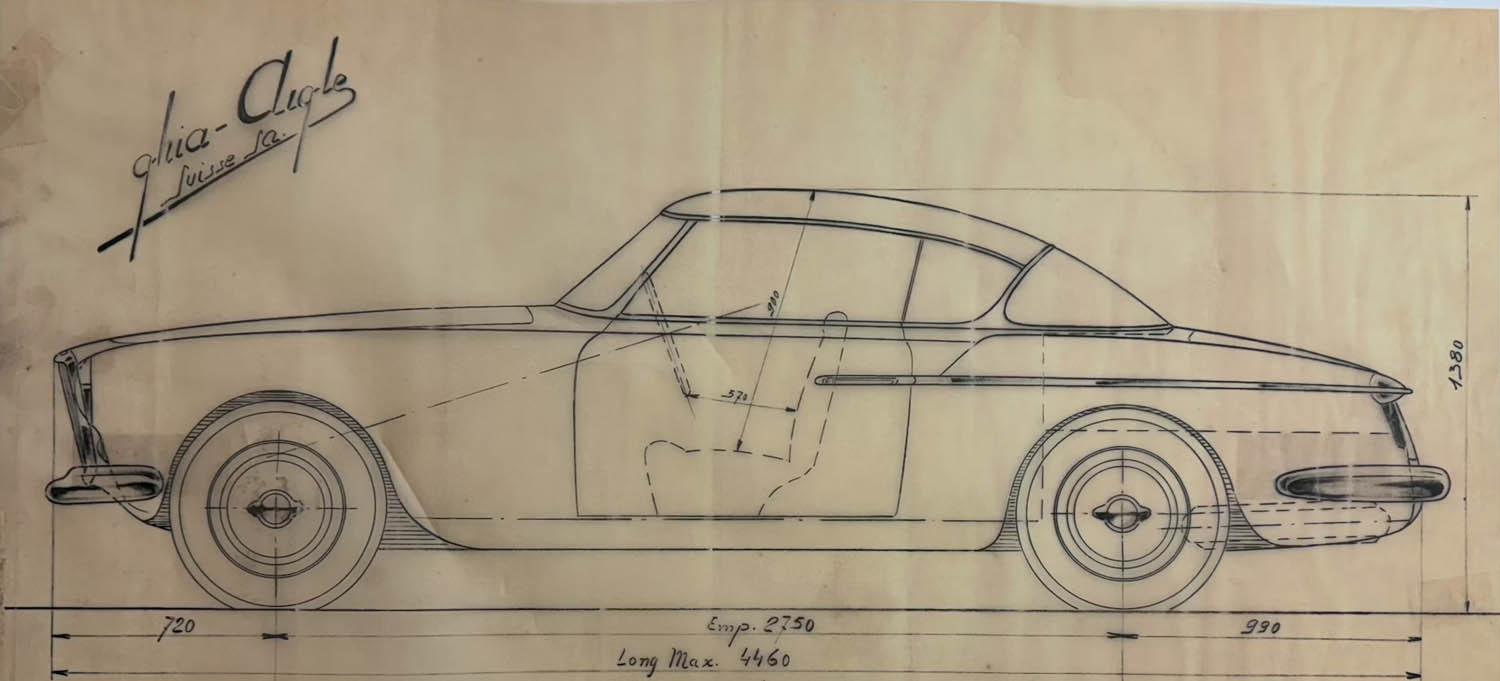





Real connections
The great benefit of Depix, according to Lunn, is the time it gives back to designers when they don’t have to render images. Its incredible speed means that a single scene can take minutes, rather than hours, enabling them to work on other tasks.
But even while AI-generated content floods the internet, the human-to-human aspects of business aren’t going away, he insists. Product designers and engineers will still brainstorm new ideas with colleagues, network to find new business and spend time getting to know clients better. “That’s not going away,” he says, adding “Personal connections between humans are going to matter way more than ever.”
But he acknowledges that, despite AI’s benefits, resistance to adopting AI tools in workflows persists. Some will naturally dwindle as the technology evolves and delivers incrementally better results. The issue of quality, for example, is being addressed by rapid advances in underlying generative AI capabilities, while legal concerns tend to fade as a fuller picture of the benefits emerges.
If businesses allow their staff to use Google Search, then they’re already using AI, says Lunn. “It’s the same thing! If you think about Google, it has all the information in the world. Now, it’s all be tokenised into a giant ball and you can put your query in with a text prompt. It goes exactly to the right spot and pulls something out in a way that combines images and text and video together – and it’s fantastic.”
The rapid evolution of Google’s AI tools in the space of a few months, he continues, strongly suggests we are on a trajectory of massive, exciting change.
So, as a start-up, does this mean that Depix risks getting pushed aside by wave after wave of new technology – or, alternatively, swallowed up by a larger vendor from the CAD and visualisation market, such as Autodesk or Siemens (or perhaps even Google, OpenAI or Grok)?
Lunn considers the question, before suggesting that it all comes down to the foundational trained AI models. Only a few of these are “worthy”, he says.
“Obviously, Google has its entire AI suite open. OpenAI is another one. There’s Grok, Claude, there’s these various different suites and then there’s all the image models. There are Chinese ones, and there’s the German one, Flux. If you’re Autodesk, you can’t compete with that [by building your own].”
He cites the example of Adobe, which tried to compete in this market with the introduction of its ‘more ethical’ Firefly product, but subsequently struggled because even a company of that size doesn’t have enough images to make it work well. “It only had 600 million [images] or something,” says Lunn. “You know, they need all the images on the global internet – like Google does – to make it work really, really well. So you can’t fight those things.”
In Lunn’s view, Depix has the freedom to stay ahead of bigger industry players, acting as a layer built on top of the foundational AI models with the freedom to move to the latest and greatest at any given time. Currently, its default engine is Google’s Nano Banana Pro, but that could change.
While offline versions of Depix Image Lab and Design Lab are possible through an MIT or Apache licence, the online version of the software has the brakes taken off.
“There are some big changes that have to come, and organisations at some point are going to have to decide, ‘Do I want to move fast, or do I want to stay in the slow lane?’ I can assure you that companies in China are in the fast lane for all products and all things that are made, and if we don’t make this transition within the West, we will be relegated to never manufacturing again.”




Imagination factory
With AI rendering issues like image quality and scale now fixed, the next big challenge (and one on which Depix has been hard at work) is improving scene control for users. Depix Design Labs gives them the ability to add to a scene basic geometric 3D shapes and sketch data, and to position objects within it, from items of furniture to people.
What’s jaw dropping is the level of intelligence at work here. Requests that might previously have proved tricky – such as requesting the primitive be turned into a jar of peanut butter sitting next to a jar of hand wash – are handled in seconds with no confusion. A photorealistic, Jif-branded jar, complete with appropriate text and colours, is scaled neatly next to the hand wash render, with perfect lighting, textures and details. No Google search is likely to find a single image of these two products next to one another, but by synthesising all the images into a big pile, the AI has the intelligence to grab the correct products and know the context in which they will be combined.
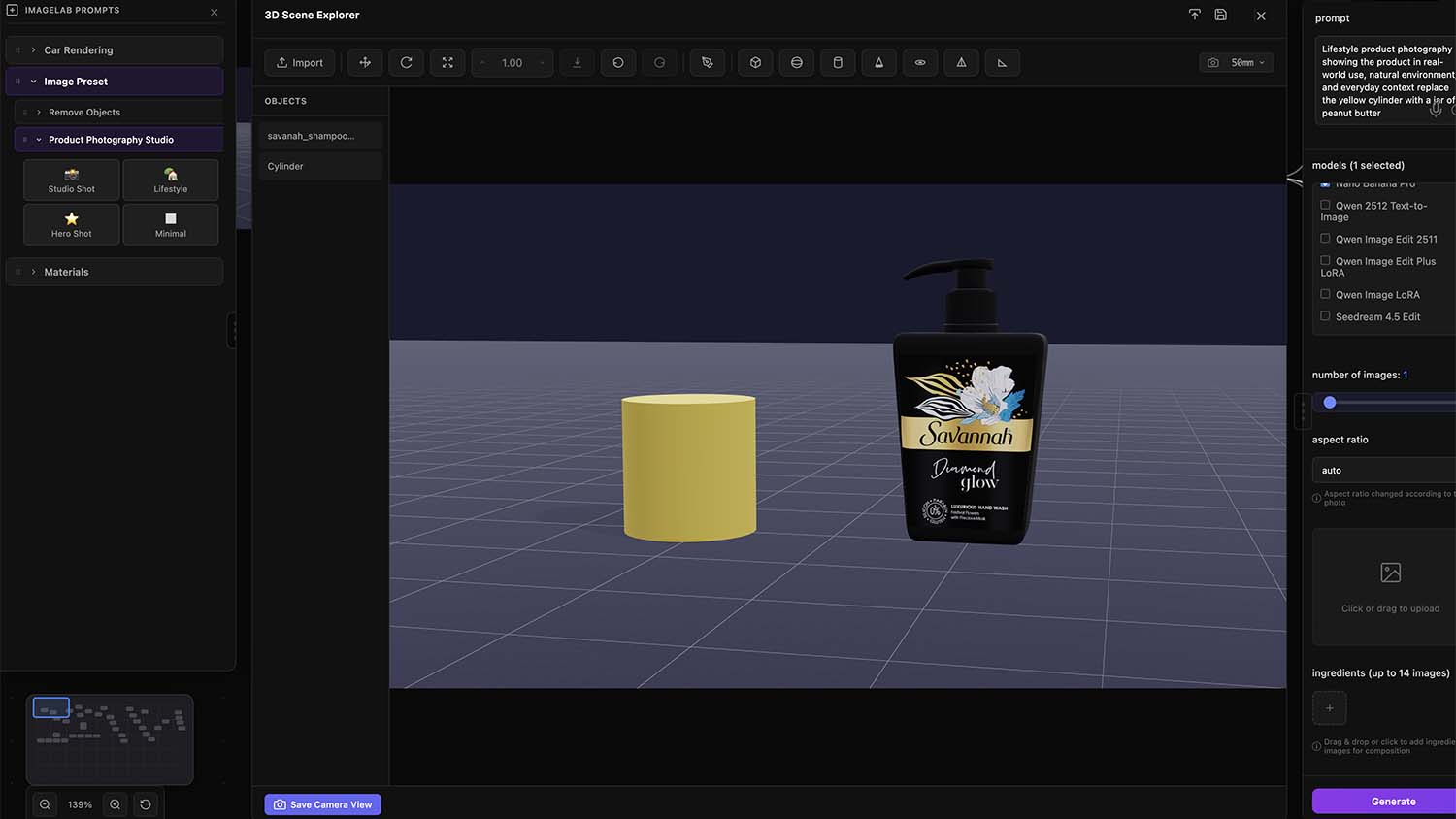
Depix Design Lab is not simply about renders, but also about delivering a full styling workflow that offers control, sparks new ideas, and allows for variants to be expanded or concepts to be dialled in, and for it all to subsequently be exported in 8k.
Visualisation expertise used to be a very long journey, requiring study, practice and time spent in order to get materials, lighting and everything else right, says Lunn. “Now, within a couple of clicks, you’re there,” he says.
There’s resistance to this change, he acknowledges, and it’s harder for some users to absorb, but ultimately, he sees Depix as an amplifier of creativity rather than a replacement for human input.
What needs to change is the relationship between designers and AI. In particular, designers need to get better at asking AI to deliver what they want and need. It comes down to two things: first, being able to articulate what you want in a prompt to AI; and second, being able to convey details in the form of sketches.
What his experience tells Lunn is that AI tools like Depix are only limited by the user’s imagination. In other words, the creativity and ingenuity of designers should keep them firmly at the helm.
This article first appeared in DEVELOP3D Magazine
DEVELOP3D is a publication dedicated to product design + development, from concept to manufacture and the technologies behind it all.
To receive the physical publication or digital issue free, as well as exclusive news and offers, subscribe to DEVELOP3D Magazine here