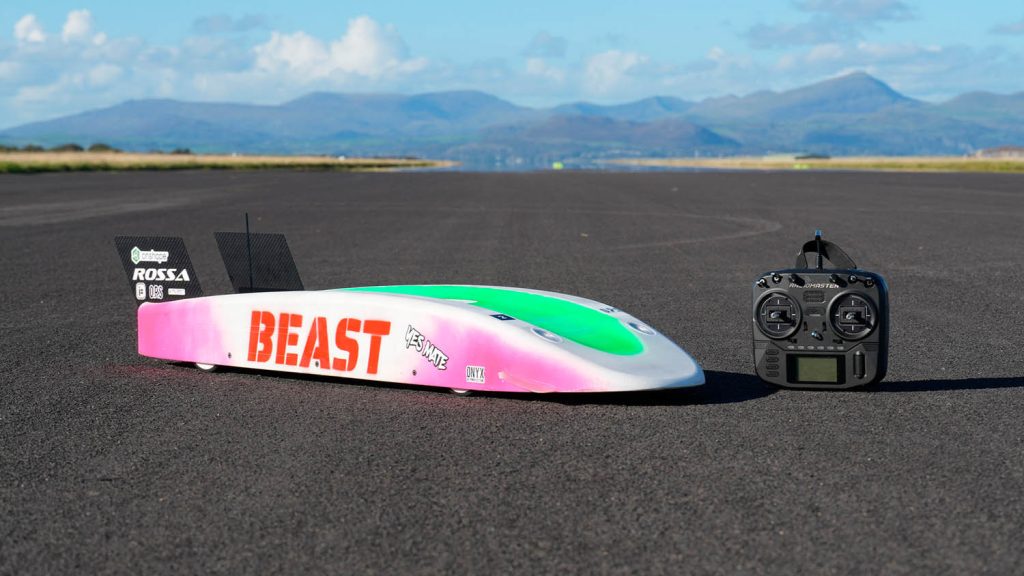

The quest to build the fastest ever remote-control car is reaching new heights and hitting speeds that drivers of even the best track cars can only dream about, writes Gabrielle Brown, who meets Stephen Wallis to discuss his race to break a world record
A mission to notch up a car speed world record probably summons up thoughts of huge engines, an unlimited budget and a workshop set-up as sophisticated as that operated by any Formula 1 team out there. But with the motorised creations of Stephen Wallis, it’s more a case of ‘blink and you might just miss it’.
In September 2025, Wallis broke the Guiness World Record for the fastest remote-control car with a diminutive design capable of reaching a jaw-dropping 234 miles per hour (mph). It smashed the existing record by 15mph, thanks to its unique design. It’s a set-up previously unheard of in speed tests run by the Radio Operated Scale Speed Association (ROSSA).
An engineer at Triumph Motorcycles by day, but a remote control (RC) hobbyist at heart, Wallis was drawn to the ROSSA speed testing events by YouTube videos of previous speed runs.
“They really captured my imagination, and when I saw that the rules were almost completely open, I could sense an opportunity to start with a blank sheet of paper and come up with something completely different to what had gone before,” he says.
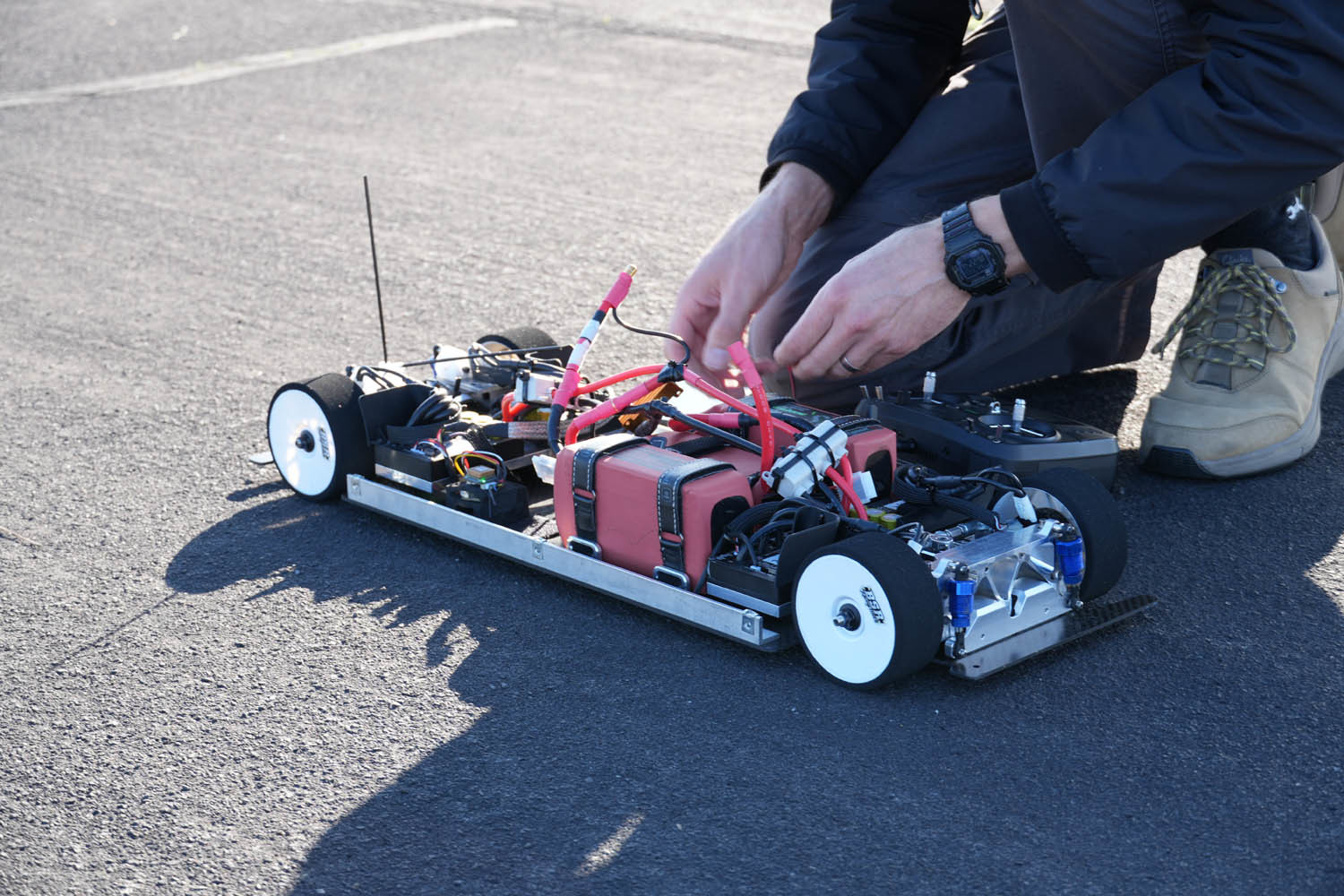
Wallis’ theory – based on a vehicle boasting four motors with direct drive to the wheels – needed to be put to the test, he decided. (RC cars typically have between one and four motors and a transmission to take the drive from the motors to the wheels.)
Wallis first began with a proof-of-concept, built from an old quadcopter drone dubbed the Crone, using horizontal wheels instead of vertical props on the shafts.
It turned out that when it comes to maintaining highspeed directional stability, the drone’s flight control system with its accelerometers, gyroscopes and other built-in sensors did an excellent job.
With 43mm diameter wheels and a length of 0.6m, the Crone achieved an unexpected 129mph at ROSSA in June 2024. Wallis was clearly on to something.
Between June and September 2024, he worked tirelessly to develop the Crone’s bigger brother, the Beast, setting himself the goal of topping 200mph.
Building the Beast
Wallis began his design with hard data, developing a spreadsheet that simulates a speed test run, into which he could enter different car and powertrain parameters for basic physics calculations. “I used this to come up with the initial sizing of the electric motors, batteries and speed controllers,” he explains.
Using Onshape, Wallis then planned an initial layout of the chassis and designed an aerodynamic lightweight body to be wrapped around it using CFD simulation.
Testing was performed using Simscale, in which he could see the effects of different layouts and body concepts on the design – but he soon ran up against a problem. The ROSSA runway in Llanbedr Airfield in Gwynedd, northwest Wales, is far from completely smooth. Wallis needed a car that could cope with undulating ground at high speed.
“I saw a lot of other cars with front splitters, commonly used to give front downforce, take flight when they hit bumps, so I sought to make my design less sensitive to ride height variation, while still developing downforce,” Wallis says.
“After many CFD iterations, my design allows air under the car, while the canards provide some assistance in reducing pitch sensitivity and providing downforce.”
Initially, the Beast didn’t have mechanical steering and relied on torque vectoring to steer, like the Crone. But at its first test event in September 2024, this caused problems. “Round 3 ended in total disaster,” he says. “Everything went wrong, and I burnt £300 worth of electrical components.”
Two motors burnt out in an initial test. Once that was repaired, all four speed controllers burnt out. The whole car had to be redesigned to add a mechanical steering switch to the VESC (Vedder Electronic Speed Controller), which can better control the current going to the motor in comparison with typical RC speed controllers.
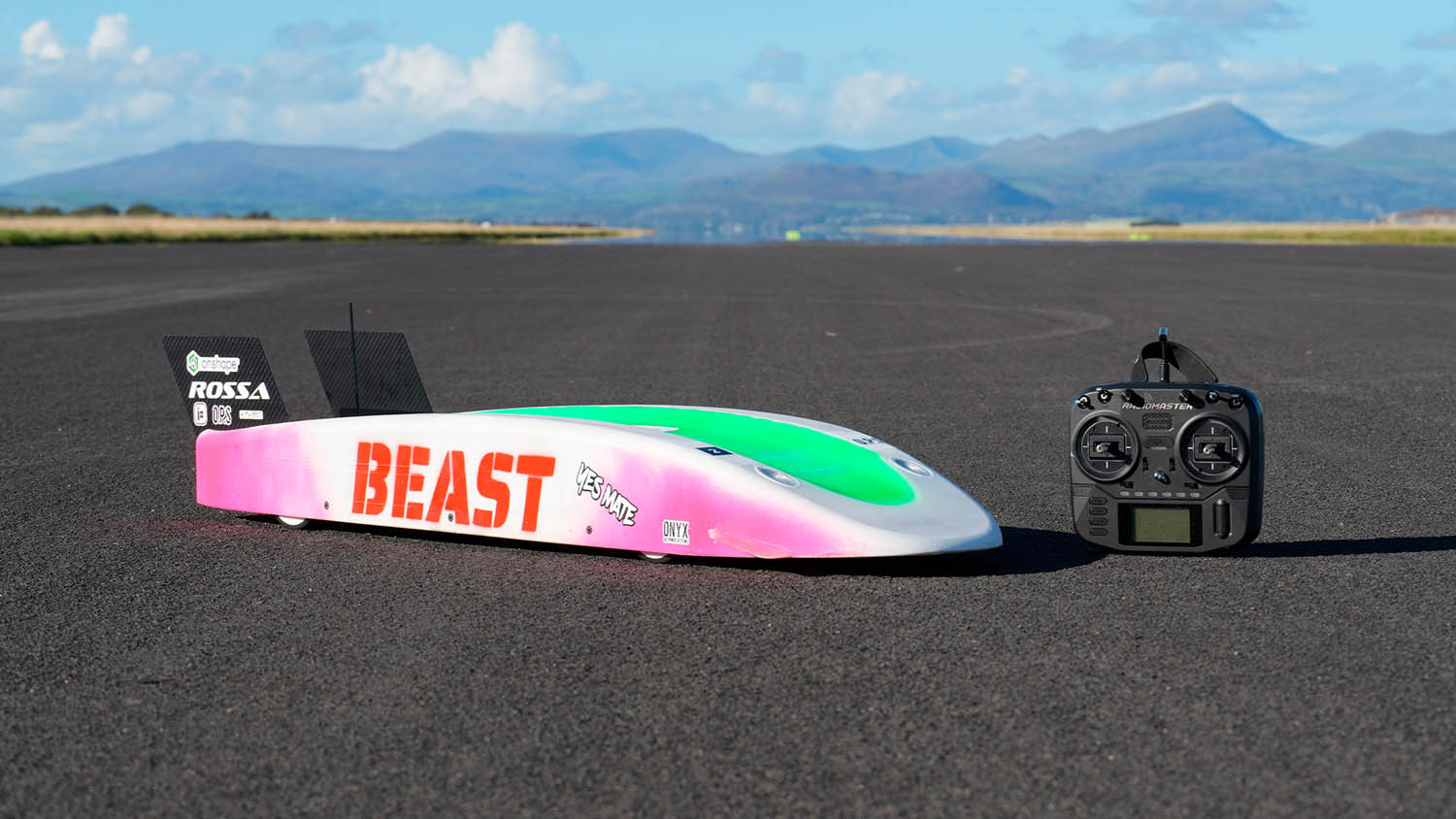
3D-printed prototypes were essential to the design process and make up important aspects of the Beast’s final form. The 1.1m-long aerodynamic bodyshell is 3D printed, as are the carbon fibre leaf spring suspension spacers and rear damper mounts.
Record breaker
The Beast made its debut at ROSSA in September 2025. In Round 1, it achieved a personal best of 196mph, but there were issues with ESC cuts and battery power limitations. After some tweaks, Beast’s Round 2 speed smashed Wallis’ goal of 200mph, accomplishing 213mph.
Welsh weather conditions pushed back Round 3 by a few days, allowing Wallis to change the layout of the chassis and fi t an upgraded battery set-up, which not only gives a higher voltage (75V compared to 63V) but also higher current capability.
“For Round 3, I had my eye on the outright RC speed records of 218.47mph through speed traps and 226mph on GPS,” he says.
Despite wind and rain continuing to trouble the course, the Beast hit a speed of 234.71mph through the speed traps, breaking the Guinness World Record.
Records, of course, are there to be broken. In Wallis’ case, that record has since been toppled in 2026, but this has only added further drive to what he has named Project 250, as he targets speeds that even the world’s best hypercars would struggle to achieve, proving once again that size isn’t everything. www.youtube.com/@steveeng18
This article first appeared in DEVELOP3D Magazine
DEVELOP3D is a publication dedicated to product design + development, from concept to manufacture and the technologies behind it all.
To receive the physical publication or digital issue free, as well as exclusive news and offers, subscribe to DEVELOP3D Magazine here