
If the marine industry is serious about cutting CO2 emissions and securing supply chains, then manufacturing approaches must change. Stephen Holmes learns how the National Manufacturing Institute Scotland (NMIS) is supporting companies in making the shift
Scotland’s River Clyde may enjoy a proud shipbuilding heritage, but it is also a forward looking place. Just one mile from its banks, the National Manufacturing Institute Scotland (NMIS) acts as a bridge between academia and industry, opening up new opportunities for manufacturers, not least those from the maritime sector itself.
The NMIS can boast a wide range of established industry partners, all with their own capabilities for R&D, and plays a key role in acting as extra skilled resources for such companies. Typical projects focus on enabling technology collaborations to be established and proven and identifying faster the kinds of innovations that might be deployed internally in order to steal a march on competitors.
As Misael Pimentel, its lead on direct energy deposition, explains: “The teams that we have at NMIS exist to help industry derisk some of the efforts they are putting forward in terms of innovation.”
In one NMIS-supported project – Marine Vessel Lightweighting 2.0 – Glasgow-based Malin Marine Consultants (MMC) have investigated a shift for the marine sector away from traditional manual fabrication, in favour of more automated, flexible and environmentally friendly approaches. Other project partners included BAE Systems, Caley Ocean Systems, Siccar, Altair and Hexagon Manufacturing Intelligence (HMI).
Target part selection
In general discussions around lightweighting parts and reimagining transportation systems, ships don’t always get much of a look-in – but in the marine business, redesigning components to reduce weight and emissions is a hot topic.
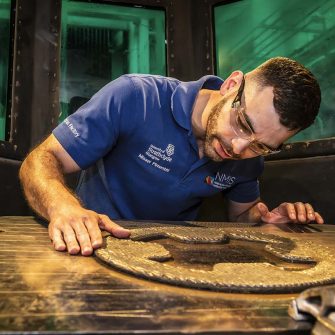
In the Marine Vessel Lightweighting 2.0 project, many potential part options were considered, before the team decided to focus on topology-optimising a tapping ring. This is a metal component that is used to reinforce openings cut into vessel decks and tanks to provide secure access points for personnel. Since most ships have many tapping rings on board, reducing their individual weight could deliver wide-reaching benefits.
According to NMIS mechanical integrity and optimisation lead Gordon Robertson, Altair Inspire was chosen from a wide range of software available to the team. It was one of the first opportunities to use Inspire, allowing them to simultaneously get to grips with the software, lightweight the tapping ring design and enhance its structural performance.
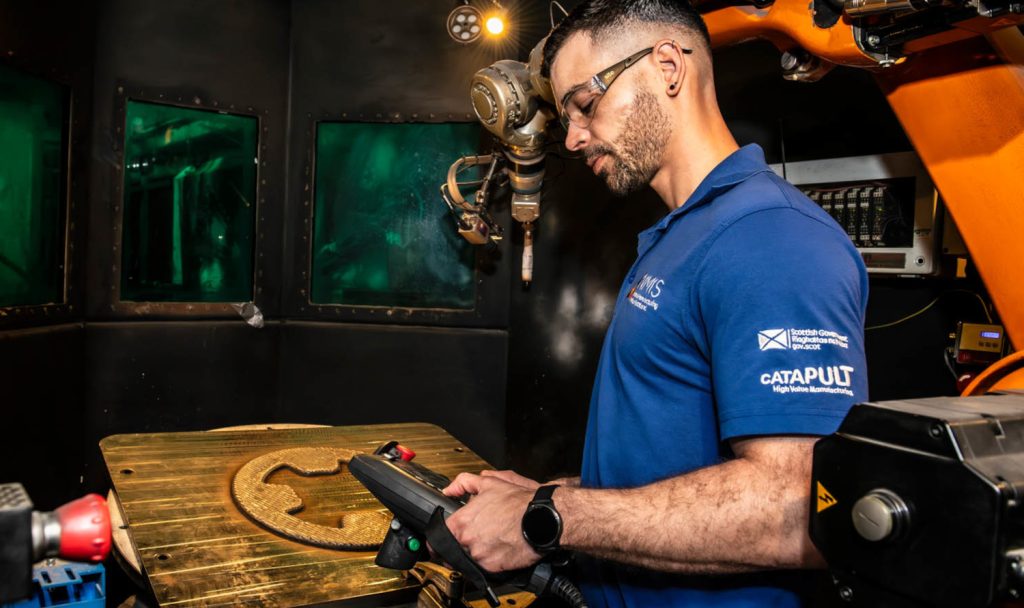
The design then moved into Hexagon Simufact, where engineers simulated the likely real-time thermal profile of the part as it was being built on NMIS’s direct energy deposition (DED) 3D printer.
This simulation, Robertson explains, “looks at the residual stress profile off the back of that, and what potential distortion you might see, and we tried to marry that up with the physical build in order to validate what the simulation was telling us. It’s good to correlate what the simulation is predicting will happen with what actually happens in the build.”
Significant reductions
The MarLight project delivered a 10% reduction in emissions, cut lead times by 90%, and reduced vessel weight by 13% in testing.
More importantly, the part underwent rigorous hydrostatic and leak testing under sustained pressure, witnessed by experts from maritime classification and professional services organisation Lloyd’s Register who provided independent verification of the tests.
“Whatever we develop in terms of the project itself helps with research, but if we want to have the part deployed in industry, a third-party accreditation body like Lloyds Register is very important, because they are the ones who certify, qualify and say you’re okay to put it into service,” explains Pimentel.
A success for sustainability at sea, the project’s use of large-format additive manufacturing also supports manufacturing efficiency, producing parts locally and on demand and significantly cutting material waste, energy use and emissions when compared with conventional fabrication methods.
With many more parts now identified for optimisation, lightweighting and production using additive approaches, there’s hope of a bright future for optimised marine manufacturing along the River Clyde for years to come.
This article first appeared in DEVELOP3D Magazine
DEVELOP3D is a publication dedicated to product design + development, from concept to manufacture and the technologies behind it all.
To receive the physical publication or digital issue free, as well as exclusive news and offers, subscribe to DEVELOP3D Magazine here