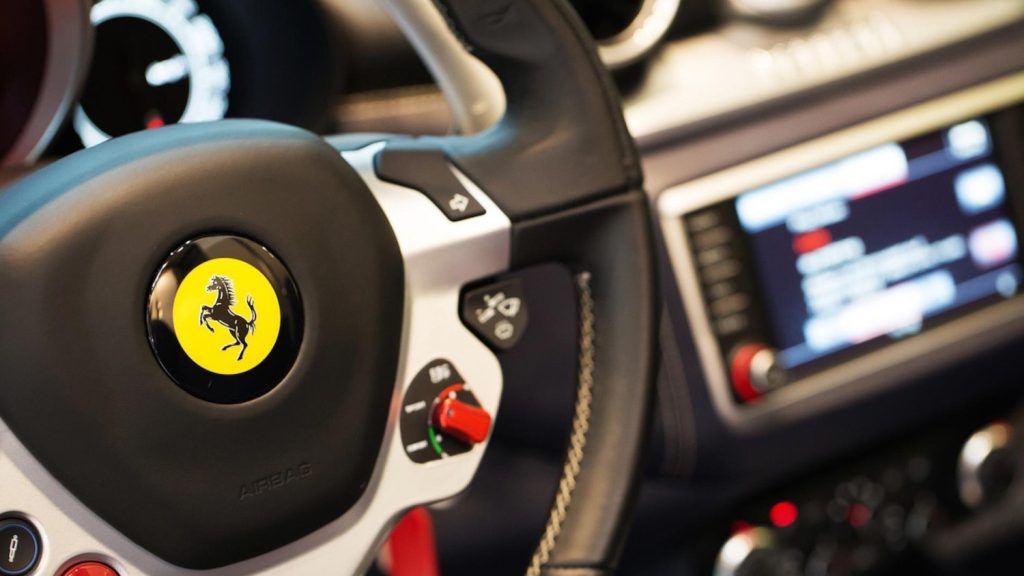

Disappointment over what he’s seen so far of the Ferrari Luce leads supercar fan Stephen Holmes to question the logic of bringing in industry outsiders to design cars that fail to spark the same passion as their forerunners
Climbing up into my bunk bed as a little kid, I’d often sit and look at the smattering of posters and cutouts I had carefully positioned on the wall next to me.
Mostly these depicted cars, and more specifically, the big beasts of the early 1990s supercar era. In other words, they were light years away from the shoeboxlike proportions, pig iron and cheap plastic of the Nissan Bluebird in which me and my siblings were routinely ferried around.
For me and my school mates, it was all about the ‘Big Three’, as we referred to them: the Bugatti EB110, Jaguar XJ220 and Ferrari F40.
We could reel o their vital statistics on command. We’d do our best to sketch them on the back pages of our exercise books. We’d dream of a time when we might actually catch a glimpse of one these beasts in the flesh. In short, these cars were the subject of a sizable chunk of our playground chatter.
Over the years, I’ve since accomplished the dream of spotting each of these cars. And every time, I have been transported back to being that tiny lad.
To this day, I still have the uncanny ability to recognise all three cars from just a glimpse of a section and from minor details, their styling being so distinctive.
The Ferrari F40, in particular, fascinated me with its sharp angles and its wide stance as it hunkered down low to the road on those unforgettable five-pointed star wheels.
So it seems pretty strange that, despite my long-running obsession with the F40 and my ability to recognise it when photographed from any one of a million different angles, I have no idea for the life of me what its interior or driver’s console looks like.
At no point have I ever even cared. For me, all that really mattered was its ferocious engineering and incredible, exciting styling.
Dream machine?
With this in mind, it came as a surprise when a first look at the upcoming Ferrari Luce started appearing all over my social media and the pages of newspapers.
What was captured in the accompanying images were not the Luce’s exterior, but instead, a series of limited views of its interior: a glimpse of steering wheel, a peek at an instrument cluster, a glance at the central console and display – and don’t forget the cup holders.
The Luce is Ferrari’s first fully electric vehicle and e ffectively has its own teaser trailer, just like a summer blockbuster movie coming to a cinema near you.
Of course, the huge spike in attention that the Luce is attracting is largely down to the people behind the wheel of its design. This comes from studio LoveFrom, headed by Jony Ive and Marc Newson – but you probably knew that already.
In other words, we’re talking about superstar designers from another generation. The Luce’s stylings seem like an exercise drawn from this pair’s greatest hits collection and, in particular, their work at Apple: machined aluminium, anodised finishes, slabs of glass, ‘squircles’ and the meticulous placement of circular elements within them. There’s a subtle hint of manufacturing process and assembly, too. It’s all there. And it’s all very 2007.
That’s the surprising thing about the Ferrari Luce – how familiar it seems, because we’ve all been carrying around a product rather like it in our pockets for nearly 20 years. It’s already dated and it hasn’t even reached prototype stage yet.
So is this familiarity a flex – or is this really a product in which every element has been, in Ferrari’s words, “meticulously designed and engineered to be functional, intuitive and thrilling to drive”?
If this were indeed the brief, then surely the specialist interiors team at Ferrari’s HQ might be justified in feeling that it could have cooked something up in-house, and maybe something better?
The involvement of LoveFrom might be viewed as a manifestation of the way that car design is moving relentlessly in the direction of consumer electronics. Or, we might deduce that, even at Ferrari, executives recognise that the driving experience needs transformation so badly that it might be best to let outsiders have a crack at it.
For me, the Ferrari Luce fails to convey sporting triumph, ineffable luxury or boundless excitement. In fact, it draws little to no emotion at all
But it’s Ferrari, after all. A new model still draws interest from all corners of the design world, and that’s largely down to its potential to influence the entire automotive industry for a generation or more to come.
Yet despite the undeniable design pedigree of its creators and lure of the ultra-exclusive prancing horse logo, I hope this isn’t the case. For me, the Ferrari Luce fails to convey sporting triumph, ineffable luxury, or boundless excitement. In fact, it draws little to no emotion at all. Our emotional connection to a car begins with its exterior. Trying to build a connection starting with the interior misses the point.
For me, the entire exercise highlights why automotive design should remain its own specialist field, separate from other kinds of products. After all, no chunky renders of matte aluminium and glass are likely to take pride of place on bedroom walls or capture youthful imaginations in the way that the posters on my bedroom wall once did.
This article first appeared in DEVELOP3D Magazine
DEVELOP3D is a publication dedicated to product design + development, from concept to manufacture and the technologies behind it all.
To receive the physical publication or digital issue free, as well as exclusive news and offers, subscribe to DEVELOP3D Magazine here