
Kaikaku is trialling its catering robots in the heat of a real-life restaurant kitchen, where the quality of each and every dish matters. Stephen Holmes visits the start-up on a mission to rescue the hospitality industry
While many engineers will be familiar with the values of Kaizen, the Japanese manufacturing strategy based on of incremental improvement embraced by Toyota among others, far fewer may be aware of its close cousin Kaikaku and its call for bold, radical reform.
Automotive production lines might be a world away from the place where you grab lunch, but the deployment of new optimised and automated systems may be the only way to save our means of eating out. Few industries, after all, have been as seriously disrupted as the hospitality sector, where changing consumer demands, time constraints and spiralling costs are causing widespread closures.
Kaikaku is a fitting name, then, for a robotics startup looking to rejuvenate the industry by automating kitchens, enabling those who run them to slash costs and reduce waste. Its promise is that, through automation, restaurants may not just survive, but prosper.
That’s the message from Ivan Tregear, chief technology officer of Kaikaku, from the company’s home in a bright warehouse space in the trendy east London area of Shoreditch. It’s extremely hard, he says, to make money out of restaurants in the modern world.
“Not only are restaurants really expensive to make and really hard to run, but they have huge maturity periods, sometimes six months to a year, before they actually keep a steady state. We want to cut that down and incentivise people to open a restaurant.”
He runs us through the maths. He and his team believe that restaurant owners can extract maybe 10% or so extra profit margin or revenue margin from automating labour, maybe another 3% to 5% from cutting food waste, and then a few extra percent in increased revenue from consistency.
It all adds up. Through robotics, the burden on training is significantly reduced and the expertise required of a store manager is also slightly lower. And, at the same time, some of these savings can be redirected into areas such as marketing, in order to further establish the business.
Human/machine interaction
Adding robots to kitchens is nothing new. In Asia, some automated kitchens are thriving, but Tregear believes that’s symptomatic of a culture more receptive to automated serving and where solitary eating is accepted as a social norm.
The team at Kaikaku is adamant that in Western hospitality, human interaction is an integral part of the dining experience, so the goal is to design robots that can work alongside human colleagues, rather than replace them. As an example, Tregear points to website chatbots. Instead of being regarded as positive, he says, users are inclined to rush through the questions they ask, in order to get to speak to an ‘actual human’.
With Kaikaku’s first system, Fusion, the intended market is quick-service restaurants (or QSRs). These are establishments that focus on speed, affordability and convenience. They typically offer limited, standardised menus and little to no table service.
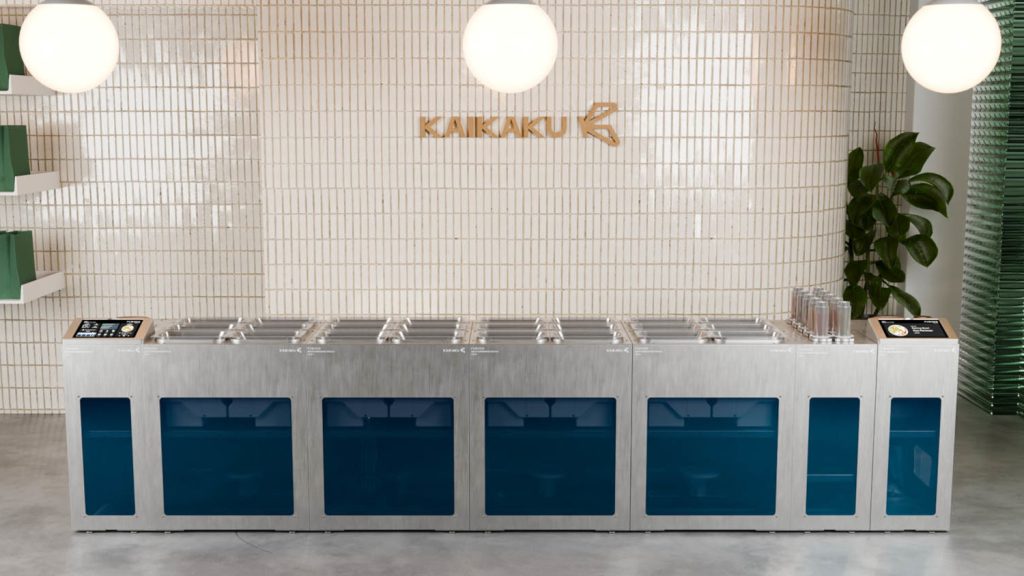
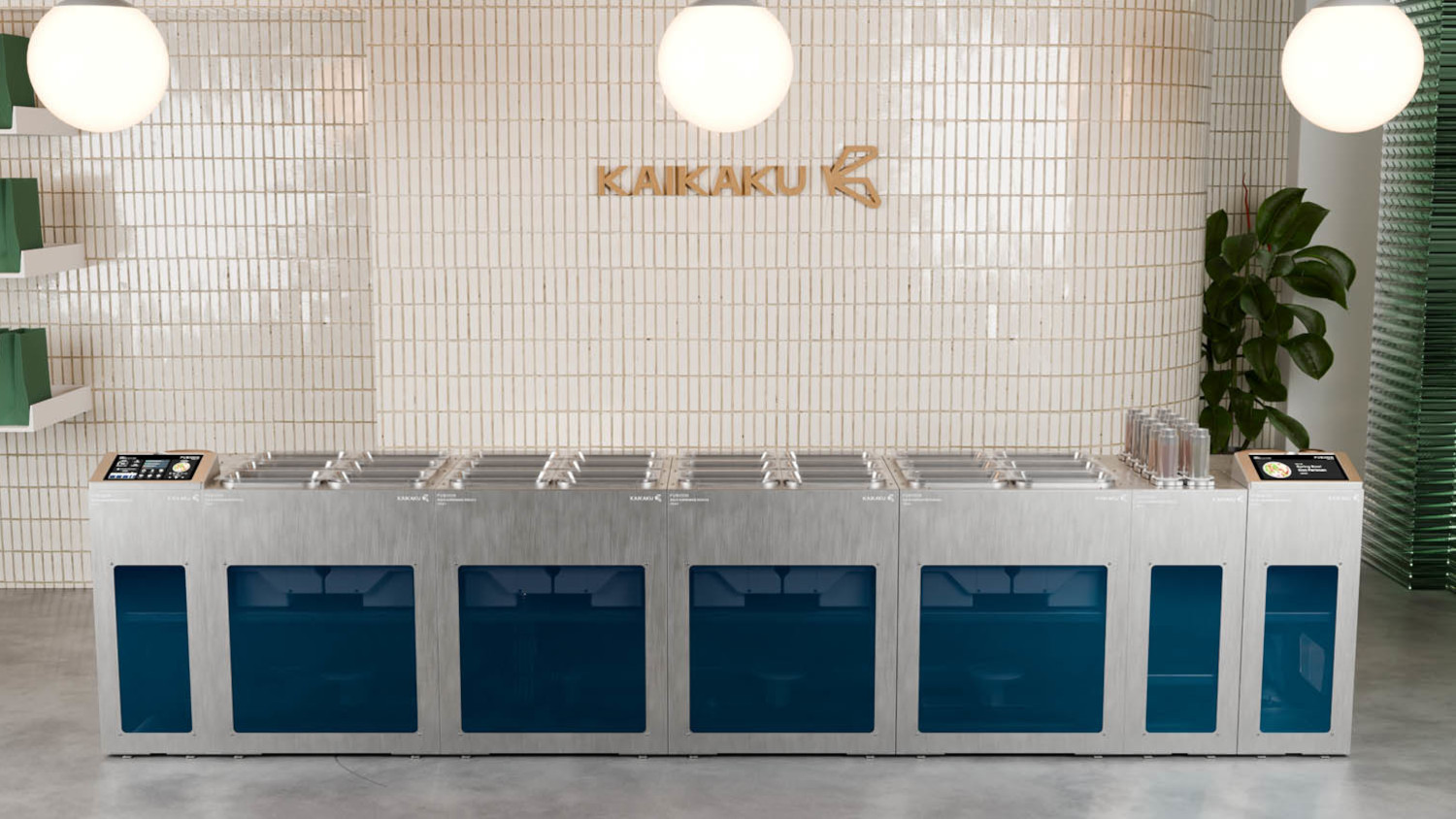
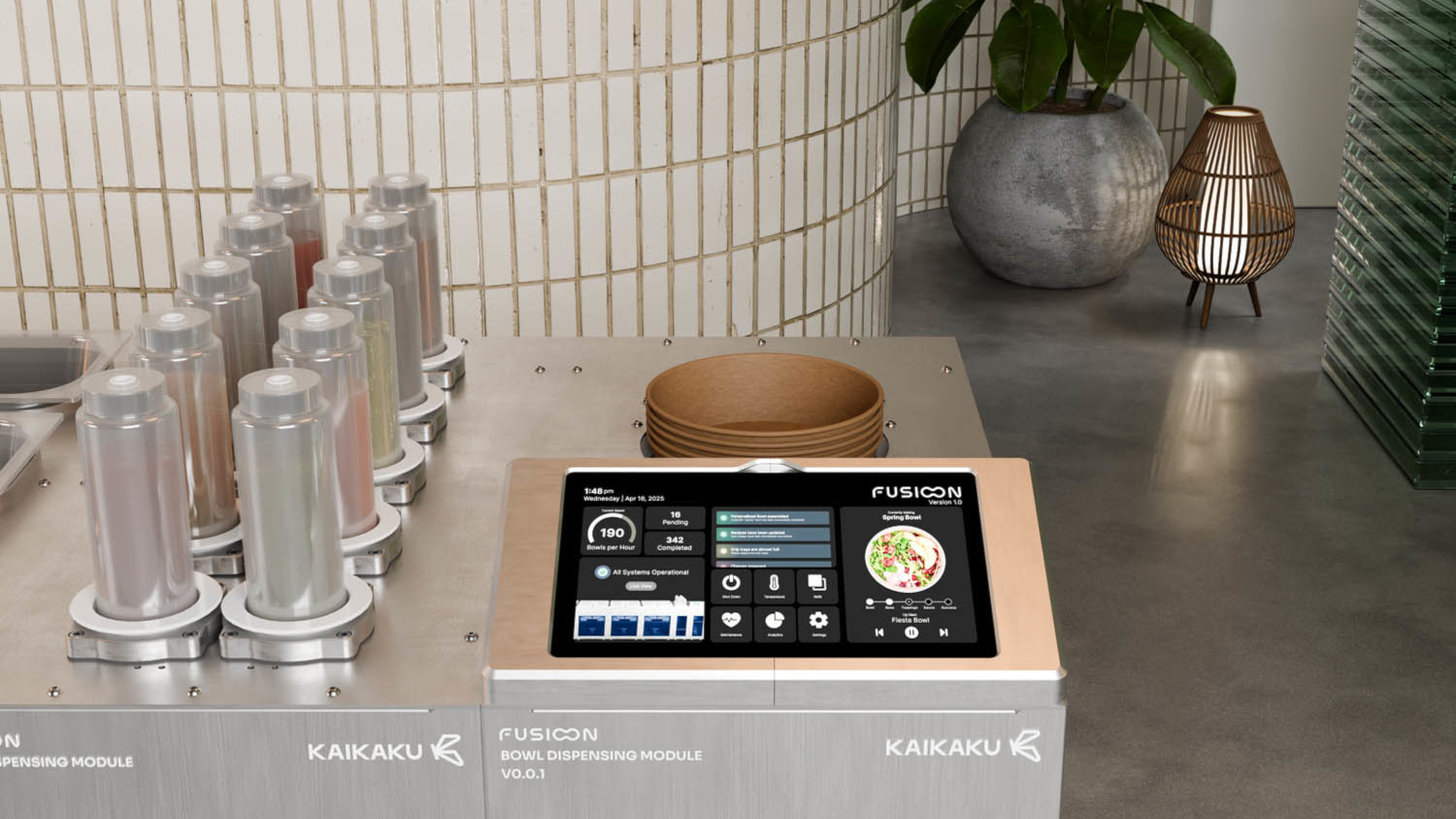
This is where Fusion thrives, with its fast throughput and strict portion control (an area in which humans are notoriously inconsistent). The back-of-house automation platform drops an empty bowl into the machine, which travels its length via a conveyer belt. As it does so, the requested ingredients are deposited into the bowl, any requested sauce is added, and the finished dish is ready for a quick check and final garnish by a human server.
A configurable set-up, each ‘drop’ unit can dispense six ingredients, kept topped up by kitchen staff from above. Along the way, bowls are kept hot, cold or at room temperature. The movement of the bowl along the conveyor belt is monitored by a proprietary positioning system.
Kaikaku’s first fully functional kitchen automation system was built in just 94 days, but with no business willing to accommodate a large prototype robot on their premises, the start-up’s team decided that the only way it could learn was to open its own restaurant.
The result is Common Room, Kaikaku’s Bloomsbury based restaurant that also functions as a live laboratory. A one-way mirror in the establishment enables engineers to operate, watch, document and adjust Fusion in real time. Diners here are not just customers, but also test subjects, providing data in a full-stack experiment that focuses on ordering flows, robotic behaviours, user interface design and failure thresholds.
Few hardware start-up projects appear on Google Maps in their first months, let alone achieve a rating of 4.7 stars and a devoted following. Common Room quickly achieved both.
“We focused on making Fusion really fast and really accurate, because obviously then it means consistency and customer satisfaction is better, food waste is less. And as cheap as physically possible, which might be slightly evident when looking at it,” Tregear laughs.
Trade kitchen equipment is expensive and costs could be prohibitive for a tiny start-up. At Common Room, aside from the single-piece, stainless steel modular chassis of Fusion (it’s “super cleanable”, Tregear explains), the Kaikaku team has focused heavily on FDM 3D printing to lower the barrier to entry.
A printer farm of 9 Bambu Lab printers – a mix of H2S and X1Carbon machines – has its own dedicated workshop and is in constant operation, producing parts for the latest version of Fusion, which offers even greater modularity.
“If we can’t be perfect, we have to be modular, and we’re definitely not perfect,” says Tregear. Each ingredient dispenser – a shaft fitted with a simple paddle that pops into place – can be thrown into a dishwasher at the end of service.
There’s no cross-contamination or visible electronics. Instead, the controllers and motors are stored in the dispenser base.
All the electronics deployed are inexpensive hobbyistgrade components as far as possible, or custom PCBs (printed circuit boards) where that has proved cheap and reasonable. This is partly for cost reasons and because using them is faster than trying to integrate expensive PLCs (programmable logic controllers). The brains behind all this kit are Raspberry Pi devices, with ESP 32s and the Arduino toolchain used for programming.
“It’s a bit of an unconventional approach, but that’s how we keep it cheap,” says Tregear.
Modularity has also helped when testing, allowing new designs and features to be added to the real-world set-up and trialled.
Version 3 of Fusion came out in April 2024 and served over 3,000 bowls to customers at Common Room in just one month. Version 4 followed in August 2025. Today, Version 5 is in place, capable of dispensing 360 meals per hour, and taking just under one hour to set up.
As a result of blisteringly fast iteration cycles and lowcost solutions developed in-house, Tregear says that the bill of materials on the latest version of Fusion came in at under £15,000. He estimates that a comparative system currently installed in a QSR chain in the US today would cost upwards of $600k to install. “That’s the kind of order of magnitude that we want to shift.”
Version control
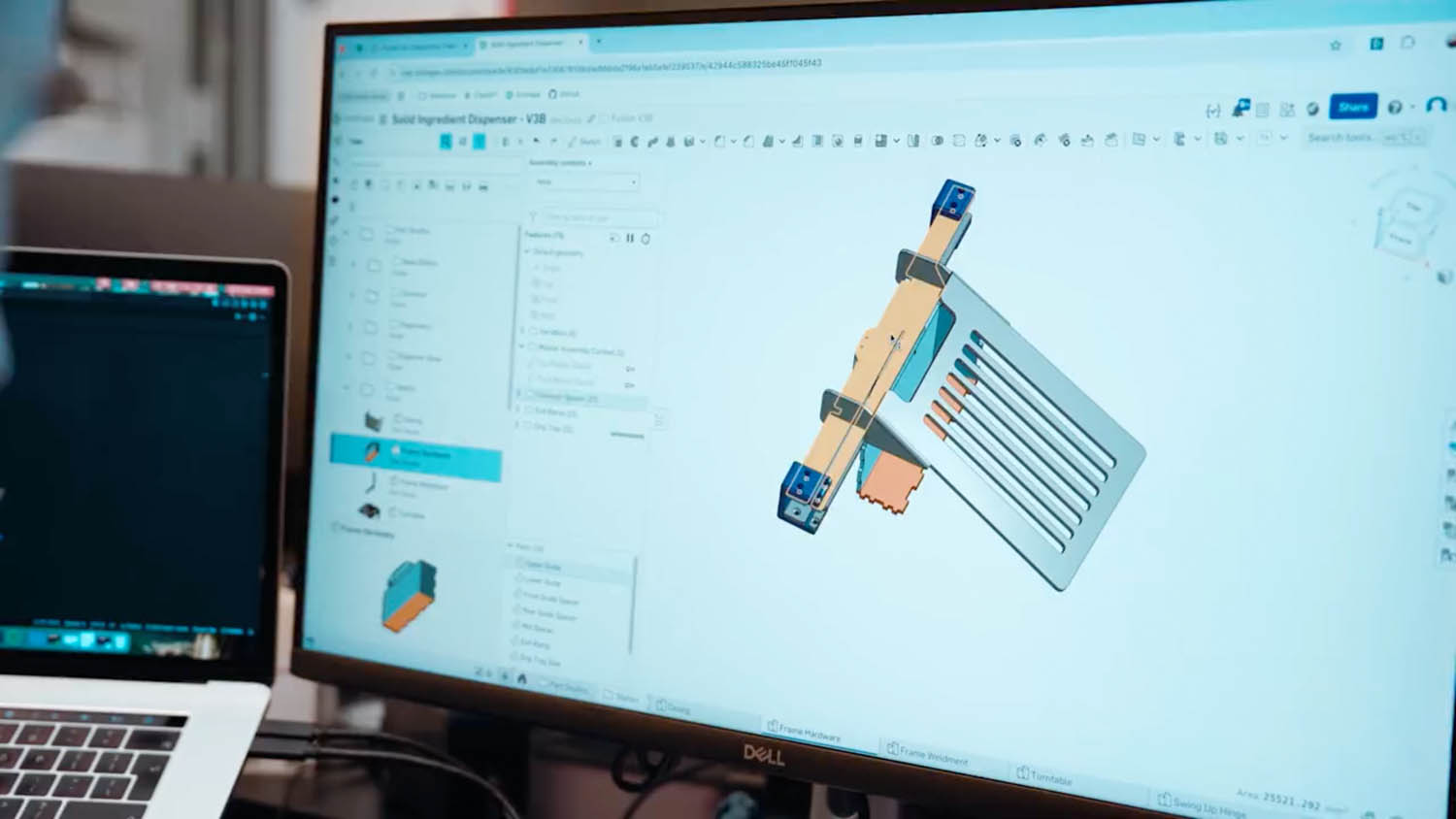
To date, Kaikaku has modelled, tested and assembled more than 20,000 components and rendered 50,000 robotic movements and tolerances in 3D CAD. All of this has been conducted in Onshape, which was chosen by Tregear following a placement at another Onshape customer, Ocado Technology.
“The version control is ridiculously good. How no one else has done that baffles me,” he states. “We’re not necessarily all software engineers here, but a lot of us like software and code for fun and are aware of Git, and yet why mechanical engineering has not caught up with Git is baffling.”
With some 200 unique components across such a small company, Tregear explains that elements like Onshape’s CAD configurations have supported more streamlined management of multiple design options within a model, removing the need for separate files for each variation.
While most components – right down to the conveyor belts – are designed and fabricated in-house at this point, something that the team at Kaikaku would love is an Accu standard component library in Onshape, enabling users to simply drag a STEP file from Accu’s parts catalogue into an assembly.
Where he finds Onshape lacking is in BOM, Tregear says, where it’s not easy to bulk edit or track a lot of components, something that nudges users towards considering PLM like PTC Arena quite quickly.
“The second we’re going to make more than one [of the same version] – which we reckon is going to be quite soon, definitely in the next six months – we’re going to need to do something. So, either we invest more time into our own crappy PLM – but probably not – or use Arena,” the CTO says.
Small team, big ideas
What’s noticeable about the small team at Kaikaku – aside from its youth and caffeine-high energy levels – is its ability to push on and to make things work, with a long-term goal clearly defined.
“We’re very bullish on the idea that, for this to work, the tech stack needs to be full stack in the restaurant,” says Tregear.
While automation is one element, Kaikaku has its own ordering kiosks, order ticker and computer-vision cameras to track occupancy rates and dwell times.
With every single dispense, we know how much food comes out, how much is wasted, how often food needs to be prepared and where the bottlenecks are Ivan Tregear, CTO at Kaikaku
The goal is to collect masses of data that no other restaurant on earth has. In this way, food vendors can optimise their operations. Today, the best that most can manage is digging into sales data.
“The bigger power that we see is that Fusion is actually a sensor that nobody else has. With every single dispense that occurs in each of these [robots], we know how much food is wasted, how much came out at the end of the day, how often food needs to be prepared and replaced and where the bottlenecks are,” says Tregear.
It’s a bold vision, but one that fits with the original Kaikaku production philosophy – a radical change to transform the fortunes of restaurants, one bowl at a time.
CTO of Kaikaku Ivan Tregear will be speaking at DEVELOP3D Live on 25 March 2026
This article first appeared in DEVELOP3D Magazine
DEVELOP3D is a publication dedicated to product design + development, from concept to manufacture and the technologies behind it all.
To receive the physical publication or digital issue free, as well as exclusive news and offers, subscribe to DEVELOP3D Magazine here