
At nTop’s user event in Los Angeles in June, we caught a glimpse of how AI-driven design might be the catalyst for a bolder, more innovative future
For decades, design has been focused around making products fast and cheap. We’ve been afraid, for the most part, of straying into new areas or new territories because of costly supply chain adjustments or the significant costs of capital investment.
So, what we’ve been following is a File -> Save As methodology. For example, that might involve taking an airplane frame structure, changing a few things on the inside, and then calling the end result ‘novel’. Or, we might take a car, change the body ever so slightly, and add a few bells and whistles to make the user feel more comfortable.
There’s nothing wrong with this approach. It’s tried, tested and true. But it’s not about creating something new.
In fact, we haven’t been able to ‘make new’ for a long time – but at the nTop Computational Design Summit 2025, I caught a glimpse of how the future of design might support a more ambitious and truly innovative approach to design.
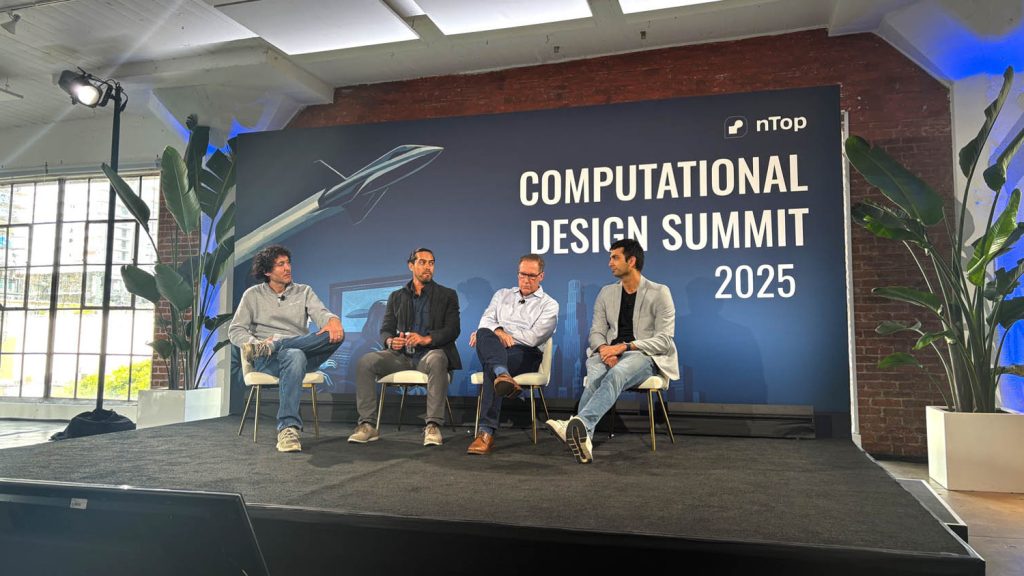
Hosted in a high-rise loft building in downtown LA on a warm afternoon in June, the venue was almost a replica of the nTop New York headquarters: high ceilings; large windows letting in lots of natural light; an open-floor concept for meetings; and modern chairs, screens, and IT equipment seamlessly blended into a historic building.
On the agenda for the day were customer stories, AI/ML workflows, hands-on labs and partner demos. The overall theme? Ambitious engineering.
High-level presentations were delivered by respected industry heavyweights Lockheed Martin and Siemens Energy.
Lockheed’s story centred around inverse design capabilities for an inverse heat exchanger using surrogate modelling and optimisation. The workflow described by Carlos Mendez, an optomechanical engineer at Lockheed Martin, centred around the impact of time saved. The ML-based design optimisation took what was previously a months-long effort and shortened it to just a few days, drastically reducing costs along the way.
Siemens Energy, meanwhile, displayed multiple heat exchanger designs, including one that utilises the current generative infill favourite Spherene, to show that meshing time using implicit files reduced from 64 hours down to just two hours. That’s a reduction of around 95%.
The message from the Siemens Energy computational design for additive manufacturing team, represented on stage by Markus Lempke and Andy Kappers, reiterated the benefits around time saved, but leaned more heavily into the quality and robustness of the mesh. They also highlighted how they’re able to push and pull implicit files into their other partner software, including Simcenter STAR-CCM+ and SimScale.
Powewring the details
Speaking with other attendees, I heard repeatedly that the issue with AI modelling is that many of the models aren’t physics-based, resulting in lower fidelity models.
At the event, these concerns were addressed by Nvidia, which pulled back the curtain on its open-source framework for AI Physics. PhysicsNeMo, introduced on stage by project senior technical engineer Rishi Ranade, was affectionately described as “a playground for engineers and researchers in the CFD community.”
The demo that followed contained model architectures for CAE/EDA, GPU-accelerated engineering data pipelines, partial differential equations, boundary conditions and geometry constraints utilised for physics modelling. Ranade left the crowd speechless, although I couldn’t tell if that was with pure wonder or if our brains were simply fried by all the physics.
The conference program took a short break from engineering to dive into the more entertaining side of modelling as Blake Courter, former CTO of nTop, gave a riveting history lesson on how implicits – critical to nTop’s modelling process – have always been here, from the early ages of the space race to guest starring in movies like Pixar’s ‘Monsters Inc.’
His message seemed to be that we shouldn’t fear implicits, because they’ve always been with us. Powerful and more robust than we give them credit for, he believes implicits are the way of the future.
Time to circle back
Late in the afternoon, a panel session chaired by charismatic nTop CEO Bradley Rothenberg fielded questions from the audience, including one that had been top of my mind for the entire day: “Is the fidelity of the process you’re using good enough to believe your answers?”
As an audience member, I was relieved to see this discussion play itself out on stage across multiple conversations.
Some of the morning presentations had felt like carefully crafted sales pitches hidden in slide decks, yet the panel discussions – featuring experts from hardware, software and executive leadership – saw ideas and methodologies actively volleyed around the stage in real time.
Michael Emory, product manager at Luminary Cloud, echoed similar thoughts to those from the Siemens Energy team (now sat in the crowd), as he emphasised the need for more physics-based AI tools.
The discussion heated up, but ended in agreement: to ensure what is simulated is mirroring reality as accurately as possible, the fidelity of the model needs to be based on the quality of the training data, the quality of simulations and the test data needed to complete the verification loop.
Speaking of reality, what does the future of qualification look like for these AI frameworks and their resulting designs? Steve Blaymaier, CTO of Aerospace & Defence at Synopsys, described a time in the early stages of digital CAD when engineers once doubted the reliability of simulation models compared to traditional hand calculations. Now, these simulation models that once had low fidelity have become commonplace. That suggests that AI and ML might follow a similar route.
Another audience member asked about the ‘unexplored design space’ – the frontier beyond building on previous iterations and being able to create clean-sheet designs every time. They asked if AI could one day allow that, and questioned why it has been left unexplored for so long. Is it because of a lack of the right type of material? Or was it simply that we’ve not had the capability to manufacture these designs because of cost or supply chain constraints?
Multiple members of the panel highlighted the new capabilities in design that are finally accessible with additive manufacturing, which has always heavily emphasised geometric freedom but has lacked designers (or design tools) needed to unlock its potential.
I felt the lightbulbs switching on in my mind as all the dots began to connect.
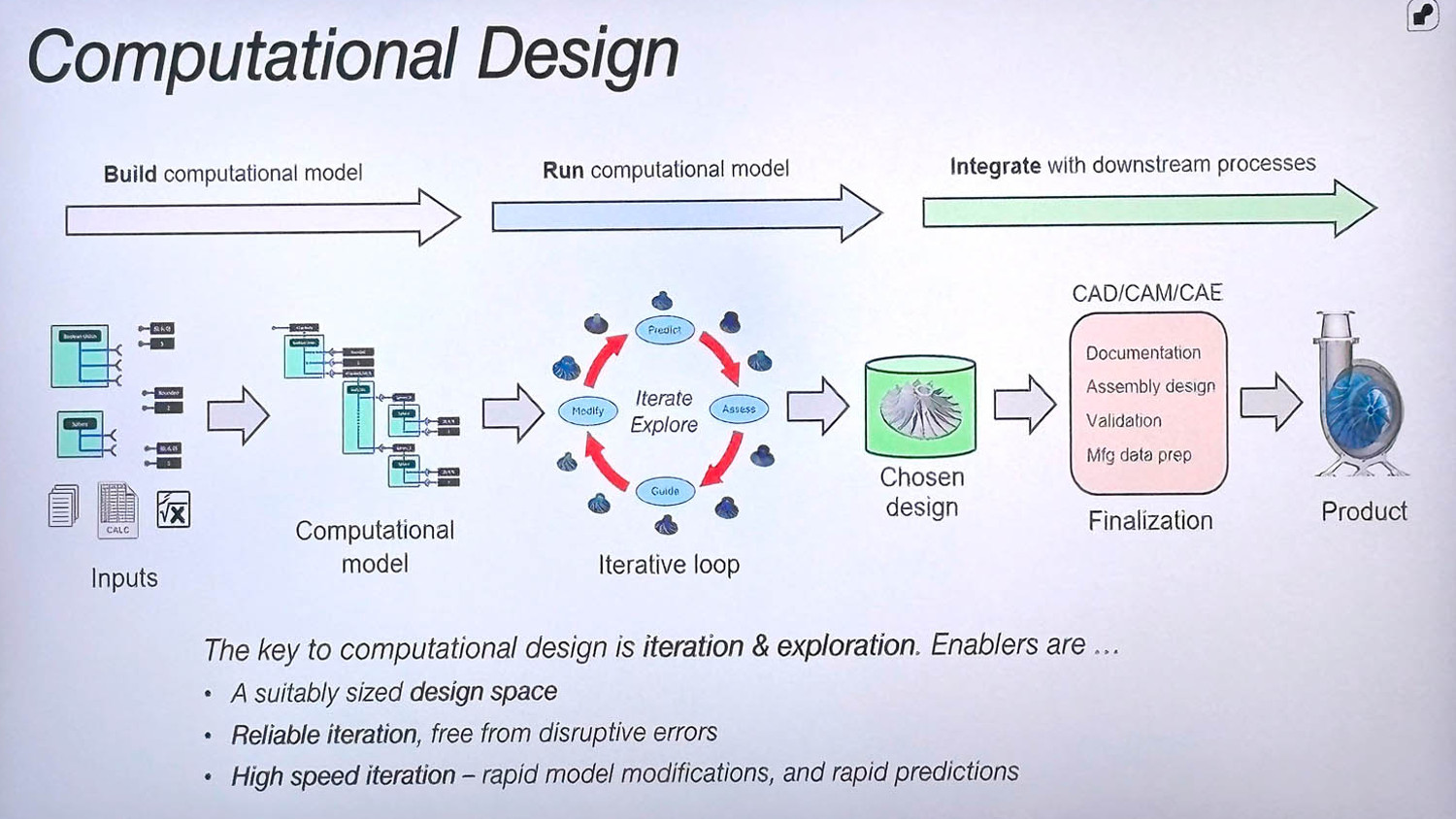
New designs could bring about the end of an era where we copy and paste the same design over and over. This new design space could take us into an era of shapes and geometries we’ve never seen before and that can be built from scratch.
Connecting the dots
All this reminded me of a presentation I saw several years ago, back when nTop was just gaining its industry wings. At that time, Rothenberg took to the stage and described his vision of how we’d soon have the design capability to recreate the complex, hollow cavities of a bird’s bone structure in a CAD model. Back then, it was just a vision, a seemingly unachievable thing to which we could only aspire – the ability to model one of Mother Nature’s most intricate designs.
But attending nTop’s Computational Design Summit 2025, I began to see that vision stepping into reality, as the summer temperatures continued to rise and late afternoon cups of coffee began to pour.
With more advanced technologies beginning to reach maturity, we can finally bring far-reaching designs to fruition
Today when Rothenberg tackles something ‘simple’, it could actually be something as complex as a fully optimised aero design workflow with co-intelligent engineering, complete with blocks for the engines, the sensor bays, weapons bays, inlets, outlets and wing type. In other words, with more advanced manufacturing technologies beginning to reach maturity, we can finally bring far-reaching designs to fruition.
I used to think of Rothenberg as a visionary or even perhaps a dreamer, as many founders often are. But with recent advances in manufacturing, paired with the advancements in software and nTop’s partners’ standing in AI and ML, I’m starting to see that bold ambitions are now close to being achievable.