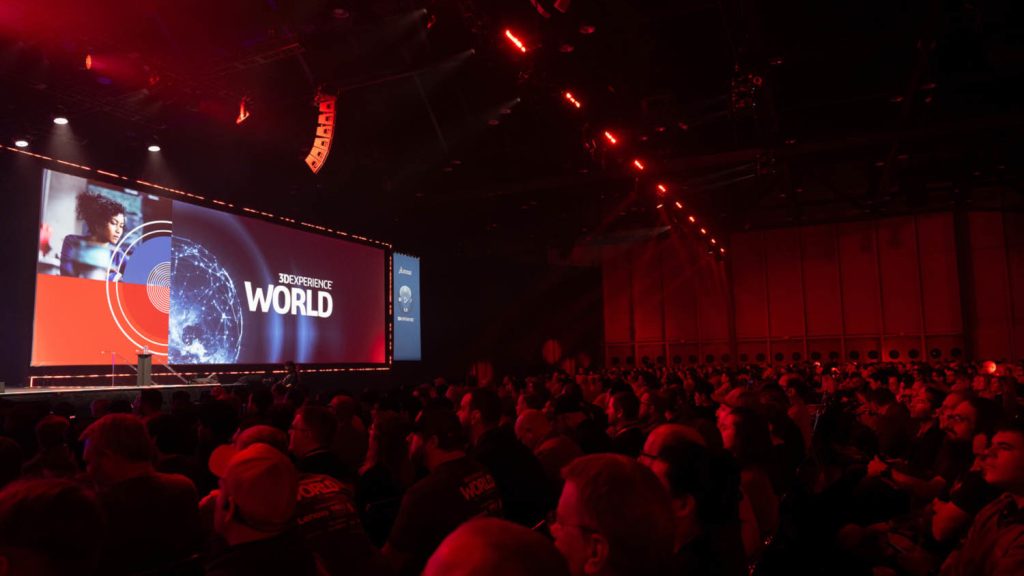

Dassault Systèmes impressed the crowds at its February user event in Houston, Texas, with the addition to its 3DExperience platform of two further AI agents. As Stephen Holmes reports, it was exciting to see the company hard at work on its AI strategy
3DExperience World might be a Dassault Systèmes event, but the signature red of Solidworks was more prevalent than ever this year, as dedicated users flocked to connect with their peers. This may be one of the most vibrant communities ever built around a CAD product.
Held for the second year running in Houston, Texas, familiarity with the surroundings of the George R Brown Convention Centre meant the mood among attendees was less frantic than usual.
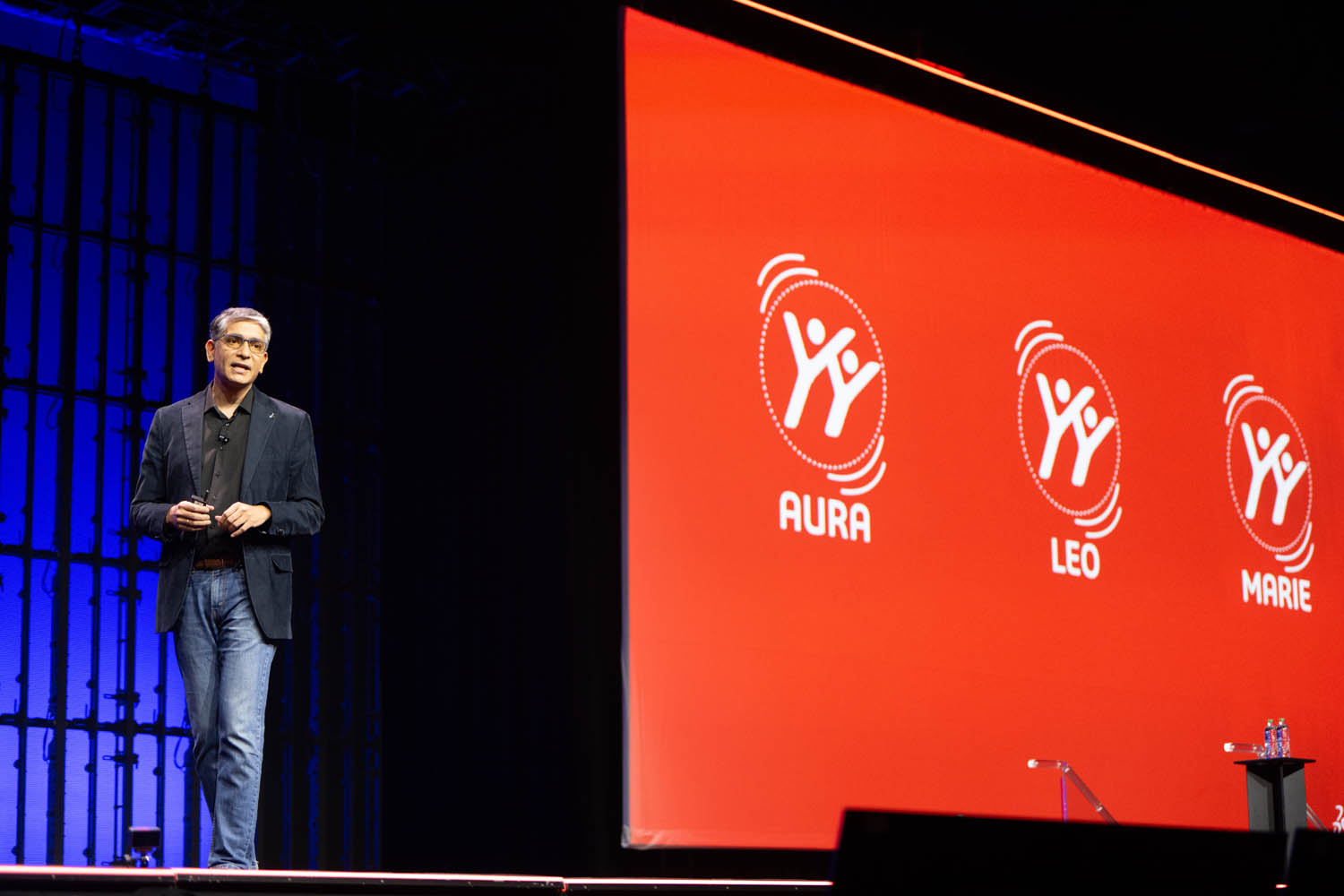
Addressing a packed opening session, Dassault Systèmes Solidworks CEO Manish Kumar unveiled further Virtual Companions – AI agents built specifically to assist designers and engineers in their work.
Aura – a copilot assistant first launched at this event back in 2025 – got an upgrade as a knowledge-focused idea generator. But it is now joined by two newcomers: Marie, for materials, chemistry and science; and Leo, for engineering, mechanics, simulation and taking products to manufacture.
Asked the same question, each of these three AI agents will give a different answer in line with their specialisms – much like a designer, engineer and materials scientist would.
At present, the three tools for ‘Industrial AI’ are built on the Mistral AI foundational model on Dassault Systèmes’ Outscale cloud, which offers high-performing models coupled with confidentiality and security standards.
Striking stagecraft
Joined on stage by Dassault Systèmes CEO Pascal Daloz, Manish Kumar performed a live demo showcasing Leo. Running in Solidworks 3DExperience XDesign, initial drawings were transformed into sketches with adjustable measurements and parameters.
Next, Sketch-to-3D turned these sketches into a 3D parametric model. Surrogate modelling, meanwhile, enables Leo to conduct performance analysis on models, running an FEA study on a part, on the basis of nothing more than a simple prompt in a fast, computationally cheap mathematical approximation.
“AI is just the multiplier. You are the value,” Kumar told attendees. Other Dassault speakers were equally keen to reassure a room packed full of several thousand designers and engineers that the company’s plan isn’t to replace them, but to help them, and that more AI technologies built along these helpful lines are set to join its arsenal.
The demonstrations of the Virtual Companions were impressive, but Leo is the one that really stood out. Kumar later unveiled a design for an industrial water storage butt held on a purpose-built gantry. This was designed, weldments and all, by Leo from a series of specifications entered by Kumar, including the tank’s volume and the location, in order that its design should comply with environmental and local legislation.
Leo determined the weight of the tank when full, the forces at work, and therefore the trusses and structure required to support it. Kumar himself showed genuine excitement at this demo and spoke of how it will enable users to make better use of their value.
“I should be able to validate the design so that when I go into production, it shouldn’t fail, the water tank shouldn’t collapse. That is my value – not to create a sketch, one line at a time. That is not my value,” he said. “My value is the idea. How can I get that idea converted into reality as fast as possible, so that I can focus on the value, not on all these mundane things?”
He declared himself “extremely excited about Leo, its capabilities, the way I see it evolving. In fact, the pace at which things are evolving is amazing.”
More skills
Kumar revealed that the three Virtual Companions will in future gain additional ‘competencies’. Leo will have, for example, competencies called mechanical engineer competency, system engineer competency, electrical engineer competency, with many more to follow.
This signals a shift to an era in which designers no longer draw out geometry in CAD, but define what they want to create with a Virtual Companion by their side to figure it out and output the right CAD data.
The cost of Leo and the other agents is yet to be announced, but it will come down to consumption-based pricing, Kumar stated.
“The amount of compute that is going to be used [for a simple table] is less than a steel car. So, depending on the amount of work that is created, the cost will be different,” he said.
Until this point, Dassault’s AI has been built upon a partnership with Mistral, but this is all changing. The first stage of this transition involves Dassault’s announcement with Nvidia, which Kumar bullishly said will put “the full AI library of Nvidia at our disposal now.” The results, he added, will be seen “very fast, very soon”.
He was also keen to highlight Dassault’s R&D spend, which fell somewhere in the region of $1.2 billion last year. “The closest competitor spends a quarter of that. So when you ask me, do we invest? We do invest! That is why we are the first ones who are able to claim that you give me a specification, and I’m going to give you a water tank, just because we are able to collect all the knowledge and knowhow. It doesn’t happen by accident.”
If AI is like the invention of the steam engine, he said, we are currently in the pumping engine phase. “We have not found the turning engine yet, [but] once we find the turning engine, that’s when the steam ships, the locomotives, the mechanical revolution is going to happen, and that room of engineers and designers and makers that is going to make that work.”
Where next?
The pathway for Dassault’s AI strategy is now much clearer – but even with the astonishing speed of AI development, it still felt as though there will be a few more 3DExperience World events before the entire crowd is on the same page.
While AI continued to be the key focus for keynote presentations, the breakout sessions perhaps more accurately reflected audience priorities, with only 5% of 355 sessions covering AI.
Dassault Systèmes boasts the largest installed base of all the 3D CAD vendors, but from conversations we had, it will take time and education to persuade users to accept increases to license fee and take up cloud apps like xDesign, necessary to use the Virtual Companions at their fullest.
Nobody can doubt Solidworks’ (and especially Kumar’s) support for its loyal users, but perhaps the solution lies elsewhere. Thirty years ago, Solidworks had a dream of putting CAD on every engineer’s desktop.
“Now,” said Kumar, “we go one level down and we put CAD on everyone’s desktop.” Uploading images to achieve manufacturable models and defining designs by talking to Virtual Companions will all happen in the next couple of years, Kumar promised. “And the reason I’m saying that is because everyone in the world is starting to use Gemini chat or some kind of large language model, which means everyone is starting to become a prompt explorer.”
If everyone can be a designer, then economies of scale come into play, and you would expect adoption to flourish. And when big companies start to adopt virtual seats for their own AI agents, a future to which Nvidia CEO Jensen Huang alluded, then Dassault looks to be in a good position to capitalise.
What that means for attendees wandering the halls of 3DExperience World is another question, however. With next year’s event set to take place in Nashville, Tennessee, it will be gripping to see how this all maps out.
Nvidia CEO: AI will give designers ‘superpowers’
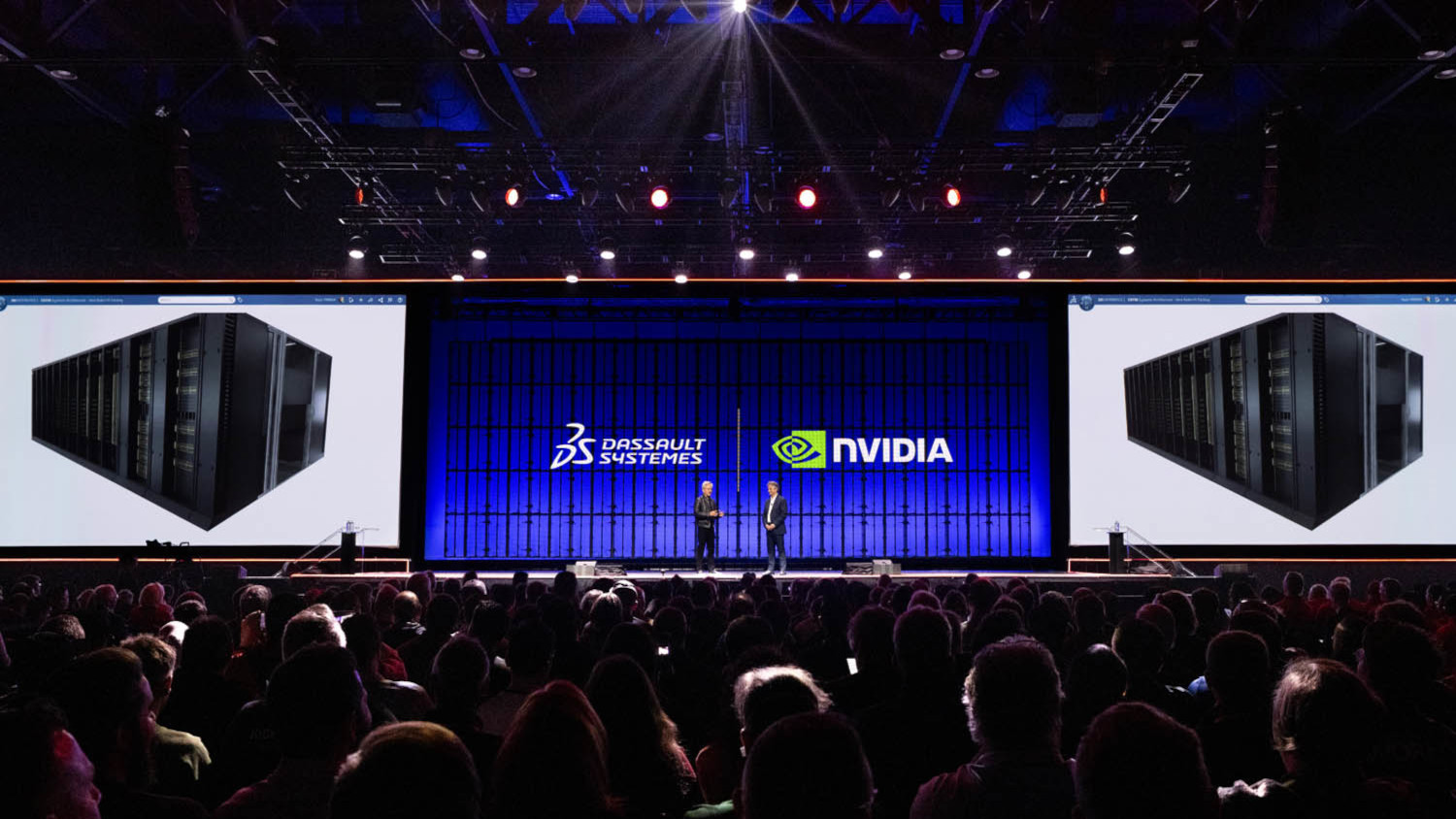
A star appearance by Nvidia CEO Jensen Huang drew a huge crowd at 3DExperience World 2026. His headline prediction? We are seeing the emergence of a world in which AI agents use more CAD than humans do.
Unsurprisingly, Huang was adamant that AI would not lead to the demise of product design and engineering roles for humans. Instead, he foresees a new, supercharged age of manufacturing in which AI agents assist with workflows and SME manufacturers increasingly rely on implicitly trained robotics.
Speaking on Day Two of 3DExperience World alongside Dassault Systèmes CEO PascalDaloz, Huang addressed head-on the fear that new, intelligent AI companions and software will reduce the need for humans in the profession.
“If AI were to replace jobs, the number of engineers, the number of software programmers, the number of designers will reduce. If the number of engineers and designers will be reduced, the amount of software they use is going to reduce. It’s exactly the opposite,” said Huang.
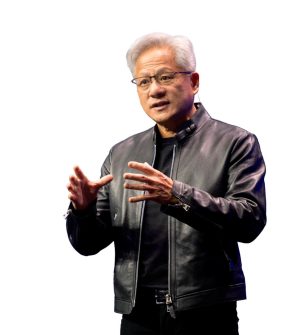
“What’s going to happen is this: every engineer will have companions and the systems announced yesterday. These agentic companions that help designers. And so every designer, every software engineer, every creator, will have companions that help them.”
The more AI companions you have, he continued, the more virtual seats you will have. “These companions are going to use Solidworks. These companions are going to use Catia. They’re going to use Simulia. So, the number of agents, AI designers, AI engineers, are going to grow exponentially. The amount of tools used is going to grow exponentially. They don’t have to have seats, you know? Engineers need to have seats, and our seats are going to be fi ne. We’re going to need them.”
The number of virtual engineers and web browsers and Excel spreadsheets will “skyrocket”, he said, “because AI agents are going to use them.”
Inside Nvidia, he said, AI already works this way. And while this scenario sounds more positive for software developers than for software customers, Huang returned to the designer’s position, saying: “Powered by AI, augmented by AI, your capabilities are lifted. And so, one of the things that’s really fantastic about the companion products that Dassault Systèmes created is that almost any engineer can now have the superpowers of Solidworks. Almost any engineer can have the superpowers of Catia, because you have a companion to help interpret your intentions.”
AI, he said, presents an opportunity to bridge the gap between human intention and design outcomes.
Nvidia’s 25-year relationship with Dassault Systèmes is set to continue, with Nvidia adopting Dassault Systèmes model-based systems engineering (MBSE) to design its latest AI factories’ starting with the Nvidia Rubin platform and integrating into the Nvidia Omniverse DSX Blueprint for large-scale AI factory deployment.
“Physical AI is the next frontier of artificial intelligence, grounded in the laws of the physical world,” said Huang.
“Together with Dassault Systèmes, we’re uniting decades of industrial leadership with Nvidia’s AI and Omniverse platforms to transform how millions of researchers, designers and engineers build the world’s largest industries.”
This article first appeared in DEVELOP3D Magazine
DEVELOP3D is a publication dedicated to product design + development, from concept to manufacture and the technologies behind it all.
To receive the physical publication or digital issue free, as well as exclusive news and offers, subscribe to DEVELOP3D Magazine here