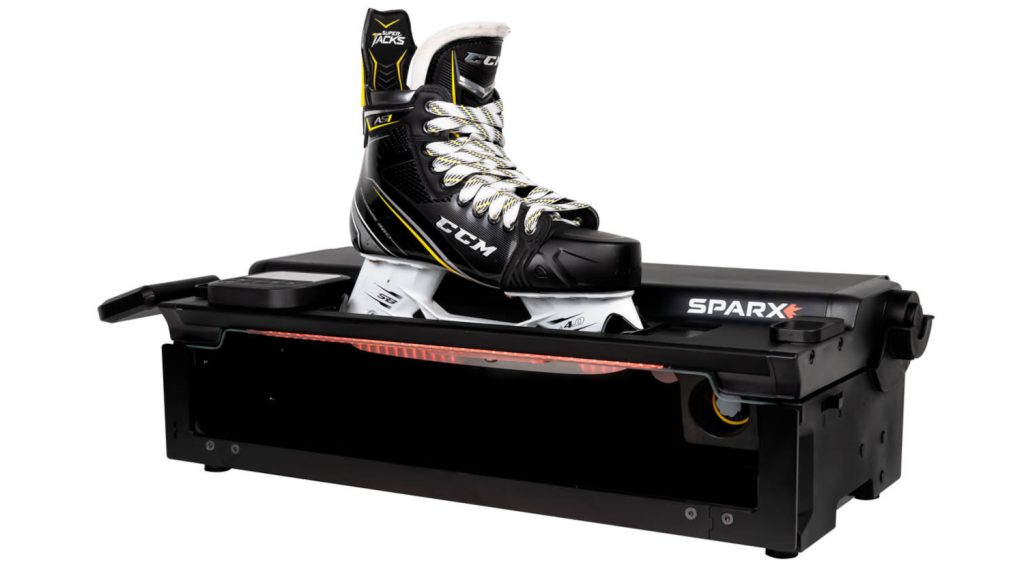

A tabletop skate sharpener promises skaters pro-level blades for every trip to the rink. Stephen Holmes hears how Sparx has not only developed a market-changing piece of kit, but also the technology to transform sports performance at the highest level
Whether a veteran hockey player or a junior figure skater, anyone who steps out onto ice must rely on two slim blades. It’s the honing of these blades that gives skaters speed and precision of movement – not to mention confidence that their bolder manoeuvres will unfold as planned.
Typically, those blades don’t wear down, but it takes relatively little to dull and damage skating blades. To tackle the issue, skaters get the blades sharpened by a specialist. As a general rule of thumb, most skaters are advised to sharpen their skates for every 20 to 30 hours they spend on the ice. But competitive skaters may need to up that rate to every 10 to 15 hours of use.
It depends a lot on the materials that make up a skate blade. In ice hockey, for example, newer blades that blend carbon and steel are more lightweight, but what’s sacrificed is their ability to stay sharp. And in a sport where toplevel players earning upwards of $15 million a season, they might change blades as much as four times per game.
“If you had the technology to sharpen your skates easily, you would do it every single time you touch the ice,” says Sparx CEO Russell Layton. It’s like a chef sharpening their knives, he says. “We’ve all got used to skating on skates that were dull or had a lost edge,” he says.
“With our product, we’re completely changing this landscape.”
Sparx’s fully integrated sharpening system is a compact, automated design that can be installed at ice rinks, sports stores, clubhouses and even at home. The user places their skate blade into the slot and pre-set precision alignments take care of everything else. The only consumables are the system’s grinding rings, which can be swapped to support different hollow grinding profiles.
Layton explains that Sparx users are now sharpening every time or every other time they head onto the ice. “It’s like giving a runner fantastic running shoes. They feel like the only thing holding them back is their training and their cardio. So, by giving every hockey player and fi gure skater a really nice foundation with sharp skates, it’s up to them now to perform at their highest level. There’s no limitation,” says Layton.
Blades of glory
Previously a medical devices designer, Layton says that an entrepreneurial side to his personality meant that he always wanted to build a business of his own. That led him to consider areas of his own life that could benefit from improvement. Having grown up skating, he knew the frustration and cost associated with weekly trips to ‘sharpener shops’.
Layton established Sparx Hockey in 2013 with the goal of building and selling an automated, at-home sharpener. He began by buying a manual tabletop skate sharpener, teaching himself the process. He quickly found that the technical aspects of sharpening came down to a series of constants – constant pressure, constant rotational speed, constant shape. An automated product, he felt, was achievable.
Next, he built out a design team, enlisting two engineers who were still in college at that point, designing various concepts as CAD models in Solidworks, and building prototypes. Solidworks, he says, was the obvious choice for Sparx, since he had used it extensively in his medical-device work: “The last thing I was going to do was take a risk on CAD.”
To figure out the product footprint, the team took the defined range of human foot sizes as its indicator of likely length. The width of the product, meanwhile, is defined purely by the widest foot size, plus room for the device’s mechanisms on either side. Over the last decade or so, Sparx has done much to reduce the height and depth of the Sparx Sharpener, with the goal of making each new version more compact and as close to the skate plate as possible.
Both the sharpening and the holding mechanisms have been iterated from many different angles. The 10,000 RPM grinder wheel is a thin, super-abrasive disc that removes steel from the bottom of the blade to create the concave ‘hollow’ profile that allows a skater to grip the ice and is essential for accelerating, turning and stopping precisely.
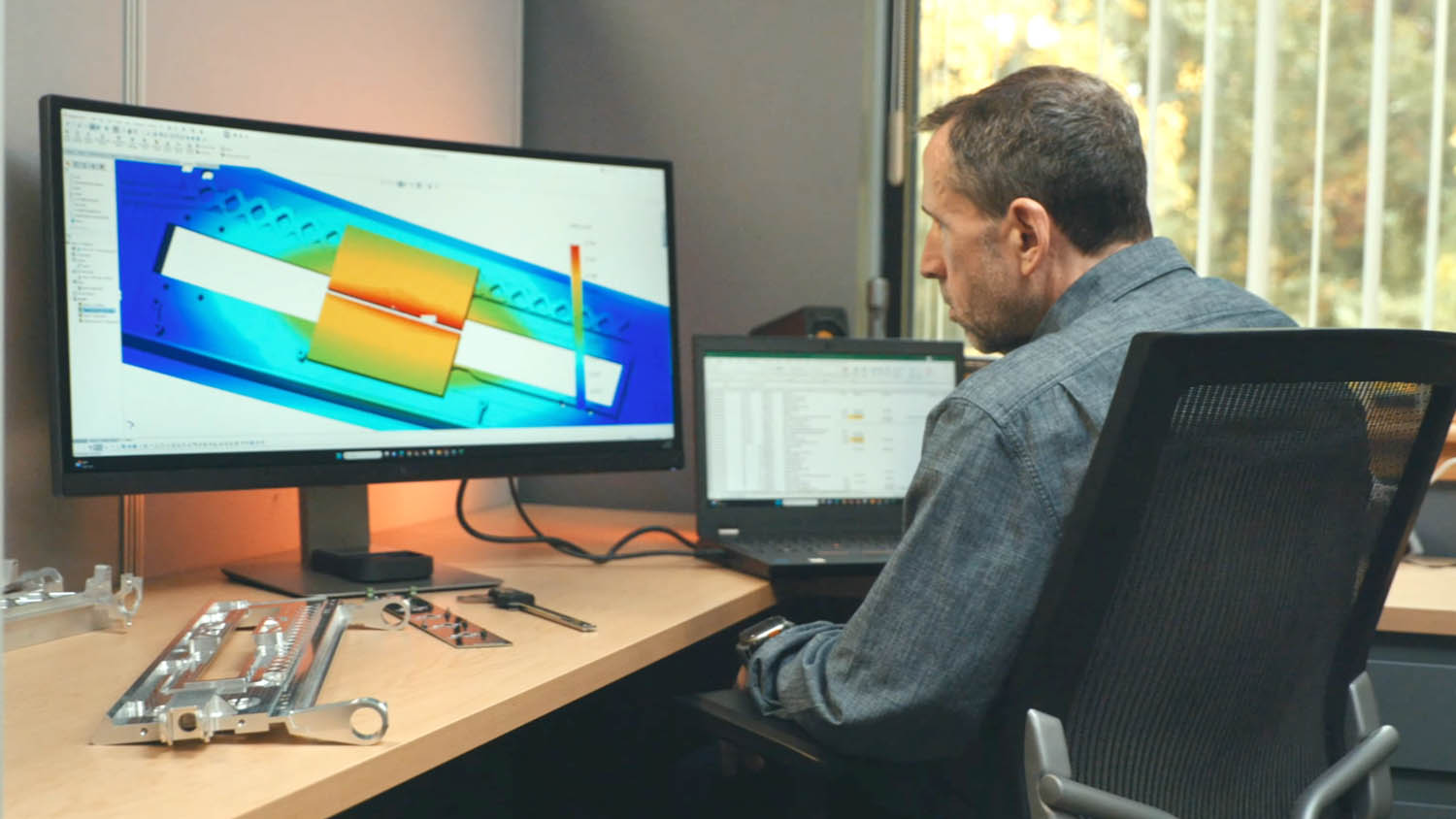
With no mass to dissipate the build up of heat caused during the sharpening, the team used Solidworks to add a spinning heat sink – an impeller that pulls cool air into the Sparx Sharpener. Using the Solidworks’ thermal simulation package, the team started from a baseline design and iterated on the design of the impeller fins to optimise drawing heat out and cool air in.
To sharpen the skate blade precisely through its full arcing length, the machine needs to apply constant pressure. Using Solidworks, the designers adjusted the spring locations to try to even out the force profile – something that would take forever to do manually. This gave the designers the smoothest force profile as this grinding ring moves across the skate blade.
“Using Solidworks for all these different examples to optimise the design digitally meant that I never have to waste time building stuff that’s not optimised,” says Layton.
The Sparx team utilises physical prototyping heavily for testing new ideas. The majority of components can fit easily on the print bed of a Bambu Lab 3D printer. The company operates a farm of these for building polymer parts. It also has a Tormach milling machine and an Epilog fibre laser cutter in its well-stocked workshop, so that the team can quickly produce metal components and housings.
From its original bootstrapped beginnings, Sparx was soon a full-time business. In part, that was due to the team’s propensity to prototype parts early and often and its commitment to iterating on ideas. “I looked around and there was like, tens of thousands of dollars’ worth of machined aluminium parts, and we had a little skeleton skate sharpener. It was almost like I couldn’t turn away from it,” says Lawton.
The next stage saw him become even further embedded in the entrepreneur lifecycle, when he launched the sharpener on crowdfunding site Kickstarter. Some $200,000 worth of skate sharpeners were funded, but the campaign proved to be more about exposure than investment. Sparx wound up losing money on every single product sold via the crowdfunding, but newspapers picked up on the product, interested NHL teams got in touch, and the product took off .
Smart sharpener
Over time, the Sparx Sharpener has become digitally connected. In 2022, the company acquired an optics company, allowing it to develop Sparx Beam, an accessory that contains a laser and a camera to measure the accuracy and precision of skate sharpening and report its results to an app on the user’s phone.
This data connection is proving valuable. It enables Sparx to communicate with end users, sending them pop-up reminders to sharpen their skates before the weekend, for example – and it also allows the company to collect a lot of data on the performance and usage of its devices.
That means Sparx can track the operational health of its machines, adjust components for greater product longevity and improve the user experience. It can also spot trends occurring in sharpening profile choices and forecast consumable sales.
Eventually, Layton hopes that Sparx will be able to suggest different grind profiles to maximise the performance of individual players, by combining AI with its data and other data from player performance monitoring and tracking sensors.
Finally, the data enables Sparx to ensure that its products all perform in the same way and at the same level, whether it’s a user’s first or 100th time using the product. The goal is to get the same exact sharpening, each and every time, whether the user is a young kid or an NHL player, says Layton. With new levels of performance unlocked – and a whole lot of time freed up when a skater isn’t waiting for their blades to be sharpened – Sparx is giving a new generation of skaters the confidence to glide boldly into the future.
This article first appeared in DEVELOP3D Magazine
DEVELOP3D is a publication dedicated to product design + development, from concept to manufacture and the technologies behind it all.
To receive the physical publication or digital issue free, as well as exclusive news and offers, subscribe to DEVELOP3D Magazine here