
Large-format 3D printing brings with it some tough engineering challenges. To overcome these, maybe we should take our inspiration from the architects of historic buildings that have stood the test of time, writes our columnist SJ
It is 2026. Choose your battles wisely. It’s advice I frequently hear, but am still terrible at applying. I find it hard to back down from a fight, especially when a challenge is thrown down by a mediocre white man in corporate America whose conservative design inclinations lead him to 3D print only rectangular bricks that he believes to be the ‘pinnacle of innovation’. But what if this particular part or assembly didn’t have to be a brick? What if we gave art and creativity a chance in this highly conservative, risk-averse aerospace world? But what would that look like? Where would we even begin?
I like to bring to these conversations what I refer to as ‘big print energy’. It’s an ethos I take seriously.
Ever since I started out in large-format metal printing – and for the sake of clarity, we’ll define ‘large’ as anything bigger than the standard 400mm cubed build volume – what I’ve noticed is that the physics of the process have changed.
That change is slight in most cases: a few adjustments to angles, a change in my preferred hole diameter size, a slightly greater emphasis on channel width and an avoidance of large overhangs.
But as I began to adapt support structures for these bigger pieces, I struggled to find ways to get rid of all the bulky mass. Some of you may be thinking that topology optimisation or latticing might provide answers – but features such as these are generally not strong enough to withstand the physics of large-format printing. So, what else can?
Lessons from history
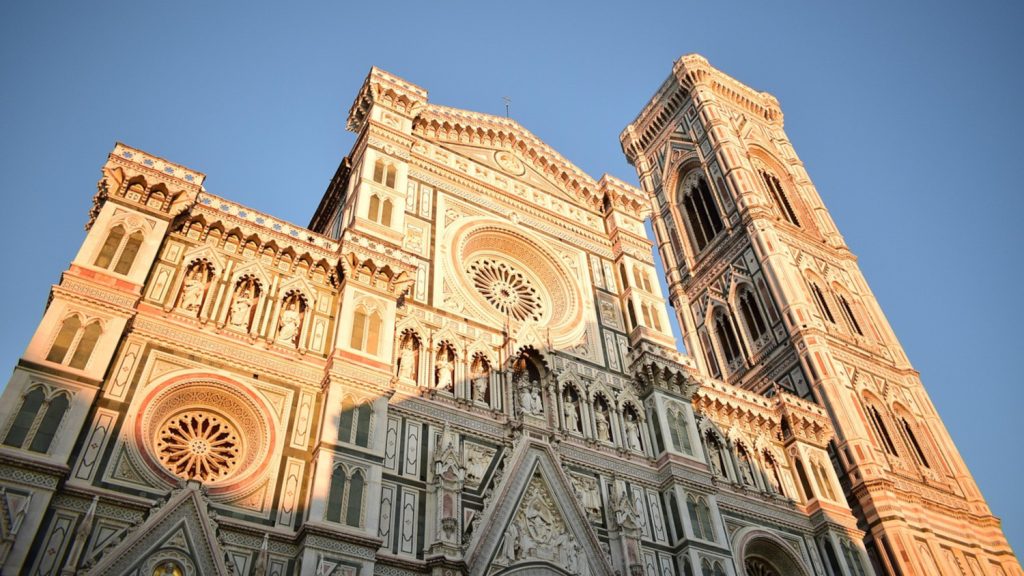
Since moving to Baltimore, I’ve been inspired by the rich history of the city, especially its architecture. I live on a street lined with historic buildings and my walks through the city’s neighbourhoods have led to a fascination with its churches.
In particular, I was drawn to the arches and window arrangements of churches, because to my eyes, they represent the epitome of design for self-supporting powder escape channels.
Bingo! I had my inspiration. Now I just needed answers on how to execute these designs and bring to them my own personal style of ‘big print energy’.
It’s important not to forget that the Gothic master masons were not just engineers. They were artists, too.
More specifically, they were artists obsessed with proportions. They used the Golden Ratio, root rectangles and ratios found in musical harmonies to design key architectural elements. They adapted arches and vaulted ceilings from Roman architecture to create rib vaults and flying buttresses.
(Yes, of course I did everything I could to try and include a ‘flying butt-ress’ in a professional engineering presentation, just for shits and giggles, because a ‘butt’ is always funny to American ears. And no, of course my manager didn’t approve it. But that’s OK, because it wasn’t compatible with the physics anyway.)
I spent weeks researching the ways in which some of the oldest, longest standing churches were built and found out they were made by hundreds of guys without so much as a digital calculator. Their work involved a lot of protractors, and it’s work made far simpler for modern-day me, thanks to some clever work with constraints and sketches in Siemens NX.
It’s time to bring art back to engineering and to bring beauty back to manufacturing. In 2026, it’s time to build something new
Art and creativity
Before long, those architectural shapes and sketches began to make their way into my own designs for work. And, to my surprise, I found I wasn’t the only architecture revivalist in the building.
Several senior engineers would come and hang out near the lab to see what geometries I had tested out that week and to offer their comments. It turns out that while they may be terrified of a lattice, the are absolutely thrilled by a vaulted ceiling. (Insert millennial eyeroll here.)
The master masons of historic buildings strongly believed in the idea of creating something that outlives you. That makes sense, given that it took multiple generations of engineers to complete many churches, and that these projects sometimes took more than 100 years from start to finish.
After my own personal successes, I think it’s time we bring back art to engineering. We stand at the ‘pinnacle of innovation’, right? So who says manufacturing can’t be beautiful? Who says it can’t be wondrous, not only in its execution, but also its aesthetic? Are you seriously going to try and convince me that all this ‘design freedom’ isn’t actually free?
Put simply, if it’s my name going on a drawing, or a model, or a work instruction, then I want it to incorporate every ounce of my own personal charisma, uniqueness, nerve and talent.
This is a hill on which I’m prepared to die. It’s time to bring art back to engineering, to bring beauty back to manufacturing. It’s time to leave your clunky, conservative bricks back in 2025. In 2026, it’s time to build something new.
This article first appeared in DEVELOP3D Magazine
DEVELOP3D is a publication dedicated to product design + development, from concept to manufacture and the technologies behind it all.
To receive the physical publication or digital issue free, as well as exclusive news and offers, subscribe to DEVELOP3D Magazine here