
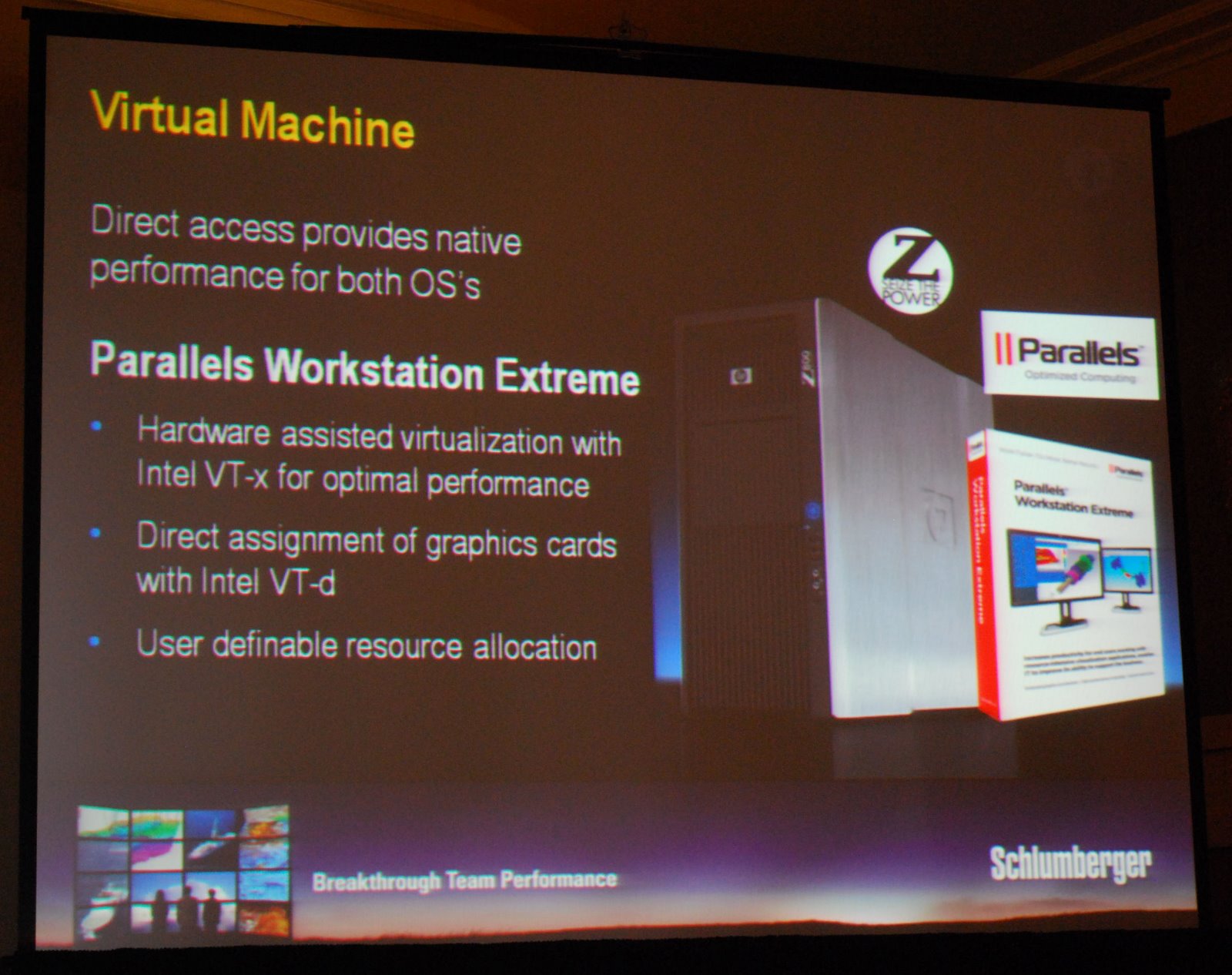
#3: Despite being one of the most interesting technologies to appear at HP’s workstation event, it was surprising that this new workstation virtualisation technology was given so little stage time. Parallels Workstation Extreme enables users to run multiple Operating Systems on a single workstation, meaning Linux and Windows users don’t have to work with two workstations concurrently or resort to dual boot. But the real beauty of the technology is that it is claimed to run applications at 95-100% of their full speed.
I had a very interesting chat with James Raquepau, OEM Alliances Director, Parallels, who explained more about the technology and how he has already had interest from the automotive and aerospace sectors. For those that don’t know, Parallels is best known for its software that enables Windows to run at speed on Apple’s OS X. The new workstation-class product will do a similar thing for Windows and Linux so engineers could switch between their Linux-based CAE software and Windows-based design software, accessing the same data off the hard drive array, driving efficiency and reducing the costs and power requirements of maintaining two workstations.
Schlumberger, a specialist in the oil and gas sector, demonstrated Parallels Workstation Extreme at the event running on a HP Z800 workstation with two 30-inch monitors. It showed it running a Linux-based simulation using all eight cores while continuing to perform interactive 3D modelling operations under Windows at full speed. Changing control of the application was as simple as moving the mouse from one screen to the other with the keyboard following suit automatically.
Schlumberger’s excitement for the software was evident, particularly as many of its customers regularly need to run legacy Linux code alongside more modern Windows applications.
James Raquepau told me the requirements for the system are two identical graphics cards (HP currently supports Nvidia’s Quadro FX3800, FX4800, and FX5800), lots of memory and ideally a dual socket (CPU) workstation. The technology is made possible by new virtualization technology built into the new Intel technology and while it should run comfortably on any dual socket Intel Xeon 5500 platform, Parallels is initially partnering with HP for the launch of the product. It will retail for $399.
This looks to be an essential technology for those with multi OS requirements, and Raquepau also told me this could include those that want to work with the forthcoming Windows 7 whilst maintaining legacy Windows XP applications. Interesting times.